
Introduction
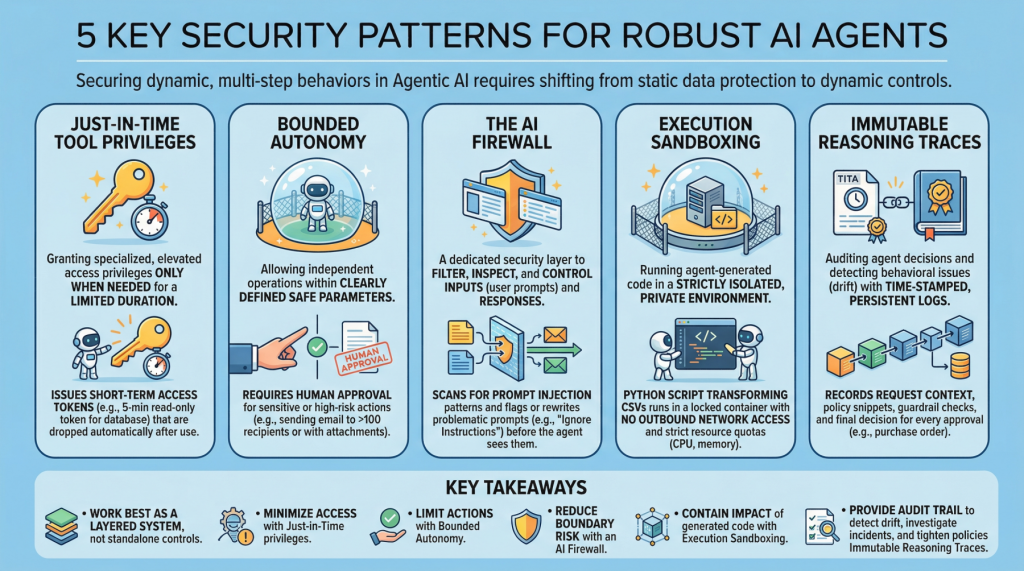
Agentic AI — systems built around autonomous software agents that plan, decide, and act using external tools — has reshaped the AI landscape and now underpins many applications built on large language models. As with any major technology wave, securing these systems is essential, and doing so requires a shift from static data security toward dynamic, multi-step behavioral security. Industry guidance reflects this: alongside the established OWASP Top 10 for LLM Applications, which lists prompt injection (LLM01) and excessive agency (LLM06) among the leading risks, OWASP introduced a separate Top 10 for agentic systems in late 2025. The five patterns below describe practical, layered defenses and why each matters.
1. Just-in-time tool privilege
Often abbreviated JIT, this model grants elevated access only when needed and only for a limited time, in contrast to permanent privileges that persist until manually revoked. For agentic AI, issuing short-lived access tokens limits the “blast radius” if an agent is compromised.
Example: Before running a billing reconciliation job, an agent requests a narrowly scoped, five-minute, read-only token for a single database table and automatically releases it once the query completes.
2. Bounded autonomy
This principle lets agents work independently within clearly defined safe parameters, balancing control against efficiency. It is especially important in high-risk scenarios, where requiring human approval for sensitive actions can prevent catastrophic errors. In practice, it establishes a control plane that reduces risk and supports compliance requirements. It corresponds directly to mitigating the “excessive agency” risk highlighted by OWASP.
Example: An agent may draft and schedule outbound emails on its own, but any message to more than 100 recipients, or any message with attachments, is routed to a human for approval before sending.
3. AI firewall
An AI firewall is a dedicated security layer that filters, inspects, and controls both inputs (user prompts) and the system’s responses. It helps defend against threats such as prompt injection, data exfiltration, and toxic or policy-violating content.
Example: Incoming prompts are scanned for prompt-injection patterns — for instance, requests to ignore prior instructions or reveal secrets — and flagged inputs are blocked or rewritten into a safe form before the agent ever sees them.
4. Execution sandboxing
Execution sandboxing runs any agent-generated code inside a strictly isolated environment or network perimeter. This contains the impact of unreliable or unexpected execution, helping prevent unauthorized access, resource exhaustion, and data breaches.
Example: An agent that writes Python scripts to transform CSV files runs them inside a locked-down container with no outbound network access, strict CPU and memory quotas, and a read-only mount of the input data.
5. Immutable logic traces
This practice supports auditing autonomous decisions and detecting behavioral issues such as drift. It involves creating time-stamped, tamper-evident, persistent logs that capture an agent’s inputs, the key intermediate artifacts used in its decisions, and the policy checks applied. Such records are an important step toward transparency and accountability, particularly in high-risk domains like procurement and finance.
Example: For each purchase order an agent approves, it records the request context, the retrieved policy snippet, the guardrail checks applied, and the final decision in a write-once log that can be independently verified during an audit.
Key takeaways
These patterns work best as a layered system rather than as standalone controls. Just-in-time privileges reduce the access an agent holds at any moment; bounded autonomy limits the actions it can take without oversight; AI firewalls reduce risk at the interaction boundary by filtering and shaping inputs and outputs; execution sandboxing contains the impact of generated code; and immutable logic traces provide an audit trail for detecting drift, investigating incidents, and hardening policies over time. Together they reduce the likelihood that a single failure becomes a systemic breach, without sacrificing the operational benefits that make agentic AI attractive.
| security pattern | Description |
|---|---|
| Just-in-Time Tool Privilege | Provide short-term, narrow-scope access only when necessary to reduce the blast radius of the compromise. |
| bounded autonomy | Control what actions an agent can take independently, taking sensitive steps through approvals and guardrails. |
| ai firewall | Filter and inspect signals and responses to prevent or neutralize threats such as injection, data intrusion and toxic content. |
| execution sandboxing | Run agent-generated code in an isolated environment with strict resource and access controls to prevent loss. |
| Traces of Inductive Logic | Create time-stamped, tamper-evident logs of inputs, intermediate artifacts, and policy checks for auditability and drift detection. |
Limitations and what to watch
No single pattern is sufficient on its own, and even combined they reduce rather than eliminate risk. Prompt-injection filtering, in particular, is an evolving arms race; current detectors can be bypassed, so AI firewalls should be treated as one defensive layer rather than a guarantee. Sandboxing and least-privilege controls add operational overhead and require careful configuration to avoid breaking legitimate agent functionality. Logging introduces its own data-governance and privacy obligations. Because agentic security is a fast-moving field, teams should track evolving guidance such as the OWASP agentic Top 10, conduct regular adversarial testing, and keep humans in the loop for high-stakes actions. Related coverage on this site examines how runtime agent frameworks incorporate validation and verification.
Authoritative guidance is maintained by the OWASP Top 10 for LLM Applications project.
