
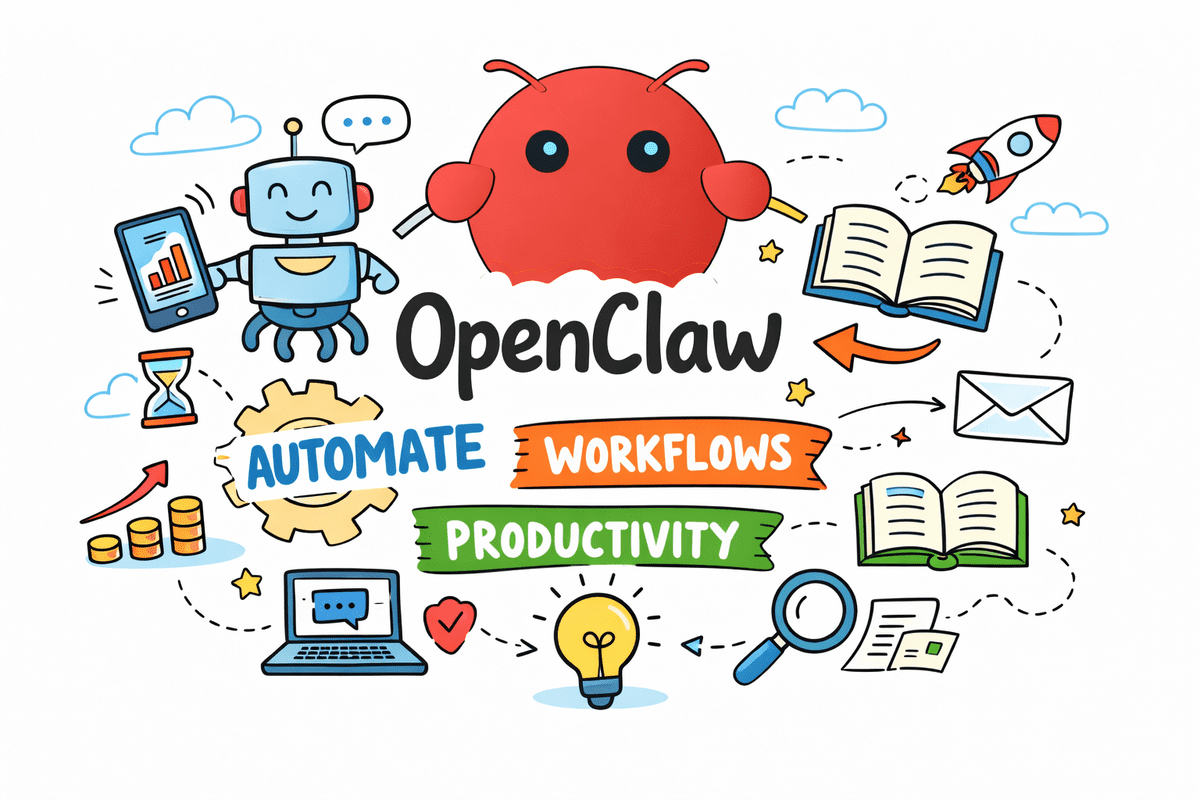
OpenClaw has become one of the most talked-about open-source agent systems, but beyond the attention the more useful question is what people actually do with it. At its core, OpenClaw turns AI from something to chat with into something that can carry out work: it links a large language model to files, tools, memory, and automation (the project documents its setup on the official OpenClaw docs), and it can be reached through messaging apps such as Telegram, WhatsApp, Discord, Signal, and Slack. That means actions can be triggered from the places people already use rather than from a separate dashboard.
The project is open source and self-hosted, so it runs on a user’s own machine or server and keeps data local. It was first released in late 2025 and gained a large following on GitHub unusually quickly. The seven use cases below reflect the kinds of real workflows the community has built. They are illustrative rather than exhaustive, and because the project is young, specific features and integrations continue to change.
1. Finance and trading assistants
A common use case is monitoring markets. People connect OpenClaw to news feeds, price data, and social sentiment so it can summarize what is happening and push useful updates on a schedule. It is worth stressing that this kind of setup is for information gathering and alerting; automating actual trades carries real financial risk, and any decision to buy or sell should remain with a person rather than an autonomous agent.
2. Remote coding and developer workflows
Developers use OpenClaw to kick off and check on coding tasks remotely. Rather than sitting at a terminal for every step, they can delegate routine work, monitor progress from a phone, and keep projects moving while away from the desk. This pattern suits long-running build, test, or maintenance tasks that do not need constant supervision.
3. Daily briefings and scheduled automation
One of the simplest and most popular uses is scheduled updates. Instead of waiting to be asked, OpenClaw can send morning briefings, reminders, task summaries, news roundups, or system alerts at set times. The idea is modest but effective: a great deal of productivity is lost to manual checking, and surfacing the right information automatically removes that friction.
4. Personal memory and second-brain systems
Because OpenClaw maintains persistent memory, many people use it as a personal knowledge layer. It can capture notes, ideas, reminders, and context over time, then retrieve them later — including loose references like a conversation or document from a previous week. This turns scattered information into something searchable rather than letting it disappear.
5. Research and knowledge pipelines
OpenClaw is also used to assemble research workflows: gathering sources, scraping pages, summarizing findings, and organizing the results into a usable form. For anyone who regularly tracks a topic, automating the collection-and-summary loop saves time and keeps a running record that can be queried later.
6. Multi-agent systems
More advanced setups coordinate several agents, each handling a part of a larger task. One agent might gather information, another draft output, and another review or route results. This mirrors a broader shift in which applications look less like a single chatbot and more like a small coordinated team working through a structured process — the same pattern explored in this agentic research assistant walkthrough.
7. Automating business operations
Small teams use OpenClaw for everyday operational work: organizing leads, drafting outreach, handling CRM-style tasks, summarizing meetings, and tracking action items. Much of this work is repetitive and unglamorous, which is exactly what automation handles well — the payoff is less context switching and more time for actual decisions.
How OpenClaw is extended
Capabilities are added through a skills system, with community-contributed skills covering areas such as email management, web scraping, monitoring, and price tracking. This marketplace model is part of why the project has grown quickly, since users can adopt existing skills rather than building every integration from scratch. Developers assembling their own agents may also find this overview of Python libraries for building LLM applications useful.
Limitations and what to watch
OpenClaw is still early-stage software, and that carries trade-offs. Granting an autonomous agent access to messages, files, and shell commands is powerful but also a security consideration, so it is sensible to run it with limited permissions and review what each skill can do. Self-hosting means the user is responsible for updates and safe configuration. Integrations and feature sets are changing rapidly, so current documentation is the most reliable reference, and high-stakes actions — especially anything involving money — are best kept under human control.
