
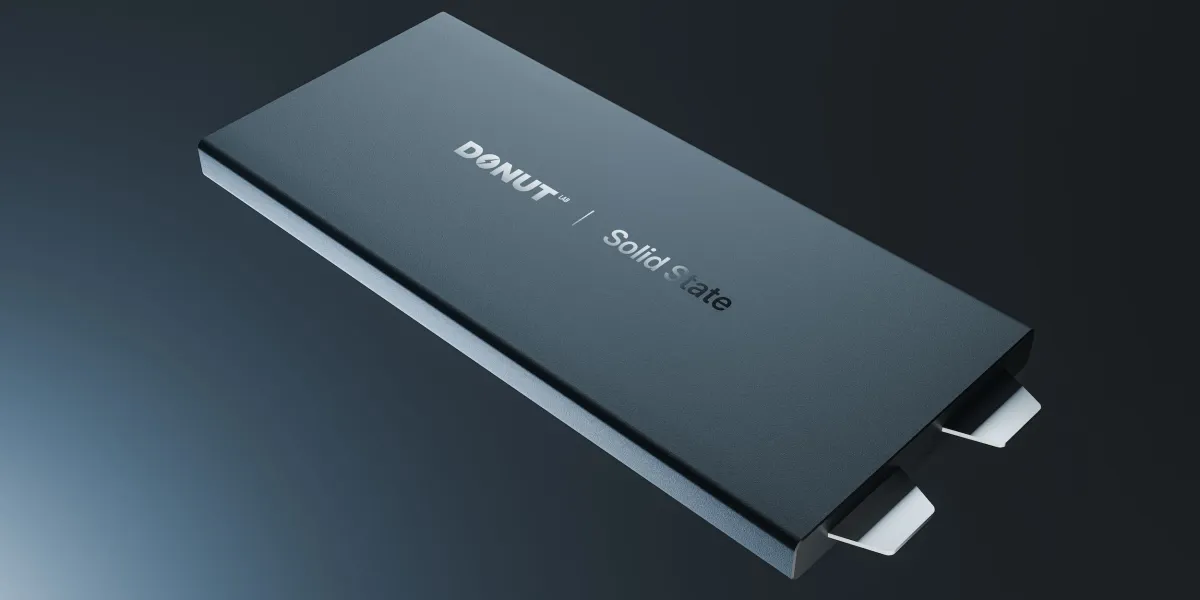
It sounded amazing – this type of technology could change the EV industry. But many wondered whether it was too good to be true. Now, Donut Lab is releasing a series of videos that it says will prove that its technology has the secret sauce. Let’s take a look at why this company is in the news, why many experts are skeptical of it, and what it means for the battery industry right now.
Solid-state batteries could provide the next generation of EVs. In place of a liquid electrolyte (the material through which ions move inside the battery), the cells use a solid material, so they can be more compact. This means significantly longer range, which could get more people excited about driving an EV.
The problem is that putting these batteries to work and manufacturing them at the scale needed for the EV industry is no easy task. Some of the world’s most powerful automakers and battery companies have been trying for years to get the technology off the ground. (Toyota once said it would put solid-state batteries in cars by 2020. It now plans for 2027 or 2028.)
Although it’s been a long time coming, it feels like solid-state batteries are closer than ever. Most progress so far has been on semi-solid-state batteries, which use gel-like materials for electrolytes. But some companies, including many in China, are getting closer to real solid status. CATL, the world’s largest battery company, plans to begin manufacturing small quantities in 2027. Changan, another major Chinese automaker, plans to begin testing the installation of all-solid-state batteries in vehicles this year, with mass production expected to begin next year.
Still, Donut Lab surprised the battery industry when Video Released ahead of the Consumer Electronics Show in Las Vegas in early January, the company claimed it would put the world’s first all-solid-state battery into production vehicles.
One of the most spectacular claims in the announcement was that the cells would have an energy density of 400 watt-hours per kilogram (top commercial lithium-ion batteries today sit at about 250 to 300 Wh/kg). It was also claimed that the cells could charge in five minutes, last up to 100,000 cycles, and maintain 99% capacity at high and low temperatures – while costing less than lithium-ion cells and being made from “100% green and abundant materials with global availability”.
Many experts were immediately skeptical. “In the solid-state field, the technological barriers are very high,” said Shirley Meng, a professor of molecular engineering at the University of Chicago, when I spoke with her last month. She recently attended CES and visited Donut Lab’s booth. “They had zero demos, so I don’t believe it,” she says. “Call me conservative, but I’d rather be cautious than regret it later.”
“It’s one of those things that no one knows about—they’ve never heard of it,” Eric Wachsman, a University of Maryland professor and co-founder of solid-state battery company Ion Storage Systems, said in an interview in January. “They came out of nowhere.”
