
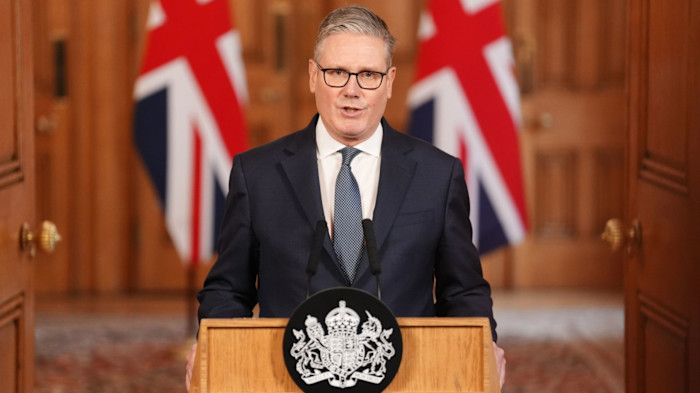
Britain has begun preparing options for a mass evacuation of its citizens from the Middle East “by air, land or sea”, as British Prime Minister Sir Keir Starmer distanced himself from the US-Israeli attacks on Iran.
UK officials believe at least 200,000 British citizens, many of whom are on holiday or in transit, may be in the area and have asked them to do the same. “Mark their presence“.
One official said there were no existing plans for a “small boat-style evacuation” of civilians – a reference to the rescue of troops from Dunkirk in 1940 – but added: “We have to think about all the options.”
The most affected people are in the United Arab Emirates. The process of recording their attendance is part of a campaign to identify those who may be most vulnerable, for example the elderly or infirm.
With airspace in the region closed, one possibility would be to transport people in the Gulf on buses to Saudi airports, including Riyadh, which would be about a 10-hour journey. Another option would be to travel by boat to Cyprus.
UK nationals in Bahrain, Israel, Palestine, Qatar, the United Arab Emirates and Kuwait have been urged to register.
British officials said more than 94,000 people had registered by Sunday evening, in what is being seen as one of the largest British consular operations ever. As of now they have been asked to stay put and follow the advice to take shelter.
Starmer has refused to support US and Israeli attacks on Iran, which he considers a violation of international law, as Britain seeks to avoid involvement in the conflict.
Britain’s Defense Secretary John Healey on Sunday repeatedly denied supporting the attacks. Britain’s stance has been more ambiguous than that of Canada and Australia, which have supported military action.
Conservative shadow foreign secretary Dame Priti Patel, who was in Washington last week, told the FT that the US administration was already “very, very unhappy” with Britain, partly over the joint UK-US Diego Garcia airport.
According to British officials, Starmer has refused to allow President Donald Trump to use the base to attack Iran. Patel said the Tories fully supported the attacks on Iran and Reform UK leader Nigel Farage urged Starmer to allow the use of British military bases and “support the Americans in this vital fight”.
But while Starmer’s stance risks a rift with the White House, the prime minister is stuck in a politically precarious position as the Left calls for him to openly criticize the US-Israel attacks.
Labor suffered a by-election defeat this week to the Green Party in Gorton and Denton, a contest in which the Greens argued that Starmer had taken a soft stance towards Israel on Gaza.
Green Party leader Zach Polanski said on Sunday: “This is an illegal, unprovoked and brutal attack that shows once again that America and Israel are rogue states.”
Dame Emily Thornberry, Labor chair of the Commons foreign affairs committee, said on Twitter: “I am pleased to see that Britain is not involved in these attacks.” iran. They are ill-advised and illegal.”
The prime minister, a lawyer by training, said on Saturday that Britain’s military operations in the Middle East were to protect Britain’s interests and allies, and were being conducted “within international law”.
Healey said that “few people will mourn” the death of Iran’s supreme leader Ali Khamenei, but he repeatedly declined to say in a BBC interview whether the US strikes were legitimate and whether he supported them.
The UK Defense Secretary said, “The UK played no role in the attack on Iran. However, we share the primary objective of all allies in the region and the US that Iran should never have a nuclear weapon.”
Lord Peter Ricketts, former head of the UK Foreign Office, said Starmer was in the uncomfortable position of “trying to walk between two rocks” while attempting to uphold international law while not further angering Trump.
“If you’re going to attack a country you have to show it’s in self-defense and there’s some kind of imminent threat. You can’t make that case here.” Ricketts told the FT: “Indifference to international law is dangerous.”
There are UK bases, military personnel and thousands of civilians in the area.
Healey has said the British aircraft and radar were deployed to “protect our people, protect our bases and protect our allies”, but Britain has so far suggested Tehran was not deliberately targeting its facilities.
“This administration is taking a heavy hand,” Healy said. “It’s increasingly being attacked indiscriminately and broadly, and people will be really concerned that it’s not just military targets but civilian airports like Kuwait.”
Britain’s Defense Ministry said on Sunday that an RAF Typhoon had shot down an Iranian drone heading towards Qatar territory.
British troops at a US base in Bahrain were within 200 meters of an Iranian missile and drone attack, Western officials said. Approximately 300 personnel are located there. British forces in Iraq were within 400 meters of an Iranian missile attack.
Meanwhile, Britain’s Defense Ministry said two Iranian missiles were fired in the direction of Cyprus, but it did not assess whether they were actually targeted at the island where Britain operates a military base.
A Republic of Cyprus government spokesman said on Sunday: “There is no indication that there is any threat to the country.”
Additional reporting by Charles Clover
