
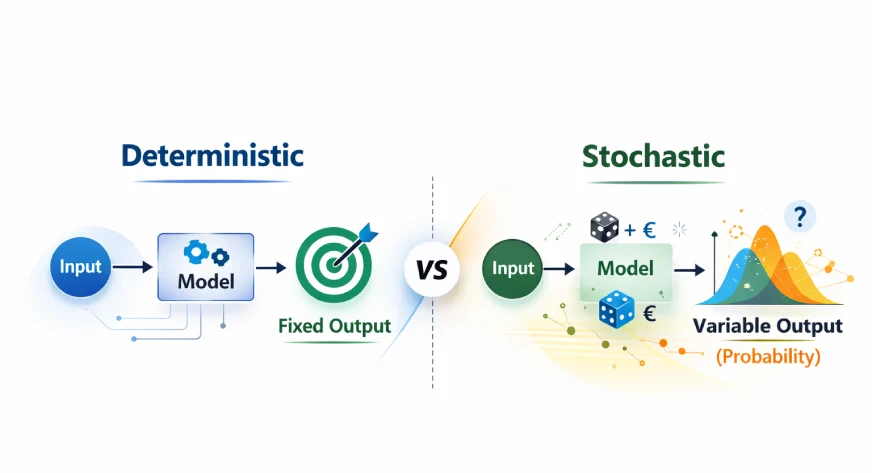
Choosing between a deterministic and a stochastic model is one of the most consequential early decisions in machine learning and risk analysis. The distinction is simple to state — deterministic models return the same output for the same input, while stochastic models build in randomness — but it shapes everything from data requirements to how results should be interpreted. The sections below define both approaches, compare them in machine learning and risk contexts, and outline how to decide between them.
Deterministic and stochastic models are two main approaches used in machine learning, risk assessment, and decision making systems. Deterministic models produce fixed outputs for a given input, while stochastic models incorporate randomness and probability. Understanding the differences between these approaches is essential to building reliable models and making informed predictions.
Learning Objectives:
- Understand the fundamental difference between deterministic and stochastic models
- Know the advantages and limitations of each approach
- Explore machine learning and their applications in risk assessment
- Identify factors influencing the choice of model, including data requirements, assumptions, and forecasts
What are deterministic and stochastic models?
A deterministic model produces the same output every time for a given input. There is no randomness involved. The system is completely defined by its parameters and inputs.
Stochastic models involve randomness. Even with identical inputs, the output may differ because the model involves probability distributions or random variables.
The main difference is how uncertainty is handled:
- Stochastic models explicitly model uncertainty.
- Deterministic models assume certainty.
Mathematical formulation
In mathematical terms, a deterministic model can be written as:
y = f(x)
Here, the output y is completely determined by the input x. If we provide the same x again, the output will always be the same. There is no randomness involved in the mapping.
A stochastic model introduces a random component:
y = f(x) + ε
In this case, ε represents a random variable or noise term. Even if x remains the same, the value of ε may change. As a result, the output y may vary in different runs.
For example, in a simple sales forecasting model:
Deterministic version:Sales = 5000 + 200 × Advertising Budget
Stochastic version:Sales = 5000 + 200 × Advertising Budget + Random Market Variation
The term random refers to uncertainty caused by market conditions, customer behavior, or external events.
Deterministic vs Stochastic in Machine Learning
| aspect | deterministic model | stochastic model |
|---|---|---|
| Production | single fixed value | range or probability distribution |
| irregularity | nobody | Present |
| dealing with uncertainty | Ignored | clearly modeled |
| data requirements | lower | High |
| interpretability | High | moderate to complex |
| Example | stable and predictable systems | uncertain and variable systems |
Pros and Cons of Deterministic Model
Pros
- Deterministic models establish a transparent cause-and-effect relationship between inputs and outputs, facilitating more simple interpretation.
- Deterministic models are computationally efficient, requiring less processing power than their stochastic counterparts.
- These models require less data for accurate predictions, making them suitable for scenarios with limited data availability.
Cons
- Deterministic models assume that we know and can accurately measure all variables, a position that may not always align with the complexities of the real world.
- They do not account for the uncertainty and randomness inherent in many real-world situations, leading to potential inaccuracies in predictions.
Advantages and disadvantages of stochastic models
Pros
- stochastic model Consider uncertainty and randomness, which makes them suitable for scenarios featuring an unpredictable future.
- They provide a range of possible outcomes, helping decision makers evaluate the likelihood of different scenarios and make informed choices.
Cons
- Stochastic models demand more extensive data and computational resources than deterministic models, which can be a bottleneck in resource-limited situations.
- Due to the probabilistic nature of their outputs, stochastic models can be more complex to interpret, requiring a nuanced understanding of probability and statistical concepts.
Deterministic vs. Stochastic: Examples
In machine learning, both deterministic and stochastic models play important roles. Deterministic machine learning algorithms, such as linear regression and decision trees, aim to find a fixed relationship between input and output. They provide interpretable models and are often used in scenarios where data behaves predictably.
Stochastic machine learning algorithms, such as neural networks and random forests, incorporate randomness and uncertainty into the modeling process. They capture complex patterns and relationships in data, making them suitable for uncertain future scenarios. Stochastic algorithms often outperform deterministic algorithms in image recognition and natural language processing tasks.
Practical Example – Deterministic Models in Machine Learning
Let’s consider a simple linear regression example. Linear regression is deterministic once trained. Given the same input and trained model parameters, it will always produce the same output.
Example:
from sklearn.linear_model import LinearRegression
import numpy as np

X = np.array(((1), (2), (3), (4)))
y = np.array((2, 4, 6, 8))

model = LinearRegression()
model.fit(X, y)

prediction = model.predict(((5)))
print(prediction) Production: :
... (10.)
If you run this code multiple times after training, the prediction will remain the same. There is no randomness during prediction.
This makes deterministic models suitable for systems where consistent and repeatable outputs are required.
Practical Example – Stochastic Model Behavior
Now consider a simple example of randomness using simulation. Here, we generate random values from normal distribution.
import numpy as np

results = ()

for i in range(5):
    value = np.random.normal(0, 1)
    results.append(value)

print(results) 
If you run this code multiple times, the output values will change. It exhibits stochastic behavior.
In machine learning, stochastic behavior appears:
- Random weight initialization in neural networks
- Mini-batch selection in stochastic gradient descent
- Bootstrapping in Random Forest
Although the final trained model may behave deterministically during prediction, randomness during training helps to improve generalization and avoid overfitting.
Performance and accuracy comparison
The performance and accuracy of stochastic versus deterministic models depend on the specific problem and dataset. Deterministic models excel in scenarios where inputs and outputs have a clear cause-and-effect relationship. They provide interpretable models and can make accurate predictions if the underlying assumptions are met.
On the other hand, stochastic models excel in scenarios where the future is uncertain and unpredictable. They capture the variability and randomness in data, allowing decision makers to assess the probability of different outcomes. Stochastic models can provide more accurate predictions if the underlying assumptions of randomness hold.
Understanding Output Variability
An important difference between deterministic and stochastic models lies in the output variability.
In deterministic model:
- An input produces a certain output.
- There is no distribution of possible outcomes.
- The result is a single value.
In stochastic models:
- An input can produce many possible outcomes.
- The outcome is often represented as a probability distribution.
- Decision-makers can evaluate risk using confidence intervals or probability ranges.
For example:
Deterministic Forecasting: Next month’s revenue = 1,000,000
Stochastic Forecasting: Revenue next month is between 850,000 and 1,200,000 The probability of more than 1,100,000 is 20 percent
This range-based output provides more information about uncertainty and risk.
Stochastic versus deterministic in risk assessment
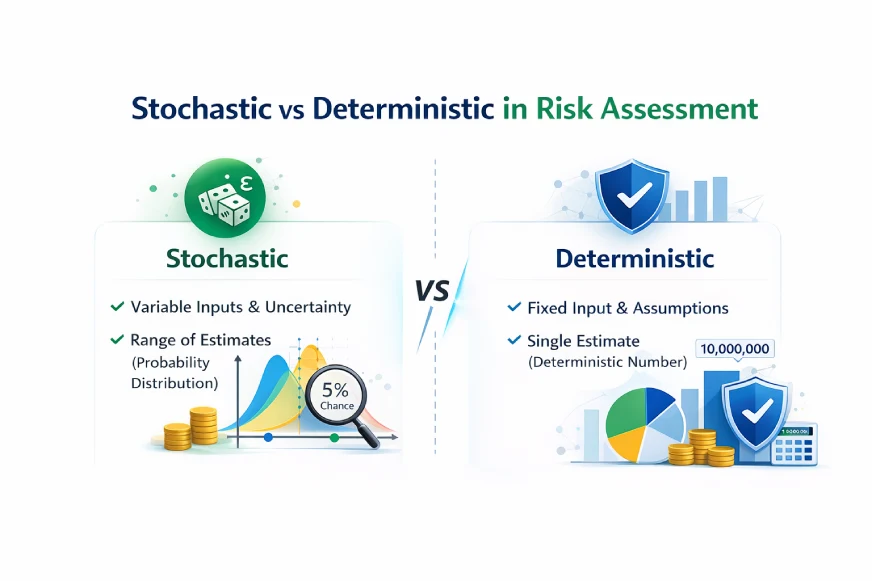
Deterministic risk assessment involves analyzing potential risks and their effects based on fixed inputs and assumptions. It provides a deterministic estimate of risks and helps decision makers understand the possible consequences of various actions. Deterministic risk assessment is commonly used in fields such as insurance and finance.
On the other hand, stochastic risk assessment incorporates randomness and uncertainty into the risk analysis process. It considers the probability of different outcomes and provides a range of potential risks. Stochastic risk assessment helps decision makers understand the probability of different scenarios and make informed decisions based on the level of uncertainty.
Real-World Case Study Examples
Consider an insurance company estimating annual claims losses.
Deterministic Approach:
- Average claim value = Rs 10,000
- Expected number of claims = 1,000
- Total expected loss = 10,000,000
It provides a single estimate but does not incorporate uncertainty.
Stochastic Approach:
The company simulates thousands of scenarios using probability distributions for claim frequency and claim severity.
Results may show:
- Average loss = 10,000,000
- Minimum loss = 7,500,000
- Maximum loss = 15,000,000
- 5% chance that the loss exceeds 14,000,000
This allows the company to prepare capital reserves based on the level of risk rather than a fixed estimate.
Robustness and uncertainty analysis
Deterministic risk assessment analyzes risks based on fixed inputs and assumptions. It provides a deterministic estimate of risks and their impacts. However, deterministic risk assessment does not take into account uncertainty and variability, leading to inaccurate predictions and decisions.
On the other hand, stochastic risk assessment involves randomness and uncertainty in the analysis. It considers the probability of different outcomes and provides a range of potential risks. Stochastic risk assessment helps decision makers understand the robustness of their decisions and assess the impact of uncertainty on outcomes.
When to choose deterministic vs stochastic models
Choosing between deterministic and stochastic models depends on the nature of the problem.
Use deterministic models when:
- The system is stable and predictable
- relationships between variables are clearly defined
- data is limited
- You need consistent and repeatable output
- Interpretability is important
Use stochastic models when:
- The system involves uncertainty or randomness
- Risk analysis required
- future results are unpredictable
- Decision making depends on probability assessment
- Variability must be measured and quantified
In many real-world applications, hybrid approaches are used. A deterministic structure can define the key relationship, while a stochastic component captures uncertainty.
Conclusion
Stochastic and deterministic models represent two fundamentally different approaches to modeling systems. Deterministic models provide clarity, simplicity, and repeatable outputs. They are ideal for stable environments with well-defined relationships. Stochastic models accept uncertainty and provide probability-based insights. They are essential in risk analysis, finance, machine learning training processes, and any domain where variability matters.
Choosing the right approach depends on how much uncertainty your system has and how much risk your decisions can tolerate.
Frequently Asked Questions
Q1. What is the difference between determinism and stochastic?
A. Determinism implies that outcomes are precisely determined by initial conditions without randomness, whereas stochastic processes involve inherent randomness, leading to different outcomes under similar circumstances.
Q2. What is example of stochastic?
A. An example of a stochastic process is stock market prices, where daily fluctuations are influenced by many unpredictable factors, causing random changes.
Q3. What is the difference between deterministic and stochastic error?
A. Deterministic error arising from systematic biases is consistent and predictable. Stochastic error is random and unpredictable, caused by inherent variability in data or processes.
Q4. What is an example of deterministic system?
A. An example of a deterministic system is the motion of a simple pendulum, which, without randomness, can be accurately predicted using its initial conditions and physical laws.

Hi, I am Janvi, a passionate woman interested in Data Science currently working in Analytics Vidya. My journey into the world of data began with a deep curiosity about how we can extract meaningful insights from complex datasets.
For a formal treatment of the underlying concept, see the reference overview of stochastic processes. For related reading on this site, see coverage of writing reliable Python code.
