
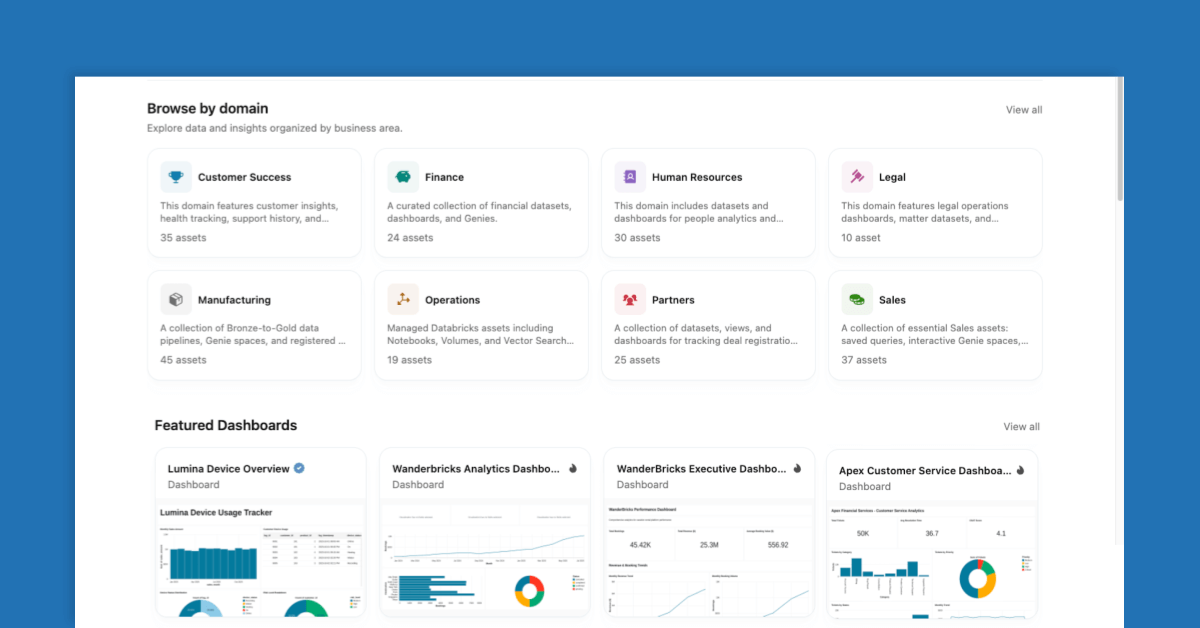
As organisations accumulate more data, a basic problem grows with it: helping people find the right data and judge whether to rely on it. Databricks has introduced a new discovery experience in its Unity Catalog governance layer that aims to answer the questions employees actually ask — does this data exist, where is it, what does it mean, can it be trusted, and how is access obtained — by attaching business context to search rather than leaving it scattered across other tools.

Why data discovery breaks down
In many companies, search is fragmented. Data is organised around source systems and pipelines, while its business meaning lives elsewhere — in dashboards, documents, wikis or simply in people’s heads. Signals about trustworthiness and the workflow for requesting access are usually disconnected from the places where people go looking. When search lacks that business context, users waste time hunting for or re-creating datasets, decisions are slowed, and adoption stalls even when the right data already exists.
Domains: organising assets by business meaning
The new capability is built on Domains, currently in beta, which group data and analytics assets by business unit or use case — finance, marketing, customer telemetry and so on — rather than forcing them into a single rigid technical hierarchy. Crucially, an asset can appear in more than one domain, which avoids the usual folder-structure dilemma of deciding where something “belongs.” Domains pair automated metadata signals with human judgement: frequently used assets surface automatically, while data stewards can pin high-priority or newly published datasets and dashboards so the most important ones are easy to find. Domain managers can curate assets across data and analytics, customise each domain’s browsing page, and add rich descriptions and designated owners.

Trust signals and built-in access
The Discover page combines AI-derived signals such as usage and popularity with human curation through certifications and deprecation tags. Certifications act as clear trust markers, helping users quickly spot which assets are approved sources of truth, while AI-assisted recommendations surface relevant material without overwhelming people. Because access requests are embedded into the search experience, a user can understand an asset’s purpose, quality and ownership and then request access at the point of need — reducing manual approvals and shortening the time to insight without turning data owners into bottlenecks.
Availability
The Discover page and Domains are in beta across AWS, Azure Databricks and Google Cloud. Databricks positions the features for enterprises with distributed data, domain-oriented teams, and platforms that serve both technical and business users — the same kind of environment described in this Bayer Consumer Health case study.

How to read it
This is a vendor announcement, so the framing naturally favours the product, and the headline features are still in beta — meaning behaviour, scope and availability may change before general release. The underlying idea, however, is broadly sound and not unique to one platform: discovery improves when business meaning, trust signals and access workflows sit alongside the data itself rather than in separate systems. Organisations evaluating the feature are best served by testing it against their own catalogues and governance needs, and by watching how the beta evolves. Full details are available on the Databricks blog.
