
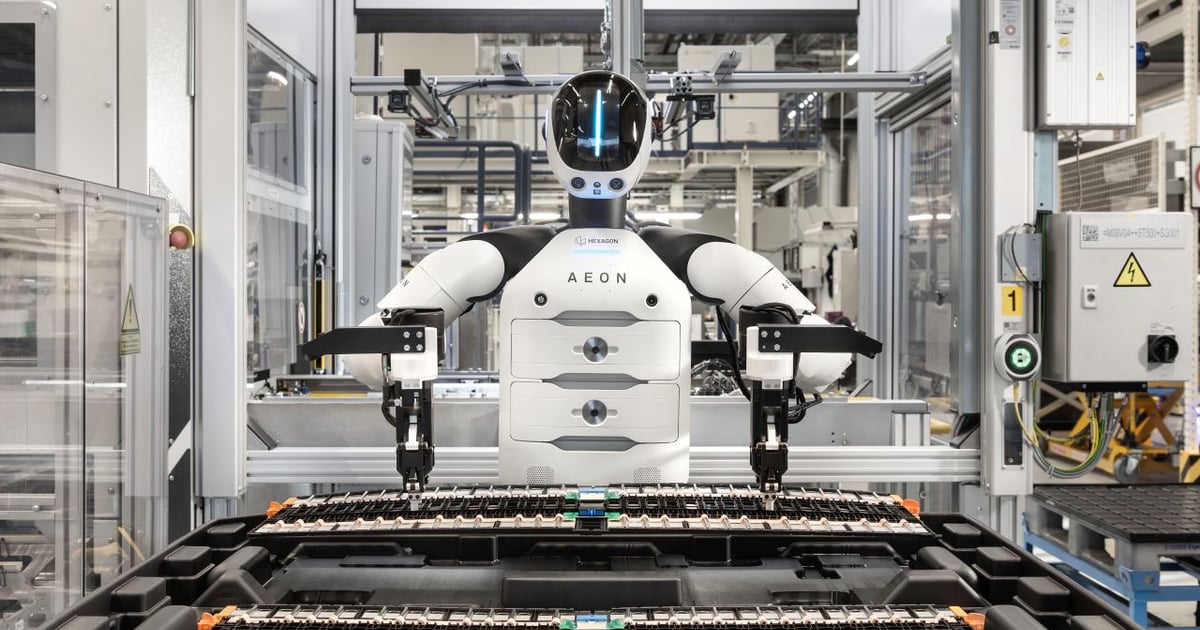
Humanoid robots are moving from demonstration videos to real car production lines, with two major automakers reporting concrete milestones in 2026. BMW has begun the first pilot of a humanoid robot in its European production network, at its plant in Leipzig, Germany, while China’s Xiaomi has put humanoid robots to work on the assembly line at its electric-vehicle factory in Beijing. Both efforts remain pilots rather than full automation, but they mark a noticeable step toward what the industry calls “physical AI.”
BMW’s European pilot in Leipzig
In Leipzig, BMW is trialling the AEON humanoid robot, built by Hexagon Robotics — the physical-AI division of Hexagon, a long-standing BMW partner in sensors and software, based in Zurich, Switzerland. AEON was first unveiled in mid-2025 and made an initial operational appearance at the Leipzig plant in December 2025. According to BMW, a broader test is planned for April 2026, with a full-scale pilot due to begin in the summer. The Leipzig work is focused on testing the robot’s multifunctional use, and the company has set up a dedicated Center of Competence for Physical AI in Production to coordinate how AI and robotics are integrated across its plants. Over time, BMW says it hopes to apply humanoid robots to monotonous, physically demanding or safety-critical tasks, including work around high-voltage battery assembly.
What the earlier US trial showed
The Leipzig pilot follows an earlier deployment at BMW’s plant in Spartanburg, South Carolina — the first time the company used a humanoid robot in production anywhere. There, in a roughly ten-month trial, Figure AI’s Figure 02 robot retrieved and positioned sheet-metal parts for welding, working five days a week across long shifts. BMW reported that over that period the robot handled tens of thousands of components and contributed to the production of more than 30,000 X3 vehicles. A BMW board member, Milan Nedeljković, described a key lesson as how quickly the robots moved from lab to production, saying the combination of engineering and artificial intelligence opens up new possibilities in manufacturing.
Xiaomi’s assembly-line trial in Beijing
In China, Xiaomi — better known for smartphones and consumer electronics before its move into electric vehicles — has begun trialling humanoid robots at its Beijing car plant, with chief executive Lei Jun describing them as having “officially begun working as interns.” Footage released by the company showed a robot picking up screw nuts and placing them at set positions on the car floor; working alongside a second robot on the opposite side of the station, the pair reportedly reached a success rate of around 90 percent within the line’s tight cycle time. Xiaomi says the robots run on a purpose-built vision-language-action model and are being evaluated on further tasks such as removing protective films, fitting badges and moving boxes. Lei said he expects to deploy a large number of humanoid robots across the company’s factories within five years, while acknowledging a “huge gap” between robots that work in a lab and ones that perform reliably in a real factory.
What to watch
The headline images are striking, but several caveats matter. These are controlled pilots on narrow, repetitive tasks, not evidence that humanoid robots can yet handle the breadth of factory work. Performance figures such as success rates come from the companies themselves and are measured in tightly scoped conditions. Crucially, neither company has disclosed how many robots it ultimately intends to deploy or what each unit costs — the economics that will decide whether humanoids spread beyond pilots remain unclear. For now, the significance is directional: two large manufacturers on different continents are treating humanoid robots as a serious production technology, part of the broader contest among technology firms to commercialise applied AI. The full BMW announcement is available via the BMW Group press office, and the Xiaomi trial is reported by the South China Morning Post.
