
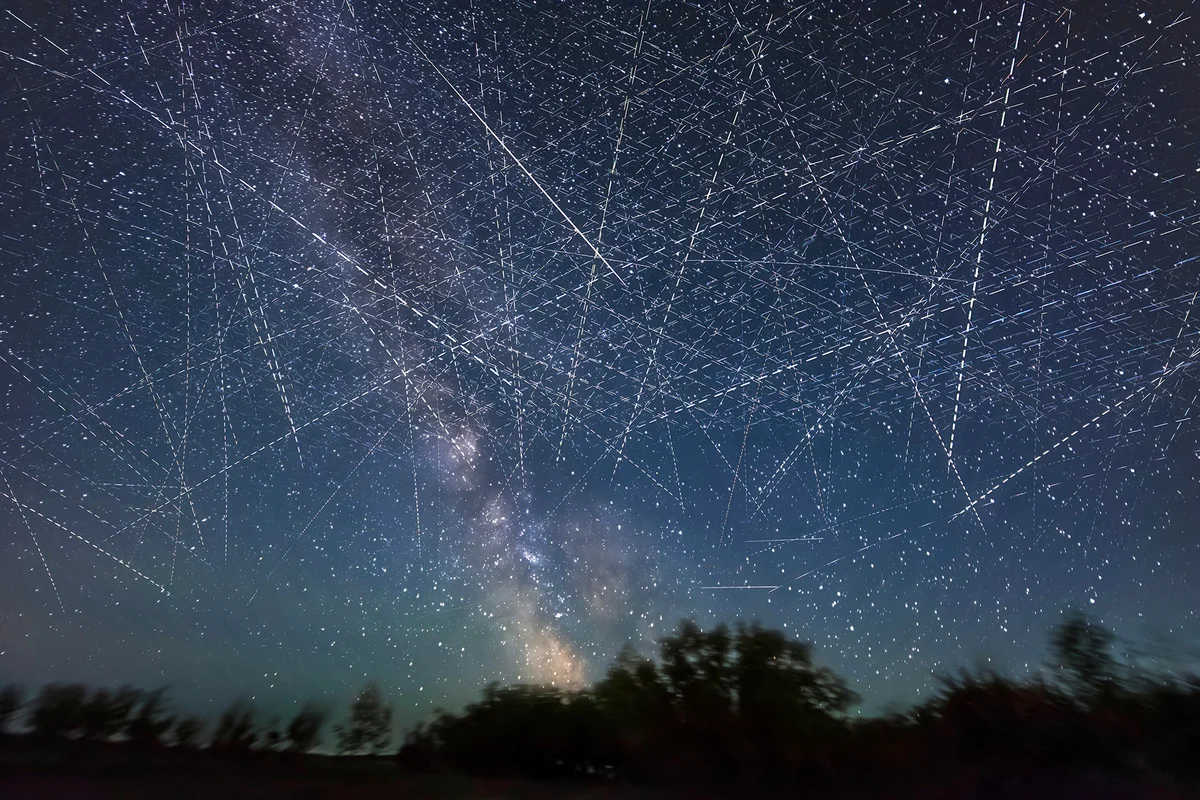
The rapid, largely unregulated growth of satellite mega constellations is raising serious concerns among astronomers and environmental scientists about the future of the night sky. What began as scattered clusters of a few dozen satellites has expanded into constellations of thousands, with proposals on the table that would push the total into the hundreds of thousands.
From thousands to tens of thousands of satellites
The scale of change over a few years is striking. In May 2023, roughly 7,500 active satellites orbited Earth, more than half of them SpaceX Starlink spacecraft providing internet service. By March 2026, SpaceX had crossed 10,000 active Starlink satellites in low-Earth orbit, less than seven years after its first operational launch. Starlink now accounts for roughly two-thirds of all operational satellites, meaning a single company already fields more satellites than the rest of the world combined.
That share is likely to grow. SpaceX applied to the U.S. Federal Communications Commission (FCC) for tens of thousands of additional satellites, including a 2019 filing for 30,000 more. SpaceX is also not alone: China has filed International Telecommunication Union paperwork for mega constellations totaling nearly 200,000 satellites, and Amazon’s Project Kuiper and other operators have their own plans for thousands more.
Data centers in space
One driver of the newest proposals is the idea of moving computing off the ground entirely. Rather than housing enormous processing capacity in terrestrial warehouses, some concepts envision each orbiting satellite performing a small portion of the computation and sending results back to Earth. In principle, such schemes could ease the strain that data centers place on power grids. U.S. data centers consumed about 176 terawatt-hours of electricity in 2023, more than 4 percent of the country’s annual use, much of it from fossil fuels and requiring large volumes of water for cooling. As demand for computationally intensive AI grows, so does the appetite for power, which proponents argue strengthens the case for space-based compute. Whether orbital data centers can deliver those benefits at scale, however, remains unproven.
The launch problem
Building such mega constellations would require an extraordinary number of launches. As astrophysicist Jonathan McDowell has noted, SpaceX’s Starship is designed to carry around 150 metric tons to low-Earth orbit, though operational capacity may prove lower. Even under optimistic assumptions, deploying a constellation on the scale of hundreds of thousands of satellites could require tens of thousands of launches. Because satellites fail after a few years and must be replaced, maintaining a constellation approaching a million satellites could demand a sustained, very high launch cadence indefinitely, with significant cumulative environmental and atmospheric effects from both launches and re-entries.
Collision risk and Kessler syndrome
More satellites also means a harder space-traffic management problem. Objects in orbit travel many times faster than a rifle bullet, and a single collision could scatter a cloud of high-velocity debris. That debris can strike other satellites and generate still more fragments, a potential runaway cascade known as Kessler syndrome. Although natural orbital decay gradually clears low-Earth orbit over time, increasing the satellite population by several orders of magnitude would raise collision risk substantially.
The threat to astronomy
For astronomy, the concern is direct. A study published in Nature in 2025 modeled the impact of the roughly 500,000-plus satellites currently planned and found that a large share of space-telescope observations would be affected. For the Hubble Space Telescope specifically, the analysis indicated that about one in three images would contain at least one satellite trail. The problem is already measurable: roughly 4 percent of Hubble images taken between 2018 and 2021 show artificial satellite trails. Ground-based telescopes are similarly affected, and vaporized re-entry debris can brighten the sky, making faint cosmic objects harder to observe. Even casual stargazing is degraded as the background sky grows brighter.
Space mirrors and “sunlight on demand”
A newer category of proposal adds another dimension. A startup called Reflect Orbital aims to launch large deployable mirrors, with the stated goal of directing sunlight to locations on Earth after dark and extending solar-energy production. The company has described plans for as many as 4,000 such satellites by 2030. Astronomers and dark-sky advocates have raised alarms, warning that reflected light far brighter than the full moon would scatter in the atmosphere, disrupt wildlife, and further erase stars from view.
Limitations and what to watch
It is worth keeping the trade-offs in view. Satellite constellations deliver genuine benefits, including broadband access to remote and underserved regions, and many of the largest figures cited above are planned or filed numbers rather than satellites actually in orbit. Regulatory filings often exceed eventual deployments, and technical, financial, and policy constraints may limit how many of these satellites ever launch. At the same time, current trends and the measurable rise in satellite trails suggest the concerns are not hypothetical. Regulators such as the FCC periodically open public comment periods on specific constellation and orbital-illumination proposals, and bodies like the American Astronomical Society track the issue. The central open question is whether governance and coordination can keep pace with deployment, since the night sky is a shared resource that, once crowded, may be difficult to restore. Related coverage on this site examines the surging energy demands of AI data centers.
Further detail is available from Scientific American and the underlying Nature study on megaconstellations and astronomy.
