
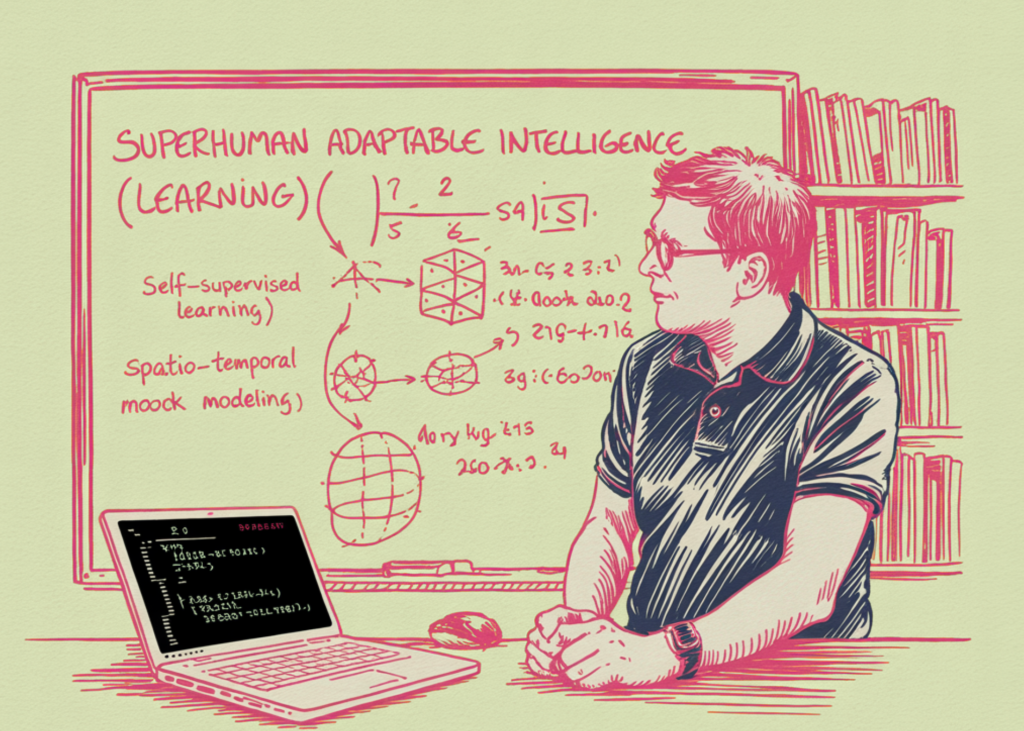
The new paper from Yann LeCun and his collaborators poses a pointed question: what if the AI industry is optimizing for a goal that cannot be clearly defined or reliably measured? Their central claim is that Artificial General Intelligence (AGI) has become an overloaded term, used inconsistently across academia and industry. Because AGI lacks a stable operational definition, the authors argue, it functions as a weak scientific target for evaluating progress or guiding research. The paper was co-authored by Judah Goldfeder, Philippe Wyder, Yann LeCun, and Ravid Shwartz-Ziv.
Why human intelligence is not the natural baseline
The paper begins by challenging a common assumption behind AGI discussions: that human intelligence is a meaningful template for “general” intelligence. The authors contend that humans only appear to be a natural baseline because intelligence is typically evaluated from within a distribution of tasks shaped by human biology and survival. People are good at the kinds of tasks that mattered to human evolution, but that competence is itself narrow when measured against the full space of possible tasks. On this view, treating human ability as the definition of “normal” intelligence builds a hidden bias into the goal.
Introducing Superhuman Adaptable Intelligence (SAI)
In place of AGI, the paper proposes Superhuman Adaptable Intelligence (SAI). SAI is defined as intelligence that can be adapted to exceed human performance on any task humans perform, and also to handle useful tasks outside the human domain. The shift is subtle but consequential. Instead of asking whether a system already matches humans on a fixed checklist of tasks, the authors ask how quickly a system can learn something new and how broadly that learning can extend. In this framework, the key metric is adaptation speed: how rapidly an agent acquires new skills and masters new tasks.
Why adaptation speed matters more than static benchmarks
This reframing restates the problem in more engineering-friendly terms. Benchmarks built on an ever-growing list of tasks become unwieldy, because the space of possible skills is effectively unlimited. The authors argue that evaluating intelligence as a static inventory of competencies is a conceptual mistake; what matters more is how fast a system can acquire new skills and adapt to new environments.
Self-supervised learning and world models
If the objective is rapid optimization across a very large task space, the paper argues, relying solely on supervised learning becomes limiting, because supervised methods assume access to large, reliable labeled datasets, an assumption that often fails in real settings. The authors point to self-supervised learning as a promising route because it can exploit structure in raw data and has already produced robust results across many domains. Notably, they do not claim that SAI requires a specific architecture; they present self-supervised learning as a promising direction rather than a final answer.
The paper also argues that stronger adaptation is likely to depend on world models. Here the authors move away from the idea that token-level or pixel-level prediction alone is sufficient for capable intelligence in the physical world, suggesting instead that systems need richer internal models of how the world behaves.
Key takeaways
- AGI is not a precise scientific goal: it is used inconsistently across academia and industry, making it hard to define, measure, or treat as a stable research target.
- Human intelligence should not define “normal” intelligence: humans appear capable only within a range shaped by biology and survival, and are limited outside it.
- SAI is offered as a better target: defined around adapting beyond human performance on human tasks and learning useful tasks outside the human domain.
- Adaptation speed matters more than benchmark breadth: the focus shifts to how quickly a system acquires new skills and adapts to new environments.
- Specialization, self-supervised learning, and world models: the authors expect future systems to require internal expertise and strong world modeling rather than a single universal architecture.
Reception, limitations, and what to watch
The proposal has drawn both interest and pushback. Some commentators argue that SAI is best understood as a special case of AGI rather than a true alternative, since “adapting to exceed humans on any task” arguably restates rather than replaces the general-intelligence goal. The paper is a position and framing argument, not an empirical result: it does not demonstrate a system that achieves SAI, nor does it resolve how adaptation speed would be measured in practice across open-ended task spaces. Its preference for self-supervised learning and world models over autoregressive language models reflects a particular research perspective that remains debated within the field. Readers should treat SAI as a proposed reframing of the goalposts whose practical value will depend on whether it yields clearer, testable benchmarks. Related coverage on this site examines emerging frameworks for adaptable agent systems.
Independent summaries of the paper are available from MarkTechPost and The Decoder.
