
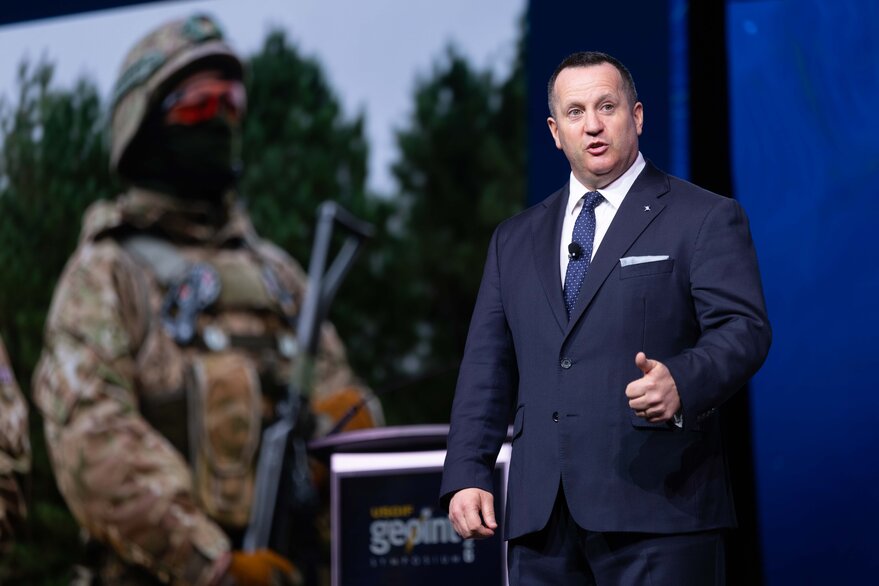
DENVER – NATO must update policies to accelerate the fusion of commercial and national geospatial intelligence and strengthen relationships between allies, Maj. Gen. Paul Lynch, NATO’s deputy assistant secretary general for intelligence, said at the GeoInt symposium May 4.
The war in Ukraine demonstrated the promise of “rapid continuous fusion of national intelligence across 32 allies” with commercial satellite imagery and open-source intelligence, Lynch said, “to make decisions in hours, not days”.
When the whole process works well, it produces sophisticated multi-source intelligence, Lynch said. “When it doesn’t work, the failure has almost never been a collection failure, it’s been an integration failure.”
Integration is more complex than ever due to the expansion of the commercial geospatial industry, which “is now an integral part of the intelligence enterprise, including NATO operations,” Lynch said.
NATO needs standards that enable commercial, national and NATO-partner data processed by AI to contribute to the same operational picture. The new standards should include metadata, model documentation and “common interfaces that don’t require bespoke integration every time a new partner or new source joins the enterprise,” Lynch said.
Updating Policies
NATO’s decision cycles were not designed to take advantage of the abundance of available data.
“The operational environment now demands a framework in which commercial geospatial data collected, processed and analyzed by industry can be combined with national imagery, partner data and open-source intelligence and delivered to a commander at the speed of operational need in a set of 32 national classification systems and legal contractual frameworks,” Lynch said. “It’s not easy.”
One challenge, Lynch said, is updating the policies that determine “who can share what, with whom,” under what authority and at what pace.
The National Geospatial-Intelligence Agency’s Luno program, which combines commercial geospatial imagery with AI-powered analytics, is a promising approach, Lynch said. “The alliance needs a parallel development.”
Without a program like Luno, “commercial data enters NATO intelligence systems mostly through exceptions and workarounds, not through designed routes,” Lynch said. Redesigning the routes would require amendments to “data-use policies, security-classification guides, contract frameworks and releaseability rules”.
Lynch said that dealing with governance issues “may have the greatest return on intelligence infrastructure investments made by NATO over the next five years.”
AI complexity
AI-enabled technology further increases the governance challenge as NATO analysts must understand the underlying models, training data, assumptions, and confidence limits.
“The AI interoperability challenge is not just technical,” Lynch said. “This is governance and it has an associated dimension. No one nation can solve this.”
“AI-enabled exploitation, imagery analysis, change detection and multi-source fusion is truly changing what is possible, reducing the time from collection to action and enabling associates to focus on tasks that require human judgment,” Lynch said.
strengthening relationships
NATO allies also need to continue to build relationships through exercises and exchange programs, Lynch said.
Relations between the allies proved essential to NATO intelligence sharing during the early days of the Russian invasion of Ukraine. “Decisions that should have taken a few weeks were made in a matter of days,” Lynch said. “Imagination and evaluation proceeded through channels that required approval on paper.”
“Intelligence was shared quickly because of trust, because the people on both ends of the data request knew each other,” Lynch said. “They trusted each other’s judgment and understood each other’s constraints well enough to move forward without waiting for an outline to be drawn up.”
No single policy framework can produce those results, Lynch said, “only years of practice, exchange and working in the same room on less consequential problems do that.”
