
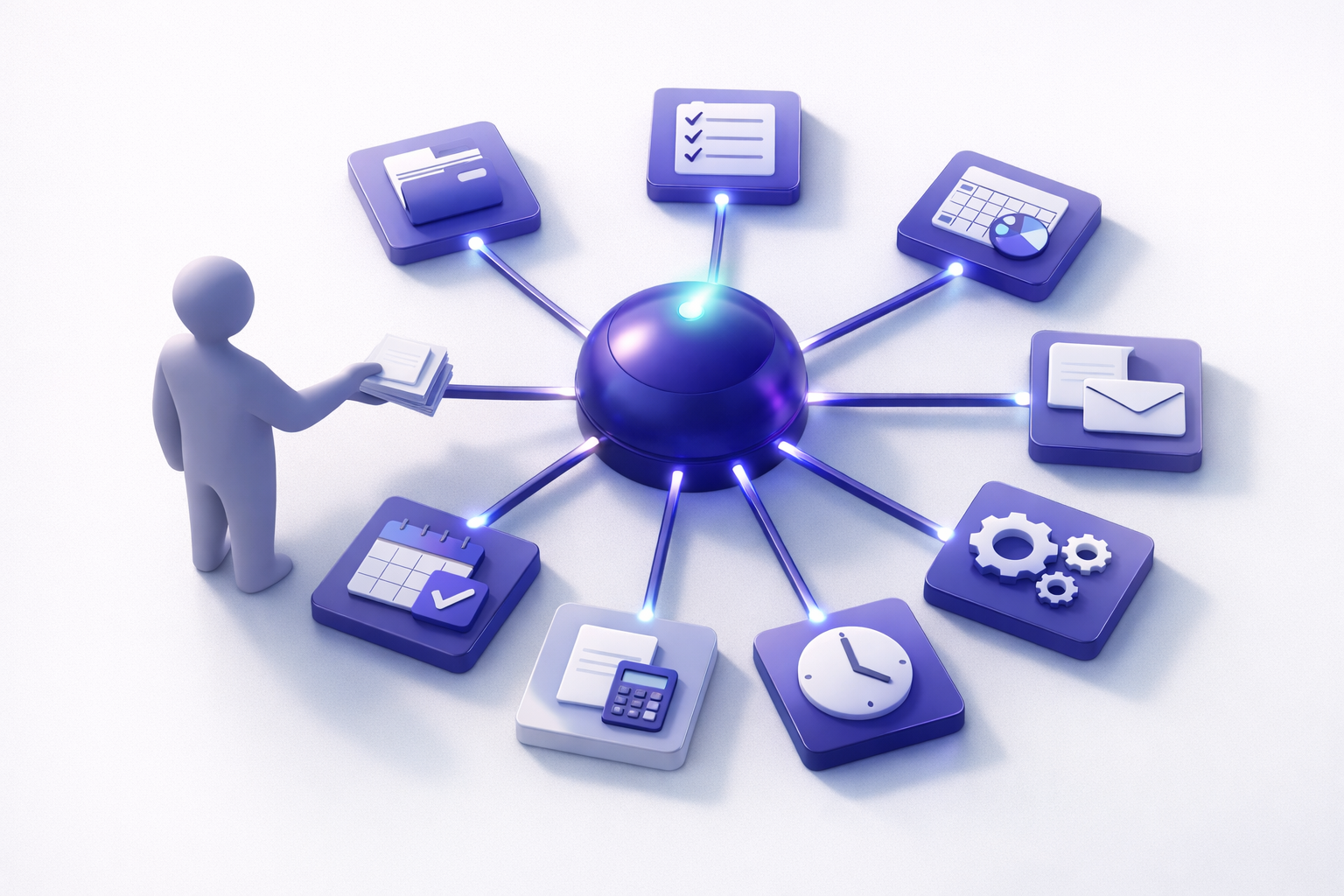
Fifty-seven percent of companies now run AI agents in production, and the small businesses among them are quietly rewriting how the back office works. The headline shift of 2026 isn’t a smarter chatbot — it’s AI workflow automation for small business that finishes whole tasks on its own, from reading an invoice to routing a support ticket, with a human stepping in only to approve.
For owners juggling sales, service and admin at once, that’s the difference between a tool you have to babysit and a teammate that simply gets things done.
From chatbot hype to AI workflow automation for small business
The first wave of small-business AI was conversational: you asked a question, it answered, and you did the rest. The current wave is agentic. An agentic workflow is a system where you set a goal and the software figures out the steps, takes action across your apps, and keeps going until the job is complete. Instead of drafting a reply for you to send, it reads the incoming ticket, classifies it, pulls the answer from your knowledge base, resolves the routine cases, and escalates the tricky ones with context already attached.
That is why analysts describe 2026 as the year “workflow AI” beat chatbot hype. The market is rewarding tools that finish bounded, reviewable jobs — support routing, lead handling, finance admin — over ones that simply chat.
Where the early wins are
Early adopters consistently report 20–30% faster workflow cycles, and the biggest gains land in unglamorous back-office work: invoice processing, claims handling, and customer-query routing. These are exactly the tasks that eat a small team’s week — repetitive, rules-based, and easy to fall behind on. Hand them to an agent that works overnight and you reclaim hours without adding headcount.
Why small businesses can move faster than the enterprise
Counterintuitively, being small is an advantage here. Large organisations are slowed by legacy systems, approval layers, and integration debt. A small business running on a handful of cloud apps can wire an agent into its stack in an afternoon. Adoption data backs this up: alongside the 57% already in production, another 22% are piloting and 21% are in pre-pilot — the technology has crossed from experiment to operations.
No-code platforms like Make, Zapier and n8n let you build these agentic workflows visually, without writing a line of code. That keeps the barrier low and control firmly with the owner. If you have already leaned on AI for AI marketing for small business, extending the same logic to operations is a natural next step.
Treat it like a project, not a plug-in
The owners getting real value approach automation as a small project rather than a magic switch. That means starting narrow: pick one high-volume, low-judgement task, map exactly what a good outcome looks like, and keep a human review step in the loop until the agent earns trust. Bounded scope plus human review is the pattern that separates the businesses saving money from the ones cleaning up after a runaway bot.
It also means watching cost. As usage climbs, many teams deliberately choose smaller, cheaper models for routine steps and reserve the powerful ones for genuinely hard work — the same discipline reshaping how AI pricing works for small business. Good AI project management is less about the flashiest model and more about matching each task to the cheapest tool that clears the bar.
A practical starting point
Choose one workflow that is repetitive, well-defined, and currently slowing you down — invoice intake, first-line support, or lead qualification are proven candidates. Document the steps, connect an agent through a no-code platform, and run it in parallel with your existing process for a week. Measure the time saved and the error rate, then expand only once it is reliable. Handled this way, AI workflow automation for small business stops being a buzzword and becomes the quietest, most dependable member of your team.
