
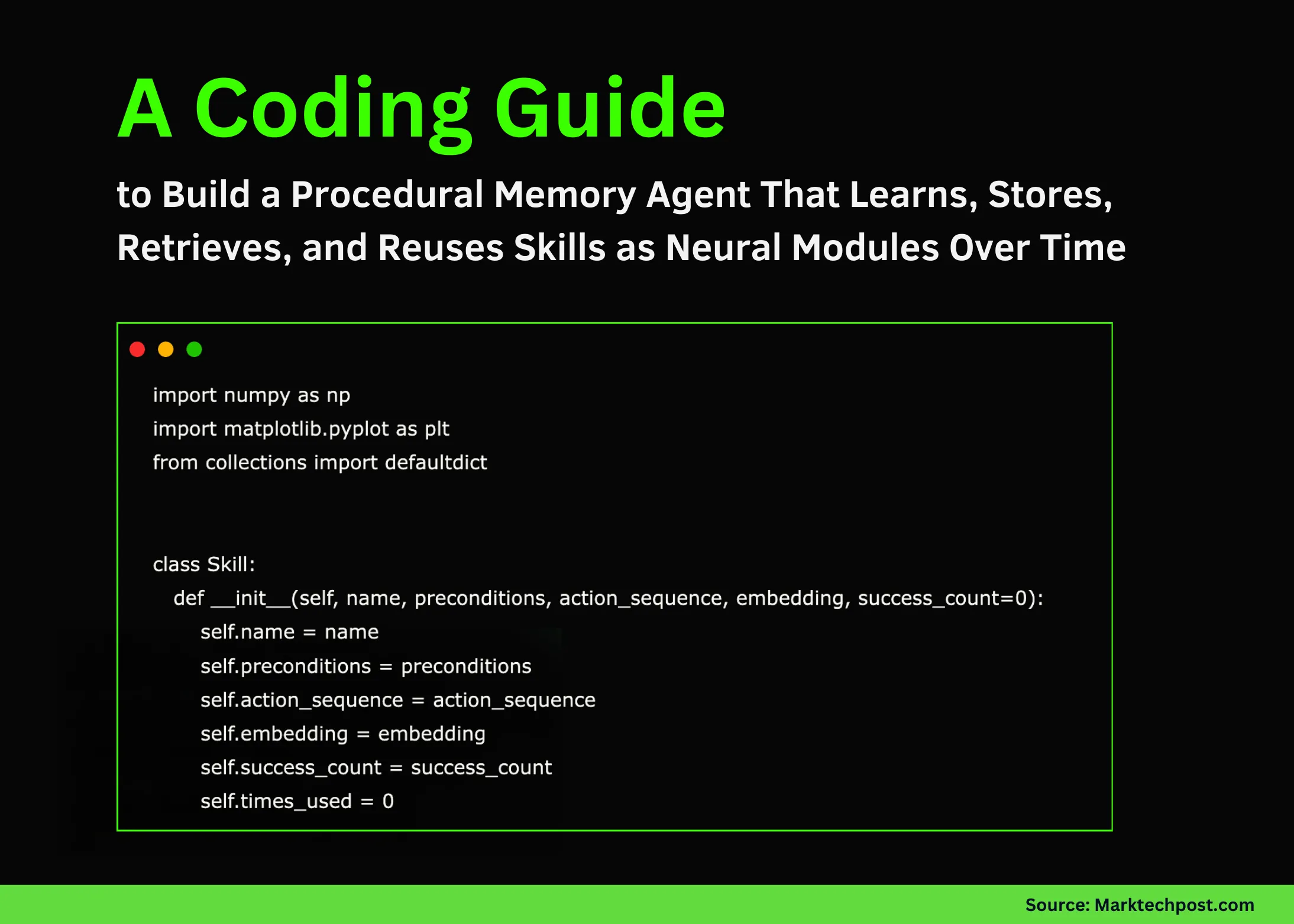
This tutorial explores how an intelligent agent can gradually build procedural memory — learning reusable skills directly from its interactions with an environment. The framework is minimal but instructive: skills behave like small neural modules that store action sequences, carry contextual embeddings, and are retrieved by similarity whenever a new situation resembles past experience. Over several training episodes, the agent’s behavior visibly shifts from primitive exploration to drawing on a library of skills it assembled itself.
In plain terms, procedural memory is the difference between figuring out a task every time and remembering how it was done last time. Humans rely on it constantly (typing, driving, making coffee); most AI agents today do not, re-deriving every solution from scratch. Approaches like the one below — extracting reusable skills from successful attempts — are one of the active research directions for making agents cheaper and more reliable over long horizons. The complete code for each section is available in the tutorial repository on GitHub.
Step 1: Skill representation and storage
import numpy as np
import matplotlib.pyplot as plt
from collections import defaultdict


class Skill:
   def __init__(self, name, preconditions, action_sequence, embedding, success_count=0):
       self.name = name
       self.preconditions = preconditions
       self.action_sequence = action_sequence
       self.embedding = embedding
       self.success_count = success_count
       self.times_used = 0

   def is_applicable(self, state):
       for key, value in self.preconditions.items():
           if state.get(key) != value:
               return False
       return True

   def __repr__(self):
       return f"Skill({self.name}, used={self.times_used}, success={self.success_count})"


class SkillLibrary:
   def __init__(self, embedding_dim=8):
       self.skills = ()
       self.embedding_dim = embedding_dim
       self.skill_stats = defaultdict(lambda: {"attempts": 0, "successes": 0})

   def add_skill(self, skill):
       for existing_skill in self.skills:
           if self._similarity(skill.embedding, existing_skill.embedding) > 0.9:
               existing_skill.success_count += 1
               return existing_skill
       self.skills.append(skill)
       return skill

   def retrieve_skills(self, state, query_embedding=None, top_k=3):
       applicable = (s for s in self.skills if s.is_applicable(state))
       if query_embedding is not None and applicable:
           similarities = (self._similarity(query_embedding, s.embedding) for s in applicable)
           sorted_skills = (s for _, s in sorted(zip(similarities, applicable), reverse=True))
           return sorted_skills(:top_k)
       return sorted(applicable, key=lambda s: s.success_count / max(s.times_used, 1), reverse=True)(:top_k)

   def _similarity(self, emb1, emb2):
       return np.dot(emb1, emb2) / (np.linalg.norm(emb1) * np.linalg.norm(emb2) + 1e-8)

   def get_stats(self):
       return {
           "total_skills": len(self.skills),
           "total_uses": sum(s.times_used for s in self.skills),
           "avg_success_rate": np.mean((s.success_count / max(s.times_used, 1) for s in self.skills)) if self.skills else 0
       }
This layer defines how skills are represented and stored in the memory structure, and implements similarity-based retrieval so the agent can match a new state against previous skills using cosine similarity. Once skill metadata, embeddings and usage statistics are in place, skill reuse becomes possible.
Step 2: A simple training environment
class GridWorld:
   def __init__(self, size=5):
       self.size = size
       self.reset()

   def reset(self):
       self.agent_pos = (0, 0)
       self.goal_pos = (self.size-1, self.size-1)
       self.objects = {"key": (2, 2), "door": (3, 3), "box": (1, 3)}
       self.inventory = ()
       self.door_open = False
       return self.get_state()

   def get_state(self):
       return {
           "agent_pos": tuple(self.agent_pos),
           "has_key": "key" in self.inventory,
           "door_open": self.door_open,
           "at_goal": self.agent_pos == self.goal_pos,
           "objects": {k: tuple(v) for k, v in self.objects.items()}
       }

   def step(self, action):
       reward = -0.1
       if action == "move_up":
           self.agent_pos(1) = min(self.agent_pos(1) + 1, self.size - 1)
       elif action == "move_down":
           self.agent_pos(1) = max(self.agent_pos(1) - 1, 0)
       elif action == "move_left":
           self.agent_pos(0) = max(self.agent_pos(0) - 1, 0)
       elif action == "move_right":
           self.agent_pos(0) = min(self.agent_pos(0) + 1, self.size - 1)
       elif action == "pickup_key":
           if self.agent_pos == self.objects("key") and "key" not in self.inventory:
               self.inventory.append("key")
               reward = 1.0
       elif action == "open_door":
           if self.agent_pos == self.objects("door") and "key" in self.inventory:
               self.door_open = True
               reward = 2.0
       done = self.agent_pos == self.goal_pos and self.door_open
       if done:
           reward = 10.0
       return self.get_state(), reward, done
The environment gives the agent tasks such as picking up a key, opening a door and reaching a goal — a playground for the procedural memory system. Its simple structure makes improvements in behavior across episodes clear and explainable: primitive actions visibly evolve into more complex, reusable skills.
Step 3: Embedding context and extracting skills
class ProceduralMemoryAgent:
   def __init__(self, env, embedding_dim=8):
       self.env = env
       self.skill_library = SkillLibrary(embedding_dim)
       self.embedding_dim = embedding_dim
       self.episode_history = ()
       self.primitive_actions = ("move_up", "move_down", "move_left", "move_right", "pickup_key", "open_door")

   def create_embedding(self, state, action_seq):
       state_vec = np.zeros(self.embedding_dim)
       state_vec(0) = hash(str(state("agent_pos"))) % 1000 / 1000
       state_vec(1) = 1.0 if state.get("has_key") else 0.0
       state_vec(2) = 1.0 if state.get("door_open") else 0.0
       for i, action in enumerate(action_seq(:self.embedding_dim-3)):
           state_vec(3+i) = hash(action) % 1000 / 1000
       return state_vec / (np.linalg.norm(state_vec) + 1e-8)

   def extract_skill(self, trajectory):
       if len(trajectory) < 2:
           return None
       start_state = trajectory(0)(0)
       actions = (a for _, a, _ in trajectory)
       preconditions = {"has_key": start_state.get("has_key", False), "door_open": start_state.get("door_open", False)}
       end_state = self.env.get_state()
       if end_state.get("has_key") and not start_state.get("has_key"):
           name = "acquire_key"
       elif end_state.get("door_open") and not start_state.get("door_open"):
           name = "open_door_sequence"
       else:
           name = f"navigate_{len(actions)}_steps"
       embedding = self.create_embedding(start_state, actions)
       return Skill(name, preconditions, actions, embedding, success_count=1)

   def execute_skill(self, skill):
       skill.times_used += 1
       trajectory = ()
       total_reward = 0
       for action in skill.action_sequence:
           state = self.env.get_state()
           next_state, reward, done = self.env.step(action)
           trajectory.append((state, action, reward))
           total_reward += reward
           if done:
               skill.success_count += 1
               return trajectory, total_reward, True
       return trajectory, total_reward, False

   def explore(self, max_steps=20):
       trajectory = ()
       state = self.env.get_state()
       for _ in range(max_steps):
           action = self._choose_exploration_action(state)
           next_state, reward, done = self.env.step(action)
           trajectory.append((state, action, reward))
           state = next_state
           if done:
               return trajectory, True
       return trajectory, False
This section creates embeddings that encode the context of a state–action sequence, enabling meaningful comparison between skills. Skills are then extracted from successful trajectories, transforming raw experience into reusable behavior — simple exploration gradually crystallizing into structured knowledge the agent can apply later.
Step 4: Choosing between skills and exploration
   def _choose_exploration_action(self, state):
       agent_pos = state("agent_pos")
       if not state.get("has_key"):
           key_pos = state("objects")("key")
           if agent_pos == key_pos:
               return "pickup_key"
           if agent_pos(0) < key_pos(0):
               return "move_right"
           if agent_pos(0) > key_pos(0):
               return "move_left"
           if agent_pos(1) < key_pos(1):
               return "move_up"
           return "move_down"
       if state.get("has_key") and not state.get("door_open"):
           door_pos = state("objects")("door")
           if agent_pos == door_pos:
               return "open_door"
           if agent_pos(0) < door_pos(0):
               return "move_right"
           if agent_pos(0) > door_pos(0):
               return "move_left"
           if agent_pos(1) < door_pos(1):
               return "move_up"
           return "move_down"
       goal_pos = (4, 4)
       if agent_pos(0) < goal_pos(0):
           return "move_right"
       if agent_pos(1) < goal_pos(1):
           return "move_up"
       return np.random.choice(self.primitive_actions)

   def run_episode(self, use_skills=True):
       self.env.reset()
       total_reward = 0
       steps = 0
       trajectory = ()
       while steps < 50:
           state = self.env.get_state()
           if use_skills and self.skill_library.skills:
               query_emb = self.create_embedding(state, ())
               skills = self.skill_library.retrieve_skills(state, query_emb, top_k=1)
               if skills:
                   skill_traj, skill_reward, success = self.execute_skill(skills(0))
                   trajectory.extend(skill_traj)
                   total_reward += skill_reward
                   steps += len(skill_traj)
                   if success:
                       return trajectory, total_reward, steps, True
                   continue
           action = self._choose_exploration_action(state)
           next_state, reward, done = self.env.step(action)
           trajectory.append((state, action, reward))
           total_reward += reward
           steps += 1
           if done:
               return trajectory, total_reward, steps, True
       return trajectory, total_reward, steps, False

   def train(self, episodes=10):
       stats = {"rewards": (), "steps": (), "skills_learned": (), "skill_uses": ()}
       for ep in range(episodes):
           trajectory, reward, steps, success = self.run_episode(use_skills=True)
           if success and len(trajectory) >= 3:
               segment = trajectory(-min(5, len(trajectory)):)
               skill = self.extract_skill(segment)
               if skill:
                   self.skill_library.add_skill(skill)
           stats("rewards").append(reward)
           stats("steps").append(steps)
           stats("skills_learned").append(len(self.skill_library.skills))
           stats("skill_uses").append(self.skill_library.get_stats()("total_uses"))
           print(f"Episode {ep+1}: Reward={reward:.1f}, Steps={steps}, Skills={len(self.skill_library.skills)}, Success={success}")
       return stats
Here the agent learns to choose between deploying known skills and exploring with primitive actions. Training over several episodes records the evolution of learned skills, usage counts and success rates — and shows that skill reuse shortens episodes and improves overall reward.
Step 5: Training, statistics and visualization
def visualize_training(stats):
   fig, axes = plt.subplots(2, 2, figsize=(12, 8))
   axes(0, 0).plot(stats("rewards"))
   axes(0, 0).set_title("Episode Rewards")
   axes(0, 1).plot(stats("steps"))
   axes(0, 1).set_title("Steps per Episode")
   axes(1, 0).plot(stats("skills_learned"))
   axes(1, 0).set_title("Skills in Library")
   axes(1, 1).plot(stats("skill_uses"))
   axes(1, 1).set_title("Cumulative Skill Uses")
   plt.tight_layout()
   plt.savefig("skill_learning_stats.png", dpi=150, bbox_inches="tight")
   plt.show()


if __name__ == "__main__":
   print("=== Procedural Memory Agent Demo ===n")
   env = GridWorld(size=5)
   agent = ProceduralMemoryAgent(env)
   print("Training agent to learn reusable skills...n")
   stats = agent.train(episodes=15)
   print("n=== Learned Skills ===")
   for skill in agent.skill_library.skills:
       print(f"{skill.name}: {len(skill.action_sequence)} actions, used {skill.times_used} times, {skill.success_count} successes")
   lib_stats = agent.skill_library.get_stats()
   print(f"n=== Library Statistics ===")
   print(f"Total skills: {lib_stats('total_skills')}")
   print(f"Total skill uses: {lib_stats('total_uses')}")
   print(f"Avg success rate: {lib_stats('avg_success_rate'):.2%}")
   visualize_training(stats)
   print("n✓ Skill learning complete! Check the visualization above.")
The final section brings everything together: running training, printing the learned skills, and visualizing the reward trend alongside the growth of the skill library. This completes the lifecycle of procedural memory formation and confirms the agent handles experience more intelligently over time.
Conclusion
Procedural memory emerges naturally when an agent extracts skills from its own successful trajectories: acquisition, structure, metadata, embeddings and usage patterns together allow efficient reuse in future situations. Even a small environment with simple heuristics produces meaningful learning dynamics — a solid foundation for understanding what it means for an agent to develop reusable internal competencies.
Limitations and what to watch
This is a teaching implementation, and its simplifications matter. The environment is tiny and deterministic; in richer or stochastic environments, similarity-based retrieval can surface skills that no longer apply, and naive cosine matching over hand-crafted embeddings scales poorly compared with learned retrieval. Skill extraction from successful trajectories also inherits any luck in those successes — production systems typically add evaluation, pruning and versioning of skills to prevent the library filling with brittle behaviors. For readers building real agentic systems, the concepts transfer directly, but the machinery should come from maintained frameworks with tracing and evaluation support rather than from a from-scratch loop — the same discipline that applies to multi-agent systems built on production frameworks.
