
A familiar scenario plays out in many enterprises: the first generative AI application ships, early results look promising, and then the hard questions arrive. How does an organization enforce consistent security, prevent model bias, and maintain control as AI spreads across departments? The organizations asking those questions are not alone — and the emerging answer from practitioners is a discipline often called governance by design: building oversight into AI systems from the first day, rather than bolting it on after deployment.
A McKinsey survey of more than 750 leaders across 38 countries illustrates both the challenges and the opportunities. Organizations are devoting significant resources to responsible AI, yet barriers remain: a lack of knowledge and training is the leading obstacle for 51% of respondents, while 40% cite regulatory uncertainty. Companies with established responsible AI programs, meanwhile, report measurable gains in business efficiency and consumer trust. The pattern is clear enough: strong risk management is not a brake on AI value — it is a precondition for realizing it.
Responsible AI: a day-one concern, not an afterthought
Teams at the AWS Generative AI Innovation Center — one of the larger enterprise AI consultancies operating today — report a consistent finding: the organizations that achieve the strongest results embed governance into their operating model from the start. AWS has formalized this in resources such as its Well-Architected Responsible AI Lens, a framework for applying responsible practices across the development lifecycle, and in internal tooling that turns governance principles into automated controls.
In plain terms, the idea is simple. Governance that lives in a policy document gets skipped under deadline pressure; governance that lives inside the development pipeline gets applied every time.
Four practices for responsible generative AI deployment
1 – Adopt a governance-by-design mindset
A consistent pattern emerges among organizations adopting generative and agentic AI: business leaders are drawn by the promise, then struggle to find a path to safe implementation. The organizations achieving the most impactful results treat AI risk management as a foundational element rather than a compliance checkbox. That shift transforms governance from a perceived barrier into part of how teams ship — and lets AI initiatives scale with confidence rather than caution.
2 – Align technology, business and governance
Technological exploration has to move in step with governance planning. The comparison sometimes offered is conducting an orchestra: no one coordinates a symphony without understanding each instrument. Effective AI governance likewise requires a working understanding of the underlying technology before controls can sensibly be imposed. Organizations that establish clear connections between technical capabilities, business objectives and governance requirements from the outset avoid the common failure mode of controls written by people who have never seen the system they constrain.
3 – Embed security as a governance gateway
Among all governance concerns, security is the most effective entry point, because it delivers immediate protection while building the trust that broader governance depends on. A security-by-design approach runs from infrastructure protection through threat detection in complex AI workflows, and increasingly relies on automation — for example, agent-based tooling that performs security reviews and penetration testing against centrally defined standards throughout the development lifecycle.
Security then anchors a wider set of controls. AWS’s responsible AI framework, as one example, combines fairness, explainability, privacy and security, controllability, veracity and robustness, governance and transparency into a single approach. As AI systems take on more autonomous decision-making, automating these controls while retaining human oversight becomes the central scaling challenge.
4 – Automate governance at enterprise scale
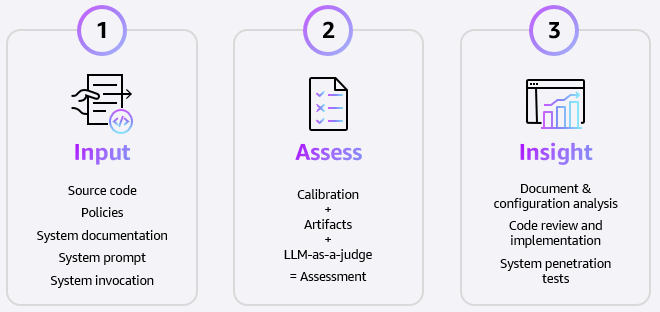
With mindset, alignment and security controls in place, organizations need a way to apply governance systematically rather than project by project. Automated risk-assessment tooling addresses this by operationalizing existing principles instead of inventing new process: a typical flow moves from user input to automated assessment to actionable insights, analyzing everything from source code to system documentation using document processing and LLM-based evaluation. The more capable systems also test generative AI applications dynamically — checking semantic consistency and probing for vulnerabilities — while adapting to each organization’s industry standards.
From theory to practice
The true measure of AI governance is how it holds up at scale. One published example involves Ryanair, Europe’s largest airline group, which is targeting 300 million passengers by 2034. For a cabin-crew application that delivers operational information to frontline staff, an AI-powered assessment built on Amazon Bedrock established transparent, data-driven risk management in an area where risk was previously hard to measure — producing a governance model the airline can extend across its AI portfolio.
Organizations that apply this kind of systematic framework commonly report faster paths to production, less manual review work, and better cross-functional alignment among technology, legal and security teams. The pattern is consistent with the broader finding that disciplined AI programs outperform ad-hoc adoption at any company size.
Limitations and what to watch
Two caveats are worth keeping in view. First, much of the published evidence for governance-by-design comes from vendors and consultancies that sell governance tooling — including the AWS examples above — so the direction of the advice is sound, but specific product claims deserve independent evaluation before purchase. Second, survey figures on responsible AI describe correlation, not proof of causation: companies mature enough to run governance programs tend to be mature in other ways too. Regulatory requirements are also moving quickly across jurisdictions, so any governance framework adopted today should be reviewed against current law — particularly for organizations operating in or selling into the EU.
The core lesson stands regardless of vendor: responsible AI governance is not a barrier but a catalyst. Organizations that build controls into the fabric of AI development innovate with more confidence, because they know the guardrails will hold as they scale.
