
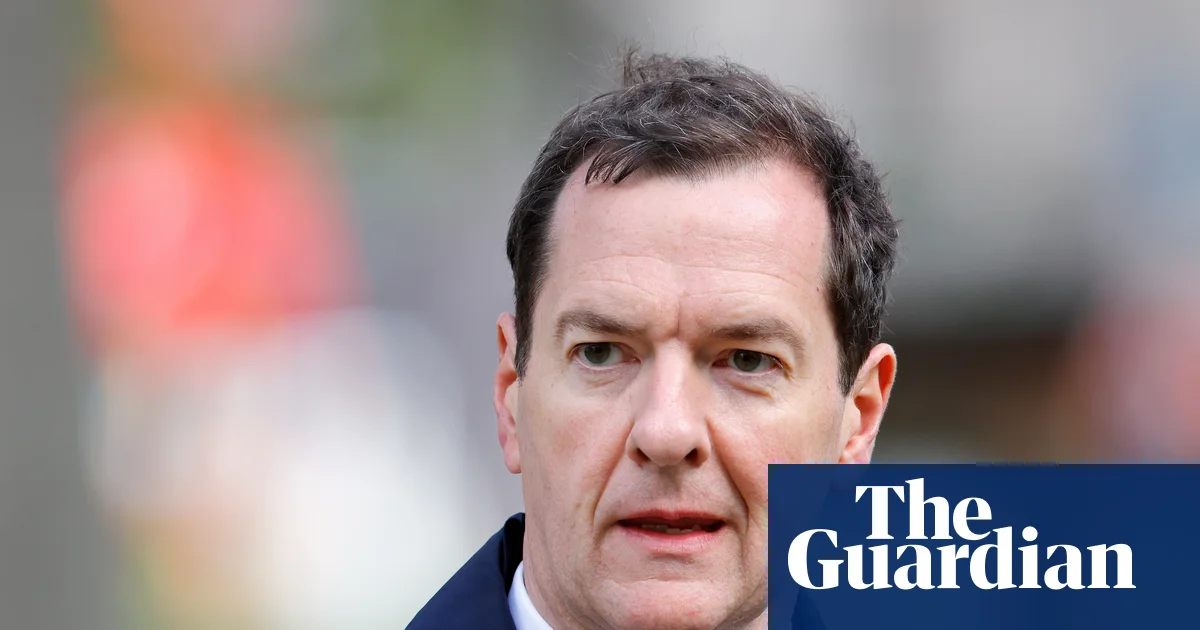
Former UK Chancellor George Osborne is joining OpenAI to lead the ChatGPT developer’s relationships with governments around the world.
He will lead a division known internally as OpenAI for Countries, through which the San Francisco artificial intelligence startup works with governments on national-level AI rollouts.
The former Conservative politician will add roles to his growing portfolio including: Chairman of the British Museum; advisor to cryptocurrency exchange Coinbase; and host of a podcast with former Labor Minister Ed Balls.
Osborne is moving from his role as senior managing director at Evercore, which in July acquired investment bank Robbie Warshaw, where he was a partner, and will be based in London rather than Silicon Valley.
His appointment by OpenAI is the latest sign that big US tech companies are increasingly focused on promoting AI adoption by national governments.
Microsoft, Google and Palantir are all working hard to provide AI services to the British government, where Osborne held office from 2010 to 2016 alongside Nick Clegg, who spent seven years working for Mark Zuckerberg at Meta.
Rishi Sunak, one of Osborne’s successors as chancellor, announced in October that he was taking an advisory role with Anthropic, one of OpenAI’s main rivals.
Other roles Osborne has held since leaving government include editor of the Evening Standard between 2017 and 2020 and advisor to US private equity firm BlackRock.
OpenAI’s national-level projects include participation in building major AI infrastructure in places such as Norway and the United Arab Emirates as part of the $500bn “Stargate” datacenter initiative.
OpenAI already has an MoU with the UK government to “establish a strategic partnership that provides opportunities to accelerate AI-powered economic growth and materially improve people’s lives” and with Estonia to provide all pupils and teachers access to a version of ChatGPT.
Osborne will be expected to create new nation-level AI infrastructure partnerships and expand on previously announced partnerships in Argentina, Australia, Germany and South Korea.
In a statement on his appointment Osborne said he believed OpenAI, valued at approximately $500 billion, is “the most exciting and promising company in the world right now”.
“In my conversations with Sam Altman, Brad Lightcap (Chief Executive and Chief Operating Officer of OpenAI) and other senior colleagues, it is clear that they are exceptionally influential leaders and that they care very deeply about their mission to responsibly harness the power of artificial intelligence, and the benefits of that are felt by everyone,” he said.
“This is exactly what the OpenAI Initiative for Countries aims to achieve, helping societies around the world share the opportunity brought by this powerful technology.”
OpenAI has recently been embroiled in controversy over the effectiveness of its chatbots. It is defending several lawsuits from the families of young people who took their lives after interacting with ChatGPT. These include the family of 16-year-old Adam Raine, who committed suicide in April after what his family’s lawyer claims was “months of encouragement from Chatgpt”.
Chris Lehane, chief global affairs officer at OpenAI, said Osborne’s appointment “reflects a shared belief that AI is becoming critical infrastructure – and early decisions about its creation, operation and deployment will shape economics and geopolitics for years to come”.
He added: “Whether the world builds a democratic AI rail led by countries with aligned values designed to put this technology into the hands of the people so they can fully participate in the opportunities of the intelligence age or an autocratic AI rail imposed by the People’s Republic of China that will be used to concentrate technology in the hands of the few – and at the expense of the many – will define what kind of world we live in.” Live in.”
