
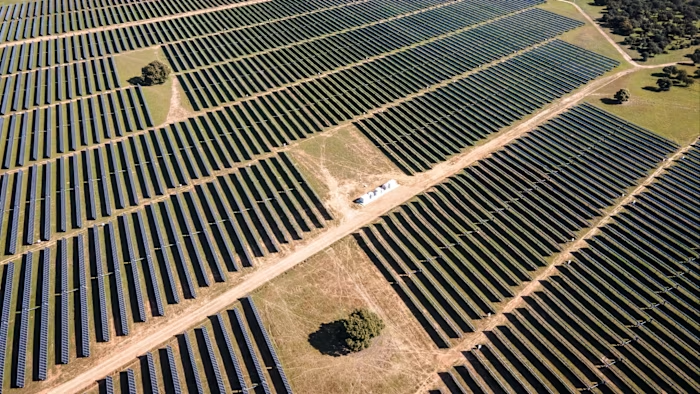
Spain has become a solar powerhouse — so much so that surging generation has outpaced demand, driven wholesale prices down (sometimes below zero) and left owners of weaker projects looking for an exit. Analysts have dubbed the resulting sell-off a “discount season.”
From boom to saturation
Abundant sunshine and pro-renewable policy turned Spain into one of Europe’s leading solar markets, with solar overtaking other technologies to supply around a fifth of the country’s electricity — roughly double the EU average. But production has grown faster than demand, depressing prices and squeezing generator profits. As officials speak of solar “saturation,” some producers are struggling to sell plants whose valuations have fallen sharply — a striking contrast with markets such as China, India, the Gulf and parts of Europe where solar is still expanding fast.
A buyers’ market
After a busy mergers-and-acquisitions market for Spanish solar portfolios from 2022 to 2024, sellers now often have to shed their weakest assets to close deals. The pressure is even more acute for “ready-to-build” projects — those with land, permits and grid access secured but no construction started — whose valuations have collapsed; industry figures cited valuations falling from well over €150,000 per megawatt a few years ago to roughly €30,000–90,000 per megawatt, with some projects reportedly advertised for token sums. Carmen Izquierdo, co-founder of the deals marketplace nTeaser, summed up the mood: sellers “are willing to sacrifice some part of the portfolio to pursue the rest.”
Negative prices and the PPA squeeze
Cheap power benefits consumers — and Spain’s government has argued it is already attracting industrial investment — but it hurts producers. When prices fall below zero, as they have for several hundred hours in 2025, generators must choose between paying to offload power or switching off. Many hedge through long-term power purchase agreements (PPAs) at fixed prices, but negative spot prices are dragging PPA prices down and pushing buyers to seek clauses that capture ultra-low rates. Notably, independent producer Zelestra signed PPAs with Microsoft in the Aragon region, where the tech company plans a data centre — a reminder that surging AI and cloud demand is becoming a significant new buyer of clean power.

Batteries as the cure
Storage is widely seen as the fix, letting plants shift output from glutted midday hours to more valuable periods. Yet analysts note battery deployment in Spain lags the UK, Germany and Italy. Following nationwide blackouts in April 2025, the government moved in November to remove some regulatory hurdles — one change dropped the requirement for a fresh environmental impact assessment when adding batteries within an existing solar plant, which industry figures say could cut battery-project timelines from three or four years to under 18 months.

Limitations and what to watch
This is a fast-moving market, so specific valuations, price levels and hours of negative pricing are snapshots that will change. Some figures come from deal marketplaces and industry participants with an interest in the narrative, and precise plant valuations depend heavily on location, grid access and contract terms. The “saturation” framing also reflects a transitional imbalance between generation and both demand and storage — not a permanent verdict on Spanish solar, which could rebalance as batteries, electrification and new industrial and data-centre demand come online. This article is informational and not investment advice.

