
Databricks has announced first-class support for the Apache Iceberg format in Delta Sharing, its open protocol for data and AI sharing. Data providers can now share data securely and live from Databricks with any client that supports the Apache Iceberg REST Catalog API, and recipients can consume it on platforms such as Snowflake, Trino, Flink, and Spark across all major clouds.
According to Databricks, Delta Sharing has seen over 300% year-over-year usage growth for two consecutive years, and major data providers including SAP, Walmart, Atlassian, and LSEG use it to share data with partners and customers across clouds and platforms. The full announcement is available on the Databricks blog.
Why open sharing matters
Databricks frames the release as a response to closed sharing ecosystems. Many data sharing solutions only work when both sides are on the same vendor’s platform, which limits reach, encourages redundant data replication, and creates lock-in. Delta Sharing’s design goal is the opposite: share any asset, with anyone, across clouds and platforms.
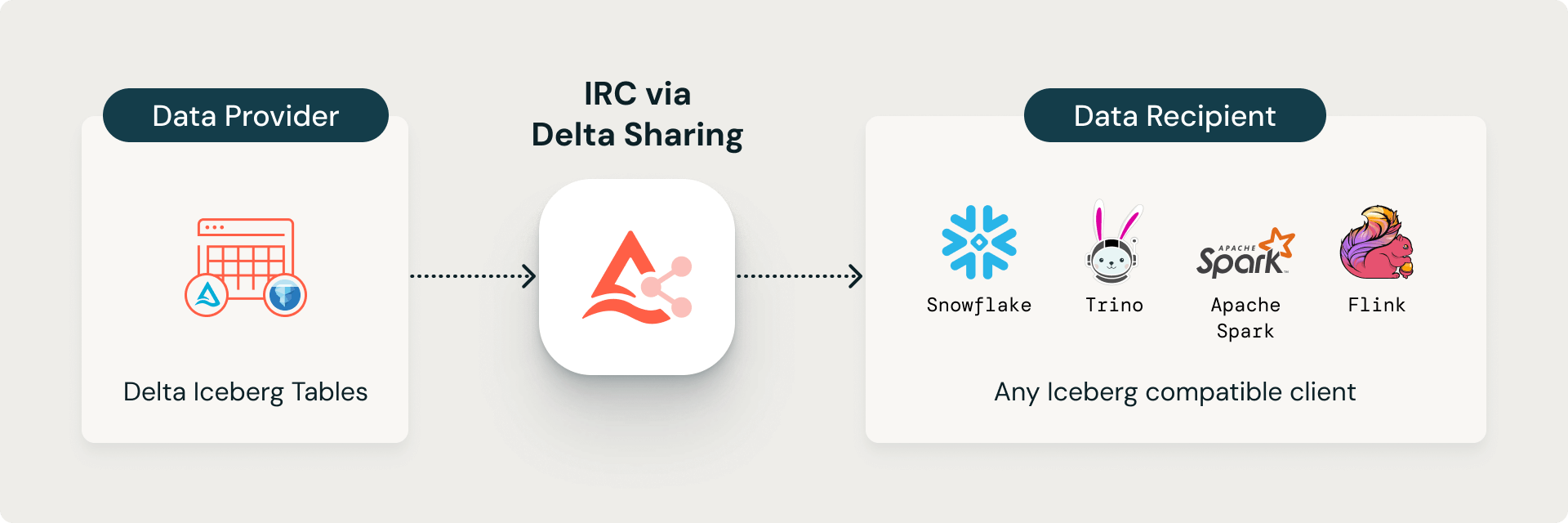
With Iceberg support, a provider can share a Delta table while the recipient experiences it as a native Iceberg table. Sharing happens over the Apache Iceberg REST Catalog API, so recipients can connect from any Iceberg-compatible engine. Providers keep advanced Delta Sharing features such as view sharing, while recipients simply see standard Iceberg tables.
What can be shared
Any new or existing table can be shared — Delta or Iceberg, managed or foreign. Iceberg tables from external catalogs can be brought into Databricks, governed through Unity Catalog, and then shared with any recipient, whether they are on Databricks, an Iceberg client, or a Delta client. Unity Catalog acts as the unified governance layer, giving organizations one place to create, govern, audit, and share data.
Foreign Iceberg tables: private preview
Databricks also announced a private preview of Delta Sharing support for foreign Iceberg tables — tables that live in external catalogs such as AWS Glue or Snowflake Horizon. Listing external Iceberg data in Unity Catalog provides unified governance across the whole data estate, and sharing it via Delta Sharing adds capabilities such as view-based fine-grained access control that the Iceberg REST Catalog API does not natively provide. With this preview, the lakehouse becomes open in both directions: it can provide data to and receive data from the wider Iceberg ecosystem.
How it works in practice
Consider a provider company that manages customer data on Databricks with Delta Lake and needs to share a daily product-sales dataset with a partner that uses Snowflake and prefers Iceberg. Previously, the provider would export the data, convert it into a Snowflake-readable format, upload it to the partner’s cloud storage, and maintain a synchronization pipeline — slow, expensive, and prone to stale data.
With Iceberg support in Delta Sharing, the provider enables Iceberg reads on the sales data (including managed and external Delta tables, views, materialized views, and streaming tables) and shares it via Delta Sharing. The partner connects from Snowflake using credentials secured by a short-lived bearer token, and its analysts query the shared table with standard SQL as if it were a native Iceberg table. Access is live and zero-copy, and the provider retains full security, governance, and auditing through Unity Catalog.
Who benefits
The feature targets organizations that share data externally with partners and customers on Iceberg-compatible platforms, and companies with multiple business units operating across clouds and platforms that need bi-directional data exchange. Databricks cites adoption patterns in healthcare, retail, finance, and ad-tech.
More Databricks coverage on this site: How Deutsche Börse built a generative AI tool to tackle the mass migration of Zeppelin notebooks to Databricks.
Limitations and what to watch
Some capabilities described here were announced as private preview rather than general availability, and preview features can change before release — current status should be confirmed in Databricks documentation. Sharing over the Iceberg REST Catalog API also depends on the maturity of each recipient platform’s Iceberg client, and feature parity (for example around views and fine-grained access control) varies by engine. Finally, growth figures and customer names come from Databricks’ own announcement and have not been independently audited.
