
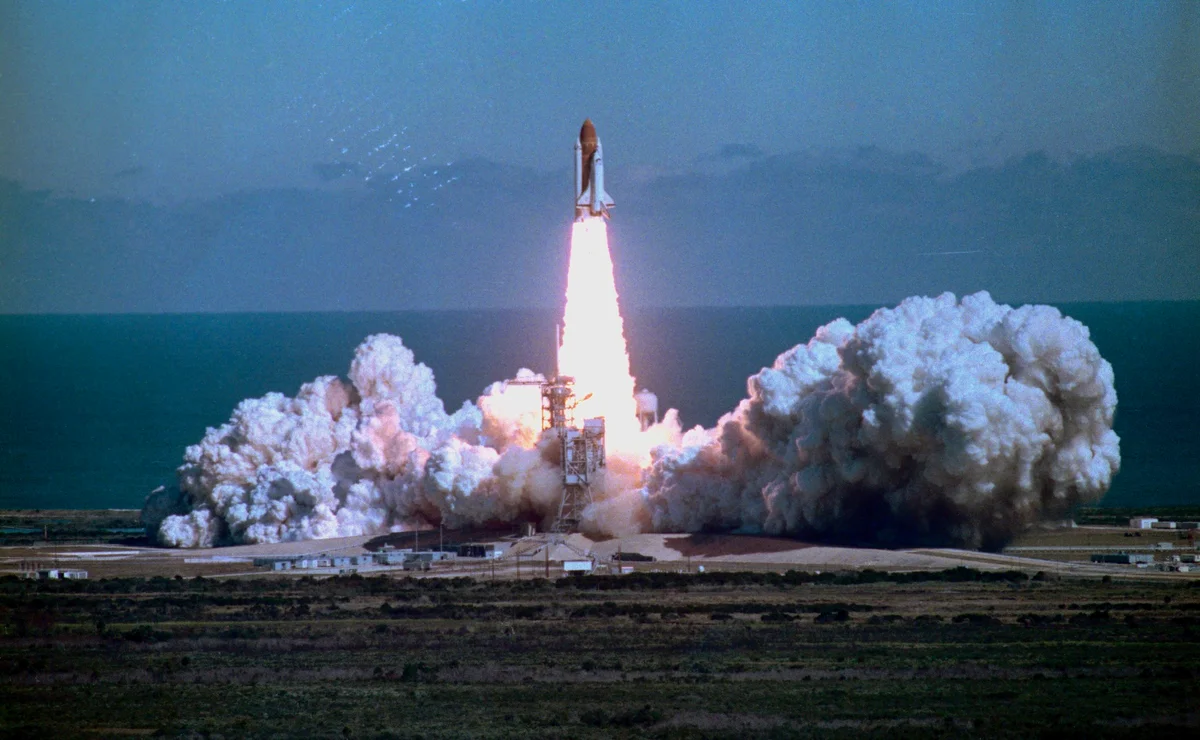
Editor’s note: This article was written ahead of Artemis II’s launch. The mission has since flown: it lifted off on April 1, 2026, carried its four astronauts around the Moon to a record distance of 252,756 miles from Earth, and splashed down safely in the Pacific on April 10, 2026.
Forty years ago, NASA’s human spaceflight program was struck by disaster when the space shuttle Challenger broke apart 73 seconds after launch, killing all seven people aboard and very nearly ending the shuttle program outright. Decades later, the mistakes behind Challenger — and the similar loss of the shuttle Columbia in 2003 — loomed especially large as NASA prepared to launch four astronauts on the ambitious Artemis II mission around the Moon: the first crewed flight of the giant Space Launch System (SLS) rocket and Orion capsule, and the first time humans would leave Earth orbit since the last Apollo mission in 1972.
NASA had already faced public scrutiny over its handling of unexpected behavior by Orion’s heat shield — the device critical to protecting astronauts during their return to Earth — observed on the capsule’s uncrewed test flight in 2022. The agency maintained that the changes made in the wake of Challenger and its other disasters were sufficient to keep the Artemis crew safe. Tracy Dillinger, safety culture program manager in NASA’s Office of Safety and Mission Assurance, described Challenger as having brought to light aspects of the agency that needed continuous work — noting that space is inherently risky, astronauts know it, and the goal is to be smart about the risks accepted. Ahead of the flight, the Orion heat shield was widely considered the greatest risk to the crew; NASA said changes to the Artemis II flight path addressed the concern.
From routine to disaster
The 1986 Challenger disaster occurred on STS-51L, the 25th flight of a shuttle program approaching its fifth anniversary. The planned week-long mission had an eclectic agenda — observing Halley’s Comet and deploying a communications satellite and an astronomical instrument — but was most notable for crew member Christa McAuliffe, a middle and high school teacher selected through a nationwide “Teacher in Space” competition. She planned to teach two lessons from orbit, and her inclusion was part of NASA’s broader effort to portray shuttle flight as normal, low-risk activity open to non-astronauts.
“It’s kind of an all-purpose carry-all vehicle that the astronauts themselves often referred to as a space truck,” says Jennifer Levasseur, space historian and curator at the Smithsonian’s National Air and Space Museum — a vehicle meant to be so routine and so safe that astronauts didn’t even need to wear pressure suits.
On that cold January morning, roughly 2.5 million students tuned in to watch the launch — and watched the disaster unfold on live television. The O-rings joining sections of one of the shuttle’s solid rocket boosters failed in launch conditions far colder than they were designed for. Just over a minute after ignition, a ruptured booster ignited the shuttle’s massive external fuel tank, tearing the vehicle apart over the ocean and killing all seven astronauts.
Engineering a safety culture
As the world watched, NASA worked to understand what had gone wrong while confronting a deeper question: was human spaceflight worth the risk of catastrophic loss? The agency rejected calls to end the shuttle program but halted flights for nearly three years. The Rogers Commission’s report — more than 200 pages, not counting its appendices — reconstructed the failure in detail, highlighting not only the O-rings’ thermal limits but the shuttle’s inherent design constraints and the sociopolitical pressures that pushed the launch forward.
“It was very clear on several missions before STS-51L that there was a problem with the solid rocket booster sections and the way they were joined together,” Levasseur says. Concerns had been raised before any shuttle flew, and on launch morning an engineer warned about O-ring behavior in wintry weather — yet program managers proceeded. “Despite all this information, NASA kept moving forward,” Levasseur says. “Its management said, ‘We have a schedule.'” That “go fever,” along with repeatedly waived O-ring discrepancies, emerged as Challenger’s real cause: the cold made the O-rings fail, but NASA’s culture was as flawed as any piece of hardware.
Smaller versions of the Challenger investigation continue at NASA today, says Sandra Magnus, a professor of the practice at Georgia Tech, former astronaut, and former member of NASA’s Aerospace Safety Advisory Panel: whenever an accident occurs, major or minor, the agency has a process to understand what happened and why.
NASA’s Artemis II The rocket rolled onto the launch pad on January 17, 2026, in anticipation of launch the following month.
Artemis ambitions
Artemis II sent NASA’s Reid Wiseman, Victor Glover, and Christina Koch, with the Canadian Space Agency’s Jeremy Hansen, on the first crewed flight beyond Earth orbit in more than five decades — and, as it turned out, to the farthest distance from Earth any humans have traveled. The pre-flight worry centered on the journey home: re-entry through Earth’s dense atmosphere inside a prolonged, friction-generated fireball.
Orion’s heat shield combines lessons from the Apollo and shuttle programs, Levasseur notes. But during inspection of the capsule flown on the uncrewed Artemis I mission in 2022, NASA found that large sections of the heat shield had unexpectedly charred and broken away. Engineers investigated for years and concluded that adjusting Orion’s return trajectory — a steeper, faster descent rather than a shallow, prolonged one — would avoid the problem. That is not the same as redesigning the heat shield, and the agency chose not to flight-test the new re-entry profile before committing the Artemis II crew to it, judging a redesign too slow and a new test too costly.

The Artemis I mission’s Orion heat shield seen after its 2022 unmanned test flight.
An outside observer could reasonably ask whether that choice echoed the schedule pressures that broke procedural norms before. Artemis is a massive program — NASA estimated in 2024 that costs from October 2011 would reach $93 billion by October 2025 — and pressure to keep it moving is real, says Jordan Bimm, a space historian at the University of Chicago. “NASA has never come to a moment like this before,” Bimm says: the agency is negotiating multibillion-dollar contracts with commercial giants like SpaceX and Blue Origin while competing with the crewed ambitions of China and India.
Experts pointed to encouraging signs from Artemis I, which endured repeated delays — including rolling the giant rocket off the pad to shelter it from a storm — as evidence that today’s NASA will make hard choices to protect people. Many of the agency’s current leaders were children when Challenger broke apart or watched the Columbia tragedy unfold later. Those memories persist, Levasseur suggests — and they will not want to repeat the mistakes made before. In the end, Artemis II’s safe return on April 10, 2026 vindicated the agency’s judgment on this flight — though the heat-shield decision will remain a case study in how NASA weighs schedule against risk.
Notes on this article
- This piece reflects reporting published around the 40th anniversary of the Challenger disaster (January 28, 2026), before Artemis II flew; the mission subsequently launched April 1, 2026 and returned safely on April 10, 2026 — details in NASA’s mission recap.
- Expert remarks are paraphrased from the original reporting.
- Earlier Artemis II preparations were covered on this site in this news roundup.
