
How can a single vision-language-action model control many different dual-armed robots in the real world? LingBot-VLA, a foundation model from Robbyant — the embodied-AI unit within Ant Group — targets exactly that problem: practical robot manipulation outside the lab. The model was trained on approximately 20,000 hours of teleoperated bimanual data collected from 9 dual-armed robot embodiments and evaluated extensively on the GM-100 benchmark across 3 hardware platforms. In plain terms, it is an attempt at a “universal brain” for two-handed robots: one policy that can look at camera views, read an instruction, and move whichever robot body it is deployed on.

A large bimanual dataset across 9 robot embodiments
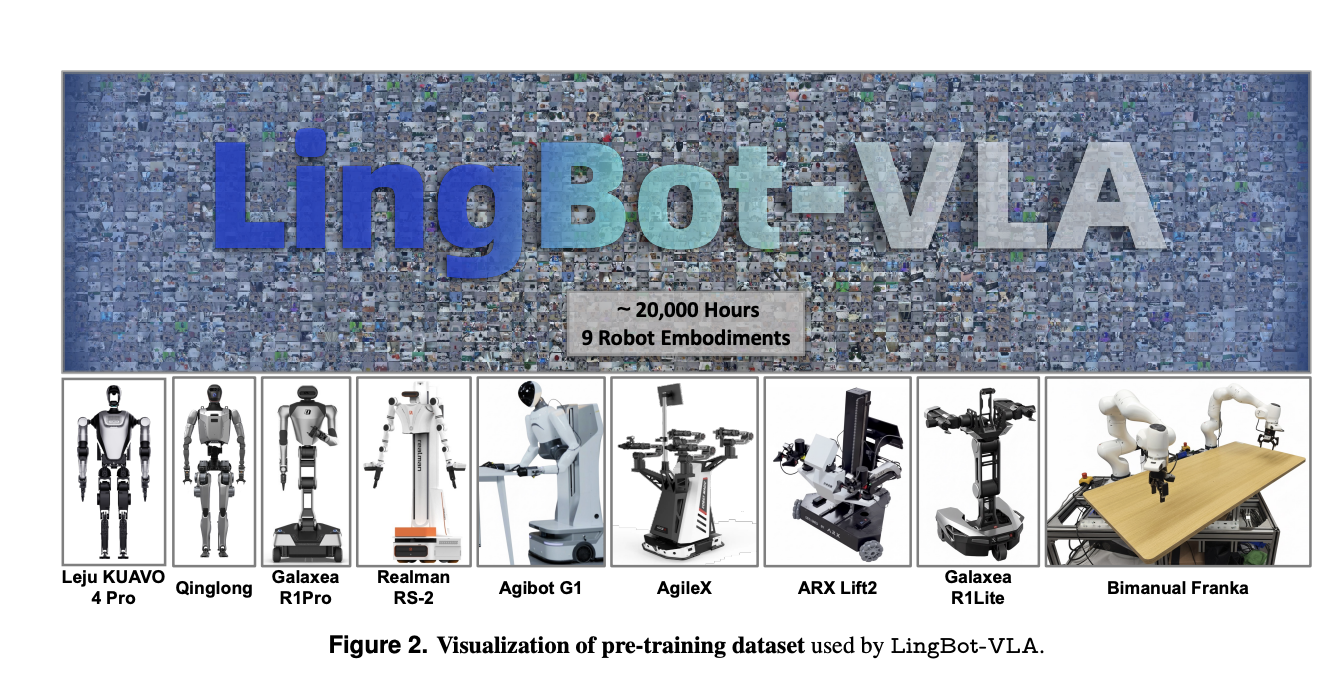
The pre-training dataset comes from real-world teleoperation on 9 widely used dual-arm configurations: AgiBot G1, AgileX, Galaxea R1Lite, Galaxea R1Pro, Realman RS 02, Leju KUAVO 4 Pro, the Qinglong humanoid, ARX Lift2, and a bimanual Franka setup. All systems feature dual 6- or 7-degree-of-freedom arms with parallel grippers and multiple RGB-D cameras for multi-view observation. Teleoperation uses VR controllers for the AgiBot G1 and isomorphic arm controllers for the AgileX.
For each scene, recorded videos are segmented by human annotators into clips corresponding to atomic actions, with idle frames at clip boundaries removed to reduce redundancy. Task-level and sub-task-level language instructions are then generated with Qwen3-VL-235B-A22B, producing synchronized sequences of images, instructions, and action trajectories for pre-training. To characterize verb diversity, the research team visualizes the most frequent atomic verbs in training and test sets: about 50 percent of the core verbs in the test set do not appear among the 100 most frequent training verbs, which pushes the evaluation toward cross-task generalization rather than frequency-based memorization.
Architecture: mixture of transformers and flow-matching actions
LingBot-VLA combines a strong multimodal backbone with an action expert through a Mixture-of-Transformers architecture. The vision-language backbone is Qwen2.5-VL, which encodes multi-view images and natural-language instructions into sequences of multimodal tokens. In parallel, the action expert receives the robot’s proprioceptive state and previous actions. The two branches share a self-attention module that performs layer-wise joint sequence modeling over observation and action tokens.
At each time step, the model builds an observation sequence connecting tokens from three camera views, the task instruction, and the robot state. The action sequence covers a chunk of future actions with a temporal horizon of 50 during pre-training. The training objective is conditional flow matching: the model learns a vector field that transports Gaussian noise along a linear probability path to the ground-truth action trajectory, yielding a continuous action representation and smooth, temporally coherent control suited to precise bimanual manipulation. Blockwise causal attention is applied over the joint sequence — observation tokens attend to each other bidirectionally, while action tokens attend to all observation tokens and only previous action tokens — preventing information leakage from future actions while letting the action expert exploit the full multimodal context at each decision step.
Spatial perception via LingBot-Depth distillation
Many VLA models struggle with depth reasoning when depth sensors fail or return sparse measurements. LingBot-VLA addresses this by integrating LingBot-Depth, a separate spatial-perception model based on masked depth modeling. Trained self-supervised on a large RGB-D corpus, LingBot-Depth learns to reconstruct dense metric depth even where physical sensors typically fail. Scene queries from each camera view are aligned with LingBot-Depth tokens through a projection layer and a distillation loss: cross-attention maps VLM queries into a depth latent space and minimizes their difference from LingBot-Depth features. This injects geometry-aware information into the policy and improves performance on tasks demanding precise 3D spatial reasoning — insertion, stacking, and folding under displacement and occlusion.
GM-100: real-world benchmarking on 3 platforms
The main evaluation uses GM-100, a real-world benchmark with 100 manipulation tasks and 130 filtered teleoperated trajectories per task on each of 3 hardware platforms. LingBot-VLA is compared with π0.5, GR00T N1.6, and WALL-OSS under a shared post-training protocol: all methods start from public checkpoints and use the same dataset, batch size 256, and 20 epochs. Success rate measures completion of all subtasks within 3 minutes; a progress score tracks partial completion.
On GM-100, LingBot-VLA with depth achieves the reported state-of-the-art average across the 3 platforms: 17.30 percent average success rate and 35.41 percent average progress score, versus 13.02 / 27.65 for π0.5, 7.59 / 15.99 for GR00T N1.6, and 4.05 / 10.35 for WALL-OSS. Even without the depth module, LingBot-VLA outperforms GR00T N1.6 and WALL-OSS, and depth integration adds further gains. In the RoboTwin 2.0 simulation across 50 tasks — trained on 50 demonstrations per task in clean scenes and 500 in randomized scenes — LingBot-VLA with depth reaches 88.56 percent average success in clean scenes and 86.68 percent in randomized scenes, against 82.74 and 76.76 percent for π0.5, with the advantage most consistent under strong domain randomization.

Scaling behavior and post-training data efficiency
The team analyzes scaling by varying pre-training data from 3,000 to 20,000 hours on a 25-task subset. Both success rates and progress scores increase monotonically with data volume, with no saturation at the largest scale studied — presented as early empirical evidence that VLA models retain favorable scaling on real robot data at this size. A data-efficiency study on AgiBot G1 across 8 representative GM-100 tasks shows LingBot-VLA surpassing π0.5 (which used the full 130 trajectories per task) with only 80 demonstrations per task, with the gap widening as more trajectories are added — meaning a new robot or task can often be adapted with dozens to about a hundred task-specific trajectories, directly reducing adaptation cost.
Training throughput and open-source toolkit
LingBot-VLA ships with an optimized training stack for multi-node efficiency, using FSDP-style sharding for parameters and optimizer state, hybrid sharding for the action expert, mixed precision with float32 reductions and bfloat16 storage, and operator-level acceleration with fused attention kernels and torch.compile. On an 8-GPU setup, the team reports throughput of 261 samples per second per GPU for Qwen2.5-VL-3B and PaliGemma-3B-PT-224 configurations — a 1.5x to 2.8x speedup over VLA-oriented codebases such as StarVLA, Dexbotic, and OpenPI on the same LIBERO-based benchmarks — with near-linear scaling from 8 to 256 GPUs. The full post-training toolkit has been released as open source.
Limitations and what to watch
- Benchmark figures are self-reported by the research team; a 17.30 percent success rate on GM-100 also illustrates how hard real-world bimanual manipulation remains — these systems are far from reliable deployment on arbitrary tasks.
- Comparisons depend on a shared post-training protocol chosen by the authors; different fine-tuning budgets could shift relative standings.
- Simulation results (RoboTwin 2.0) transfer imperfectly to physical robots, and cross-morphology generalization has been demonstrated on the 9 training embodiments plus adapted platforms, not universally.
- The VLA field is moving quickly, with frequent releases from Physical Intelligence, NVIDIA, and others; standings may change rapidly.
Key takeaways
LingBot-VLA is a Qwen2.5-VL-based vision-language-action foundation model trained on roughly 20,000 hours of real-world dual-arm teleoperation across 9 robot embodiments, with depth-feature distillation for 3D spatial understanding and reported state-of-the-art results on GM-100 against π0.5, GR00T N1.6, and WALL-OSS. Technical details are in the research paper and on the official project page. The release complements Robbyant’s related work on interactive world models, covered in this overview of LingBot-World.
