
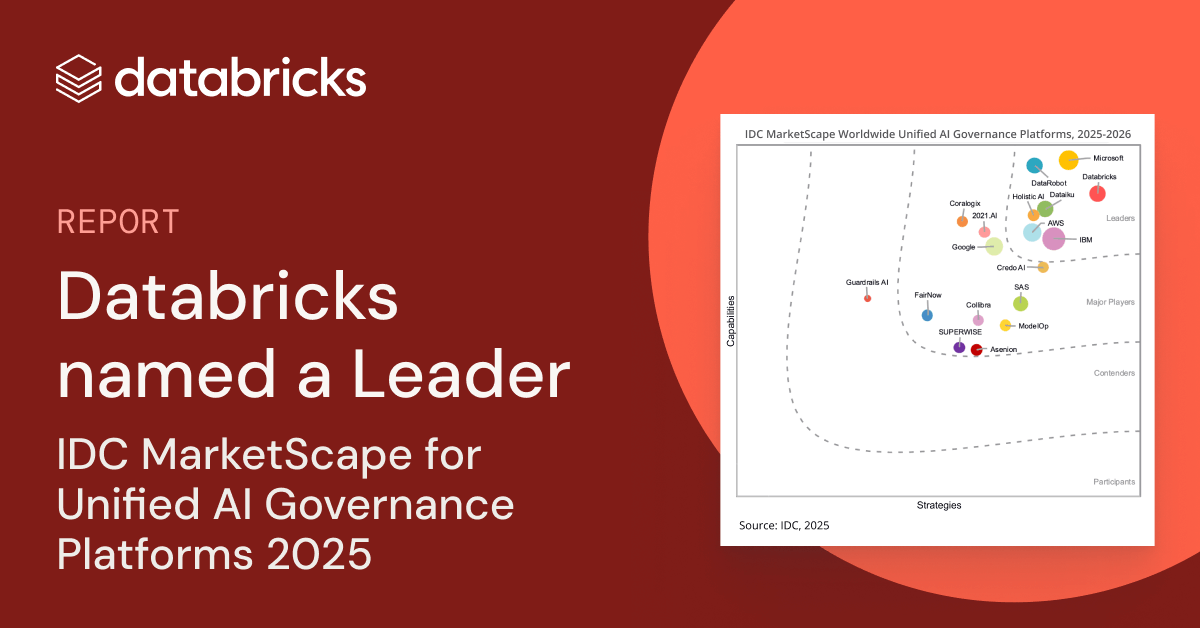
Databricks has been named a Leader in the IDC MarketScape: Worldwide Unified AI Governance Platforms 2025–2026 Vendor Assessment, a study that evaluated 20 vendors in the fast-growing market for platforms that govern traditional machine learning, generative AI, and agentic AI. According to the company, Databricks also received the highest strategy score of any vendor assessed. This article looks at what the recognition covers, why unified AI governance has become a board-level topic, and how to read analyst placements like this one.
The IDC MarketScape vendor analysis model provides an overview of the competitive fitness of technology suppliers in a given market, using a rigorous scoring methodology with both qualitative and quantitative criteria. The capability score measures product, go-to-market, and business performance in the short term; the strategy score measures alignment of vendor strategies with customer requirements over a three-to-five-year horizon.
Why Integrated AI Governance Matters Now
AI governance used to mean overseeing a handful of predictive models. As organizations move from isolated models to AI systems spanning data, models, applications, and increasingly autonomous agents, governance can no longer be manual, fragmented, or bolted on after deployment. Teams now grapple with risks that barely existed a few years ago — bias, hallucinations, data leakage, and autonomous agentic behavior — across multiple jurisdictions and regulatory regimes at once.
IDC defines the category it assessed as an integrated suite of tools, frameworks, and processes for overseeing the entire lifecycle of AI models — traditional machine learning, generative AI, and agentic AI — while ensuring compliance with legal, ethical, and organizational standards. Industry research, including Databricks’ own State of AI Agents reporting, suggests organizations that practice active AI governance put substantially more AI projects into production than those that treat it as an afterthought — governance, in this framing, is what makes scale possible.
The Databricks Approach: Unity Catalog as System of Record
The foundation of Databricks’ governance story is Unity Catalog, which manages data, models, notebooks, features, dashboards, and agents within one consistent framework. As a centralized system of record it provides fine-grained, attribute-based access control; automated end-to-end lineage across data and AI assets; integrated auditing and monitoring; and open APIs compatible with industry-standard formats such as Delta Lake and Apache Iceberg. The practical claim is consistency: the same governance applies across clouds, teams, and use cases without migrating data into a proprietary silo.
Strategic acquisitions — MosaicML, Tabular, Arcion, and Neon (now part of Lakebase) — extend that foundation by integrating operational and analytical data, a requirement for low-latency AI applications. The architectural intent is governance by design: controls embedded directly in data pipelines, ML workflows, and AI applications rather than enforced retroactively.
Governing Generative and Agentic AI at Scale
Beyond predictive models, Databricks extends governance to AI applications and agents through Agent Bricks and its AI gateway. Teams can develop and evaluate multi-agent systems, benchmark quality through built-in agent evaluation, and apply centralized guardrails that govern frontier models hosted inside or outside Databricks — controlling prompts, responses, and model interactions consistently across applications. That agent-level governance is the same machinery behind the company’s recently released orchestration layer, covered in this related piece on the Agent Bricks Supervisor Agent.
Governance as an Enabler, Not a Hindrance
A theme of the IDC assessment is that vendors positioning governance as a strategic enabler — rather than a compliance checkbox — are the ones aligned with where the market is going. Automating evidence collection, policy enforcement, and monitoring shortens compliance cycles and reduces risk, letting organizations adopt AI faster precisely because controls are built in. With regulations accelerating (the EU AI Act chief among them) and AI systems becoming more autonomous, fragmented tools and manual controls are becoming untenable.
What Unified Governance Looks Like in Practice
Stripped of category language, an integrated governance platform should answer five questions about any AI system, on demand: What data trained or grounded it, and who approved that data? Who can invoke it, and with which permissions? What did it actually do — every prompt, response, and tool call — and can that trail survive an audit? How is its quality measured, and what happens when it degrades? And when a regulation or policy changes, how quickly can the change be enforced everywhere at once? Databricks’ answer routes all five through Unity Catalog’s single system of record. Competing approaches assemble the same answers from specialized tools — catalogs, ML observability, AI gateways — which preserves flexibility at the cost of integration work. Neither approach is free; the assessment’s significance is that analysts now treat the integrated version as a market category of its own.
Limitations and What to Watch
Analyst placements deserve informed reading. A MarketScape reflects IDC’s methodology and time window, and this article draws on Databricks’ own announcement of the result; other vendors — including competitors such as Dataiku — were also named Leaders in the same assessment, which the celebratory framing of any single vendor’s blog post tends to omit. Vendor-reported statistics about governance outcomes should be treated as directional rather than precise. For buyers, the practical use of such a report is the evaluation criteria, not the medal table: organizations deeply invested in a single data platform will realize the most value from that platform’s native governance, while multi-platform environments should test how far “unified” governance actually reaches across their estate. Worth watching in 2026: how quickly agent-specific governance features mature from announcements into audited production practice, and whether open standards emerge for governing agents that span multiple vendors’ platforms.
