Earth observation (EO) constellations capture large amounts of high-resolution imagery every day, but much of it does not reach the ground in time for model training. Downlink bandwidth is the main bottleneck. Images can remain in orbit for several days while ground models are trained on partial and delayed data.
Researchers at Microsoft introduced the ‘OrbitalBrain’ framework as a different approach. Instead of using satellites simply as sensors that relay data to Earth, it turns a nanosatellite constellation into a distributed training system. Models are trained, collected, and updated directly in space using onboard compute, inter-satellite links, and predictive scheduling of power and bandwidth.
bentpipe bottleneck
Most business groups use the bentpipe model. Satellites collect images, store them locally, and dump them to ground stations whenever they pass overhead.
The research team evaluates a planet-like constellation with 207 satellites and 12 ground stations. At maximum imaging rate, the system captures 363,563 images per day. With 300 MB per image and realistic downlink constraints, only 42,384 images could be transmitted in that period, about 11.7% of those captured. Even if images are compressed to 100 MB, only 111,737 images, about 30.7%, reach the ground within 24 hours.
Limited onboard storage adds another hurdle. Old images must be discarded to make room for new images, meaning that many potentially useful samples are never available for ground-based training.
Why is traditional federated learning not enough?
Federated learning (FL) appears to be a clear fit for satellites. Each satellite can train locally and send model updates to ground servers for aggregation. The research team evaluates several FL baselines optimized for this setting:
- AsyncFL
- SyncFL
- fedbuff
- fedspace
However, these methods provide more stable communications and more flexible power than satellites. When the research team simulates satellites with realistic orbital dynamics, intermittent ground contact, limited power, and non-IID data, these baselines show unstable convergence and large accuracy degradation in the range of 10%-40% compared to ideal conditions.
The time-to-accuracy curve flattens and oscillates, especially when satellites are separated from ground stations for long periods. Many local updates are out of date before they can be collected.
OrbitalBrain: planetarium-focused training in space
OrbitalBrain starts from 3 observations:
- Constellations are usually operated by the same commercial entity, so raw data can be shared across satellites.
- Orbits, ground station visibility, and solar power can be predicted from orbital elements and power models.
- Inter-satellite links (ISLs) and onboard accelerators are now practical on nano-satellites.
The framework exposes 3 actions for each satellite in the scheduling window:
- Local Calculation (LC): Train local models on stored images.
- Model Aggregation (MA): Exchange and aggregation of model parameters over ISL.
- Data Transfer (DT): Exchange raw images between satellites to reduce data inconsistency.
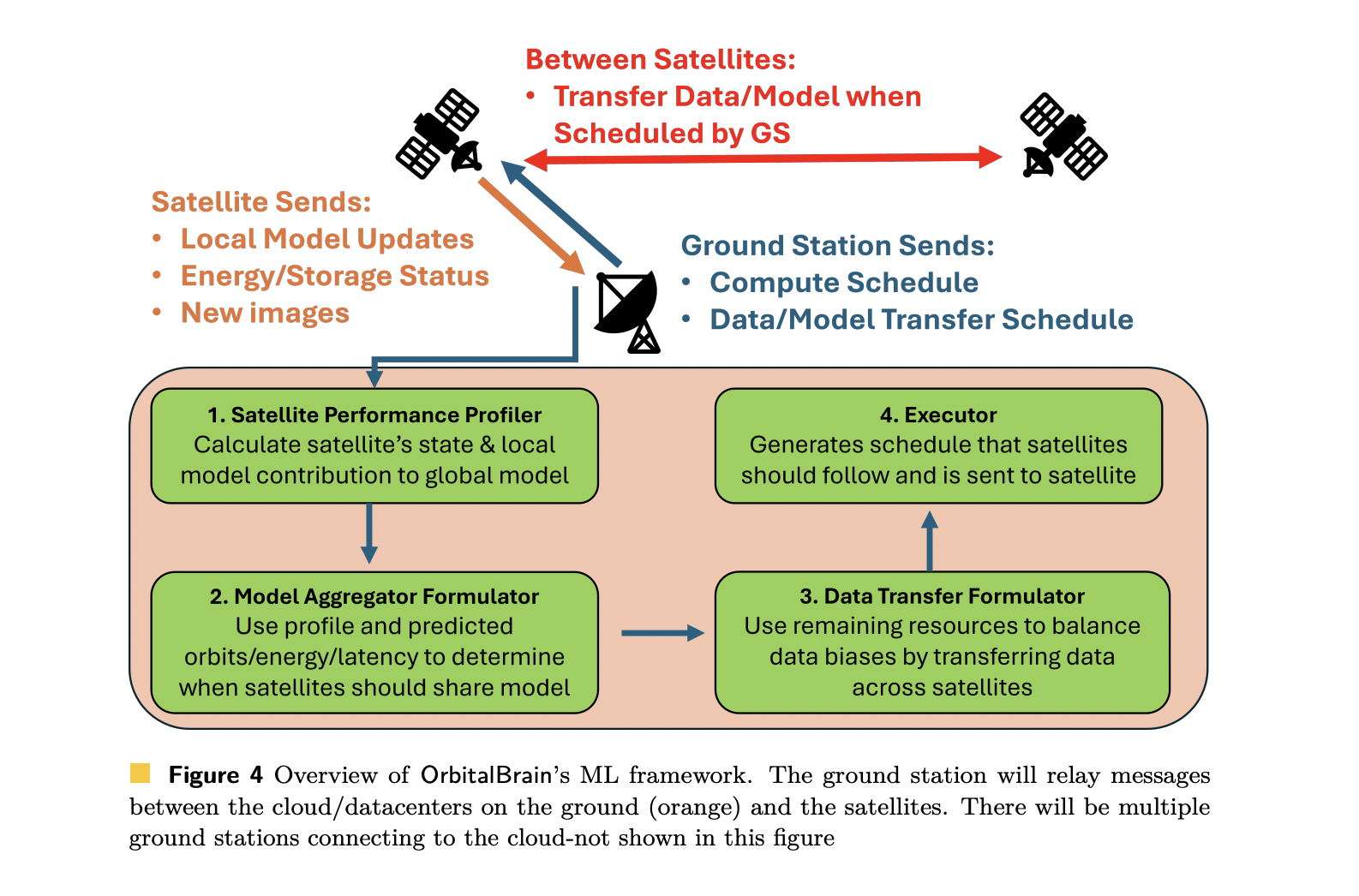
A controller running in the cloud, accessible through ground stations, computes a forecast schedule for each satellite. The schedule decides which actions to prioritize in each future window based on forecasts of energy, storage, orbital visibility, and link opportunities.
Main components: Profiler, MA, DT, Executor
- Guided Performance Profiler
- Model aggregation on ISL
- Data Transferr for Label Rebalancing
- Executor
experimental setup
OrbitalBrain is implemented in Python on top of the CosmicBeats Orbital Simulator and the Flute Federated Learning Framework. The onboard compute is modeled as an NVIDIA-Jetson-Orin-Nano-4GB GPU, with power and communications parameters calibrated from public satellite and radio specifications.
The research team simulated 24-hour tracks for 2 real constellations:
- Planet: 207 satellites with 12 ground stations.
- Peak: 117 satellites.
They evaluate 2 EO classification tasks:
- fMoW:Approximately 360k RGB images, 62 classes, trainable with DenseNet-161 last 5 layers.
- So2Sat:ResNet-50 with about 400k multispectral images, 17 classes, trainable last 5 layers.
Result: Faster time-to-accuracy and higher accuracy
OrbitalBrain is compared to BentPipe, AsyncFL, SyncFL, FedBuff, and FedSpace under full physical constraints.
For fMoW, after 24 hours:
- Planet: OrbitalBrain reaches 52.8% top-1 accuracy.
- Peak: OrbitalBrain reaches 59.2% top-1 accuracy.
For So2Sat:
- Planet: 47.9% top-1 accuracy.
- Peak: 47.1% top-1 accuracy.
Depending on the dataset and constellation, these results are 5.5%–49.5% better than the best baseline.
In terms of time-accuracy, OrbitalBrain achieved 1.52×–12.4× speedup Compared to state-of-the-art ground-based or federated learning approaches. This comes from using satellites that cannot currently reach a ground station by aggregating on the ISL and rebalancing the data delivery through the DT.
Ablation studies show that disabling MA or DT significantly degrades both convergence speed and final accuracy. Additional experiments indicate that OrbitalBrain remains robust when cloud cover conceals part of the imagery, when only a subset of satellites participate, and when image size and resolution vary.
Implications for satellite AI workloads
OrbitalBrain shows that model training can go to space and satellite constellations can act as distributed ML systems, not just data sources. By coordinating local training, model aggregation, and data transfer under tight bandwidth, power, and storage constraints, the framework enables new models for tasks such as wildfire detection, flood monitoring, and climate analysis, without having to wait days for data to reach terrestrial data centers.
key takeaways
- Bentpipe downlink is the main bottleneck: The planet-like EO constellation can only downlink 11.7% of the 300 MB images captured per day, and about 30.7% even with 100 MB compression, which severely limits ground-based model training.
- Standard federated learning fails under real satellite constraints: When realistic orbital dynamics, intermittent links, power limitations, and non-IID data are applied, the accuracy of AsyncFL, SyncFL, FedBuff, and FedSpace drops by 10%-40%, leading to unstable convergence.
- OrbitalBrain co-schedules computation, aggregation, and data transfer to orbit: A cloud controller uses predictions of orbit, power, storage, and link opportunities to select local computation, model aggregation via ISL, or data transfer per satellite, thereby maximizing the utility function per action.
- Label rebalancing and model stability are handled explicitly: A guided profiler tracks model stability and loss to define computation utility, while the data transferer uses Jensen–Shannon divergence on labeled histograms to drive raw-image exchanges that minimize non-IID effects.
- OrbitalBrain delivers high accuracy and up to 12.4× faster time-to-accuracy: In simulations on the Planet and Spire constellations with fMoW and So2Sat, OrbitalBrain improves final accuracy by 5.5%–49.5% over Bentpipe and FL baselines and achieves a 1.52×–12.4× speedup in time-to-accuracy.
check it out paper. Also, feel free to follow us Twitter And don’t forget to join us 100k+ ml subreddit and subscribe our newsletter. wait! Are you on Telegram? Now you can also connect with us on Telegram.