
AI agents are not magic. They are not autonomous co-workers ready to run client accounts unattended, and they are certainly not systems to switch on and forget. But they can be remarkably useful. Teams that understand exactly what agents are — and what they can do under appropriate oversight — can put them to work in ways that improve efficiency and client outcomes. What cannot be skipped are the basics: clear processes, realistic expectations, and a willingness to iterate.
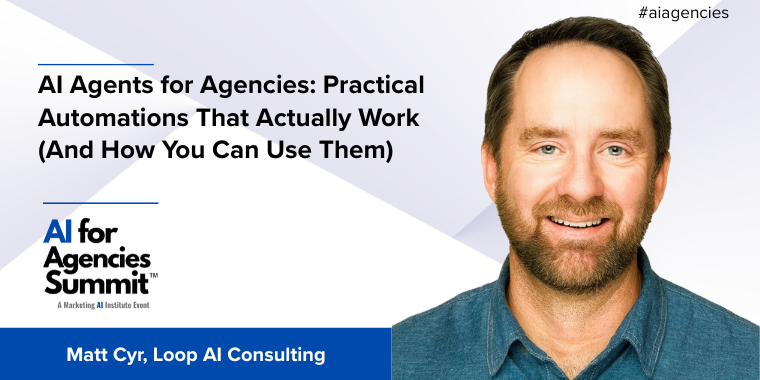
That was the premise of “AI Agents for Agencies: Practical Automations That Actually Work (And What It Takes to Get There),” a session presented by AI consultant Matt Cyr at the AI for Agencies Summit, a free virtual event presented by Screendragon on February 12, 2026, with recordings now available on demand.
Why the topic matters to agencies
The conversation around AI agents has become noisy. Vendors promise autonomous systems that run themselves, and social feeds are full of demos that make it all look easy. When agencies try to implement agents in the real world, however, most hit the same walls: unclear processes, messy data, and expectations that do not match reality.
The session’s framing cut through that noise with a simple definition — agents are AI plus automation plus process design, no magic involved. On that foundation, the session walked through two practical, agency-relevant examples attendees could adapt immediately, along with first steps toward building their own.
What the session covered
- What AI agents actually are, and how they differ from other AI tools
- Why most agent projects fail, and how to avoid the common pitfalls
- Two practical, agency-relevant agent examples ready to adapt
- First steps for designing and building an agent
- How to use agents to streamline work, improve continuity, and free teams for strategy and client relationships
The recurring theme: successful agent adoption is less about picking a platform and more about process discipline. An agent automating a poorly defined workflow simply produces errors faster. That failure pattern — and how governance prevents it — is examined in more depth in this analysis of why AI agent projects stall, and teams weighing continuous automation can compare notes with this look at always-on AI agents for small teams.
Practical takeaways for agencies starting with agents
- Map the process before automating it. If a workflow cannot be described step by step on paper, an agent cannot execute it reliably.
- Start where errors are cheap. Internal reporting, research summaries, and meeting follow-ups tolerate mistakes better than client-facing deliverables.
- Keep a human in the loop at decision points. Oversight is not a temporary crutch; for most agency work it is a permanent design feature that protects brand and client trust.
- Expect iteration. First versions underperform; teams that treat early failures as tuning data rather than verdicts are the ones that end up with working automations.
About the presenter
Matt Cyr is the founder of Loop, an AI consulting firm that helps marketing agencies and healthcare organizations adopt AI in practical, human-centered ways. With nearly 30 years of experience on both the client and agency sides, he specializes in translating fast-advancing AI capabilities into clear strategy, scalable workflows, and business impact. He has led AI evaluations, pilot programs, and platform initiatives for agencies and health systems, previously led digital teams at organizations including Boston Children’s Hospital and Northeastern University, and speaks and writes regularly on responsible AI adoption and keeping humans in the loop.
About the AI for Agencies Summit
The AI for Agencies Summit, organized by the Marketing AI Institute and presented by Screendragon, brings together agency leaders and practitioners to explore how AI is reshaping agency models, services, and growth. The 2026 edition featured six agency leaders, and sessions are available on demand.
Limitations and what to watch
- The session reflects one practitioner’s experience with agency and healthcare clients; agent economics differ across agency types and client mixes.
- Agent tooling is evolving rapidly — specific platform capabilities described in early 2026 may have changed materially since.
- Conference sessions are inherently promotional in part; the frameworks are useful starting points, but results depend on each agency’s data quality and process maturity.
