
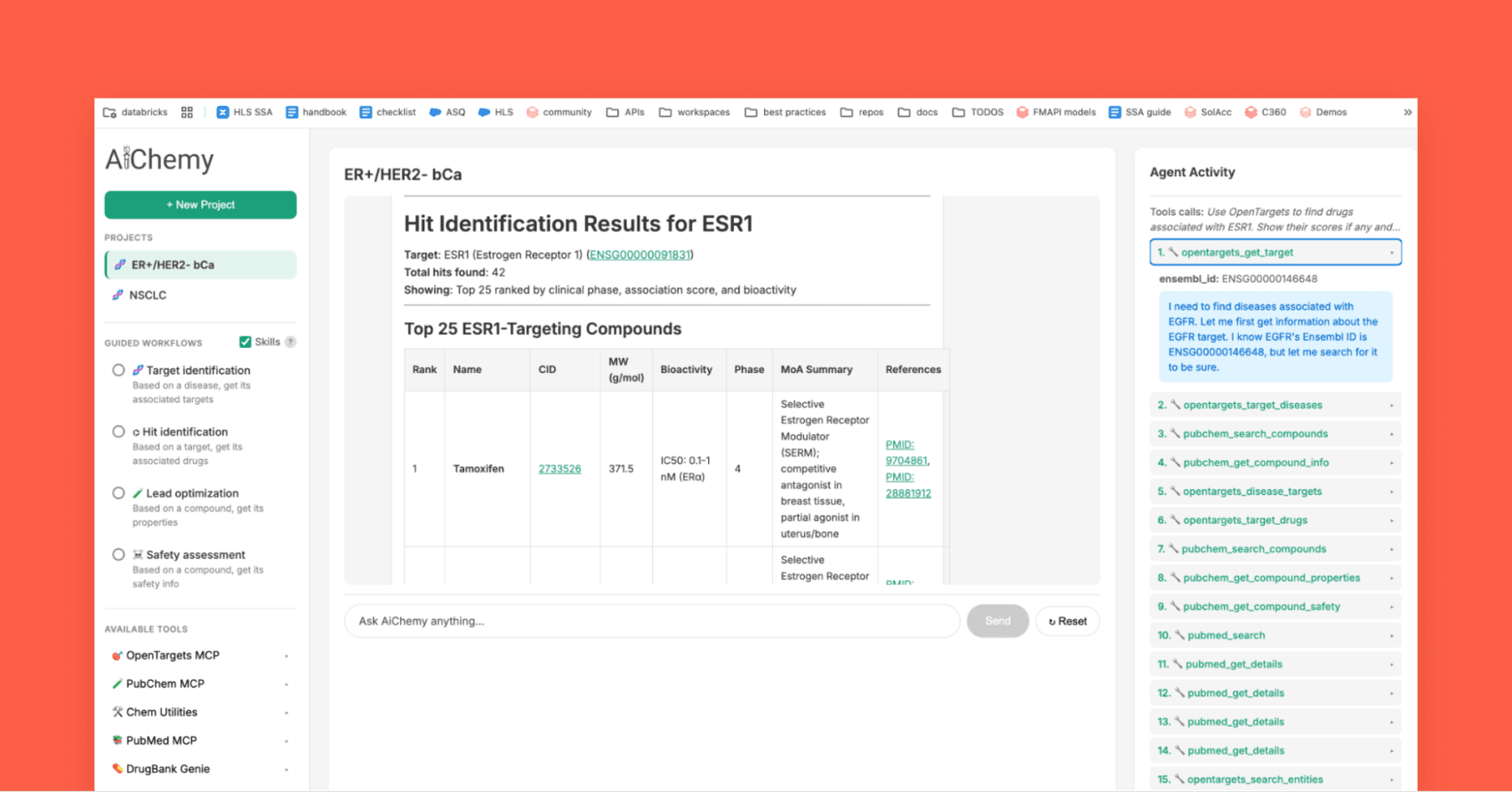
AiChemy is a reference architecture for a multi-agent AI system, outlined by Databricks in April 2026, that aims to accelerate drug-discovery research by combining an organisation’s internal data with external scientific databases. Rather than a single model answering questions in isolation, AiChemy coordinates several specialised agents that work like a cross-disciplinary team, sifting through large and disparate datasets to surface targets, candidate molecules and supporting evidence.
Multi-agent systems for interdisciplinary research
The design rests on the Model Context Protocol (MCP), an emerging standard for connecting diverse data sources and tools to AI agents through a common interface. AiChemy draws on public MCP servers such as OpenTargets, PubChem and PubMed and combines them with proprietary chemical libraries hosted on Databricks, so that public and private knowledge can be analysed together. A notable design choice is that the system grounds its findings in verifiable, traceable sources — an important property for research and regulated settings.
What AiChemy does
Two use cases illustrate the workflow. The first follows a disease → target → drug → literature-validation chain: starting from a disease subtype — for example, ER-positive, HER2-negative breast cancer, where the estrogen receptor (and its gene ESR1) is a key biomarker — the agents identify related therapeutic targets, search for candidate drugs against those targets, and then check the scientific literature for evidence supporting a given candidate. The second use case focuses on lead generation by chemical similarity: an internal library of molecules is searched using molecular-fingerprint embeddings to find structurally related compounds, drawing on large public collections such as ZINC15. (Specific molecule names used in the original demonstration are omitted here, as they could not be independently verified.)
Skills and guided tasks
AiChemy exposes a Guided Tasks panel that supplies prompts and agent “Skills” for each step of the discovery workflow. Skills are optional, loadable instruction sets that standardise how an agent produces task-specific outputs — for instance, reports formatted consistently for research, regulatory or business audiences. This modularity lets teams add capabilities without rebuilding the underlying agents.
Building a multi-agent supervisor
The architecture can be assembled in stages. Public MCP servers are connected securely through Unity Catalog connections, configured either in the Databricks UI or in a notebook. A structured drug-properties table (such as a DrugBank-derived dataset) is exposed as a Genie space to provide text-to-SQL access, while an unstructured chemical library is indexed for vector search to enable similarity lookups by embedding. From there, the agents can be combined under a supervisor in one of two ways: a no-code path using the Agent Bricks framework, which assembles a supervisory agent in a few minutes, or an advanced path implemented in a Databricks notebook for finer control over prototyping and iteration.
Evaluation, monitoring and observability
Because reliability matters in scientific work, the design emphasises evaluation and monitoring. Multi-agent invocations — whether triggered through a web UI or a REST API — are logged with MLflow traces that comply with OpenTelemetry standards. These traces capture the full execution graph, including reasoning steps, tool calls, retrieved documents, latency and token usage, which supports debugging, optimisation and auditability. Routing model calls through an AI gateway adds a further layer of governance over how the underlying language models are used.
Limitations and what to watch
A few caveats are worth noting. AiChemy is presented as a reference architecture and demonstration rather than a validated clinical tool; any target, candidate or literature finding it surfaces is a starting point for expert review, not a substitute for laboratory and clinical evaluation. The system’s usefulness depends heavily on the quality and licensing of the private libraries connected to it, and on the accuracy of the public MCP sources at query time. As an evolving framework tied to the Databricks platform, its exact capabilities and components are likely to change. Organisations evaluating it should validate outputs against trusted sources and involve domain scientists throughout. Further detail is available in the Databricks announcement.
