
SAN FRANCISCO – CesiumAstro announced on February 26 the acquisition of Vidrower, a startup that specializes in artificial intelligence for multimodal signal analysis.
Terms of the transaction, which closes in late 2025, were not disclosed.
According to the news release, CesiumAstro acquired Vidrover to accelerate its mission to embed AI in space telecommunications and intelligence, surveillance and reconnaissance infrastructure, radio-frequency optimization, autonomous payload and satellite operations, and enabling reconfigurable edge computing across product lines.
“Our systems must operate in an increasingly congested and competitive environment,” CesiumAstro Chief Revenue Officer Trey Pappas said in a statement. “By embedding AI directly into our telecom payloads, we enable adaptive RF optimization, autonomous work, and real-time decision making at the edge. This reduces latency, improves spectrum efficiency, and allows our customers to operate flexible, self-adapting space networks at scale.”
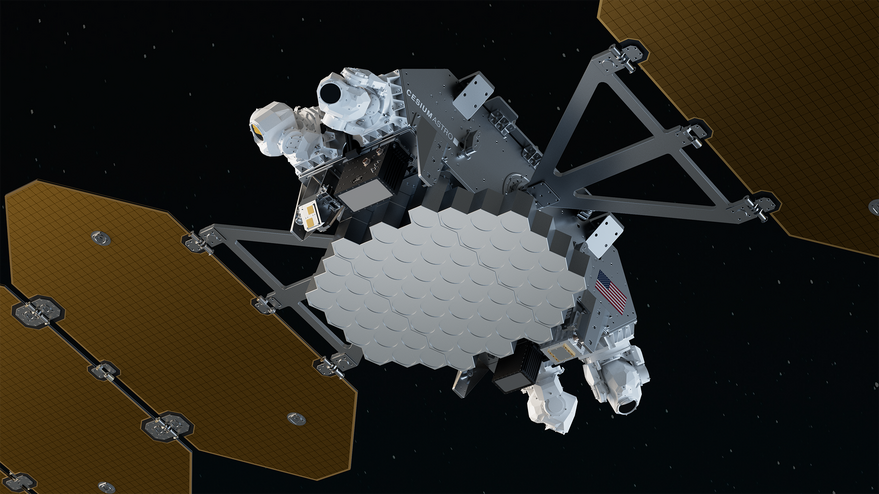
CesiumAstro, founded in 2017, creates software-defined phased-array communications systems for commercial and military space and airborne platforms. In 2024, CesiumAstro unveiled Element, a multi-beam active phased-array satellite.
CesiumAstro is growing rapidly, thanks to a $470 million funding round announced on February 2.
“We are positioning the company to be an industrial producer of this advanced technology,” said Shay Sabripour, Founder and CEO of CesiumAstro. space news In a recent interview.
The news release said the Vidrover acquisition “positions CesiumAstro to further advance its best-in-class digital processor and active phased-array technologies.”
Onboard or cloud processing
According to a CesiumAstro news release, the VidRover technology will “provide AI-enabled workload orchestration to allow satellites to determine which data should be processed in orbit and which data should be sent to ground-based cloud and enterprise systems”.
Vidrover was founded in 2016 by Joe Ellis and Daniel Morozoff-Abezgauz, PhD candidates at Columbia University’s Digital Media and Multimedia Lab. Following the acquisition, Ellis, now Chief Technology Officer of Vidrover, is overseeing the integration of machine-learning capabilities across CesiumAstro’s product portfolio, with a focus on next-generation, AI-native space systems.
“By embedding analytics and autonomy directly into the Element family of satellites and communications payloads, CesiumAstro is establishing a real-time planetary intelligence layer” to intelligently route essential data across an expanding network of space-based assets, Ellis said in a statement. “Our goal is to get machine learning inference as close to the data in orbit as possible, and most importantly to get the data as quickly as possible to where it needs to be processed on Earth.”
