
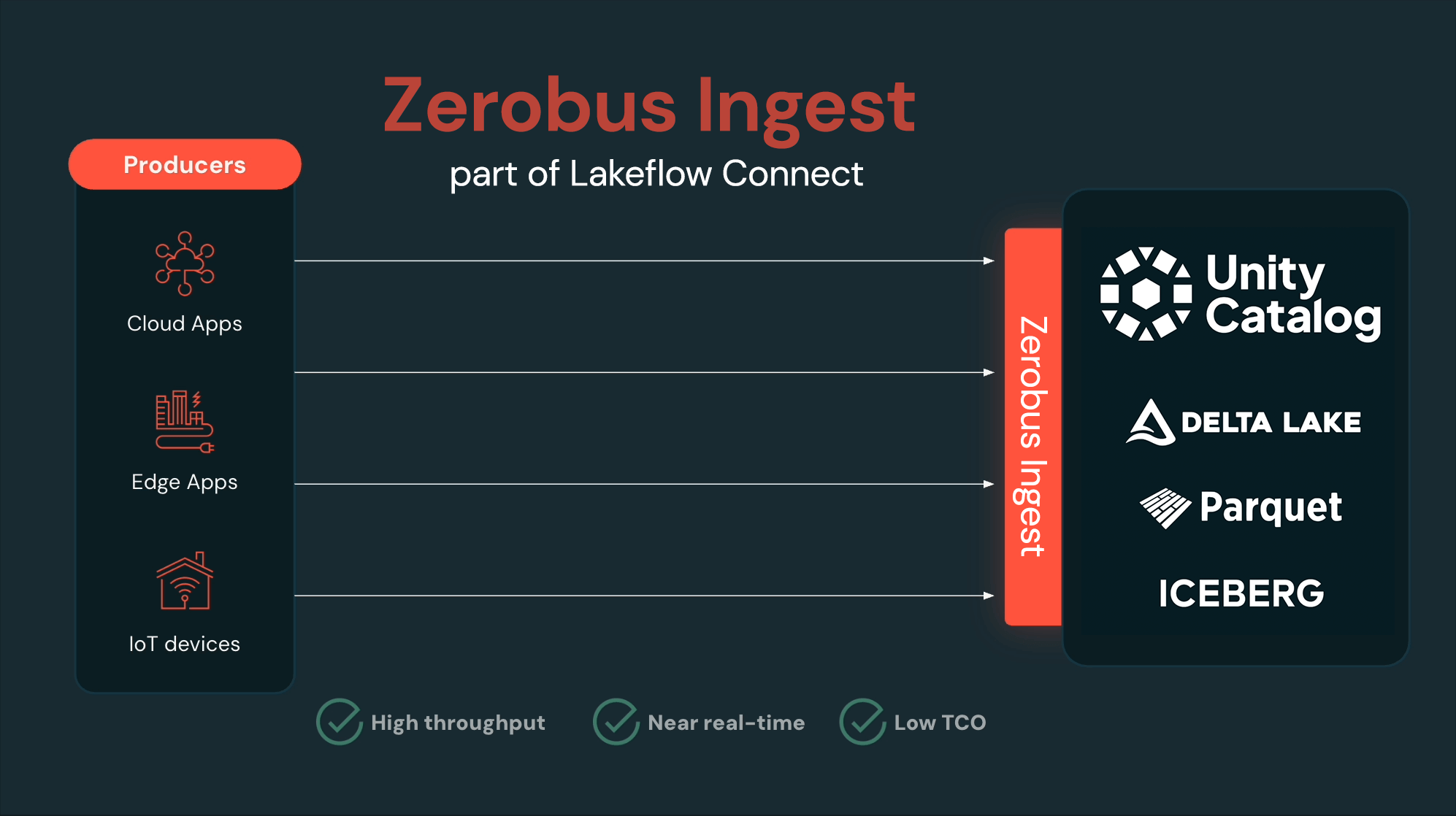
As organizations scale real-time operational intelligence, traditional streaming architectures have become a costly bottleneck. Operating message buses such as Kafka, along with schema registries and connector frameworks, adds a “complexity tax” that pulls engineering time away from higher-value work. Duplicated storage raises cloud bills, multi-hop pipelines delay insights, and data in transit often sits outside centralized governance, creating compliance and data-lineage gaps. Databricks positions its Zerobus Ingest service as a response to those problems.
What Zerobus Ingest Is
Zerobus Ingest is a fully managed, serverless streaming service, offered as part of Databricks Lakeflow Connect, that streams data directly into governed Delta tables. It reached general availability in early 2026. By removing intermediate layers, it lets data producers bypass the message bus and push events straight into managed tables in the lakehouse. In practical terms it compresses a traditional pipeline — source system to a Kafka cluster with schema registry, then connectors, then the lakehouse — down to two components: source systems feeding Zerobus Ingest, which writes to the lakehouse.
How It Works and What It Claims
Integration is handled through an SDK, and the serverless architecture scales automatically without configuration changes. According to Databricks, the service supports thousands of concurrent connections and can sustain more than 10 GB per second of aggregate throughput to a single table, and it provides ingestion at a fraction of the per-gigabyte cost of running and maintaining a dedicated message bus. Removing the intermediate bus eliminates two cost centers — the compute and storage the bus consumes, and the engineering time needed to manage it. The GA release includes a production-ready gRPC API, REST APIs in beta, and SDKs for Python, Java, Rust, Go and TypeScript, and all data lands in open Delta tables governed by Unity Catalog. These performance and cost figures are vendor-reported and reflect Databricks’ own benchmarks.
Reported Use Cases
Databricks describes several scenarios for the service. In manufacturing and IoT, Toyota’s Digital Transformation team has reported using Zerobus Ingest to detect overheating factory conditions in minutes rather than hours and to collect diverse factory telemetry in real time, drawing on global IoT connectivity from the provider Soracom across cellular, satellite and LPWAN networks. In IT and security, teams can stream logs and behavioral events directly to the lakehouse for faster threat detection, model retraining and incident response. In commerce, high-volume clickstream data can be captured with minimal infrastructure to support real-time personalization, A/B testing and conversion optimization.
Availability and Pricing
Zerobus Ingest is generally available on Amazon Web Services and Microsoft Azure, with Google Cloud Platform support described as coming soon. Pricing is volume-based under the Lakeflow serverless model, and Databricks introduced an introductory promotional pricing period alongside the GA launch. Current pricing details are published on the Lakeflow Connect pricing page.
Limitations and What to Watch
Several considerations temper the headline claims. The throughput and cost figures come from the vendor and have not been independently benchmarked, so real-world results will depend on workload, table design and region. Cloud coverage is uneven at launch — teams on Google Cloud cannot yet adopt it. A single-sink, direct-to-lakehouse model also deepens reliance on the Databricks and Unity Catalog ecosystem, which is a meaningful trade-off for organizations that value a vendor-neutral streaming layer or that already run Kafka for use cases beyond ingestion, such as event distribution to multiple consumers. Databricks publishes connector limitations in its documentation, and evaluating those constraints against existing requirements is worthwhile before migrating production pipelines. For teams weighing how much data to move and where to process it, the broader question of selective versus bulk data handling is explored in this look at retrieval versus loading everything into context.
The original announcement is available on the Databricks blog, with independent coverage from SiliconANGLE.
