
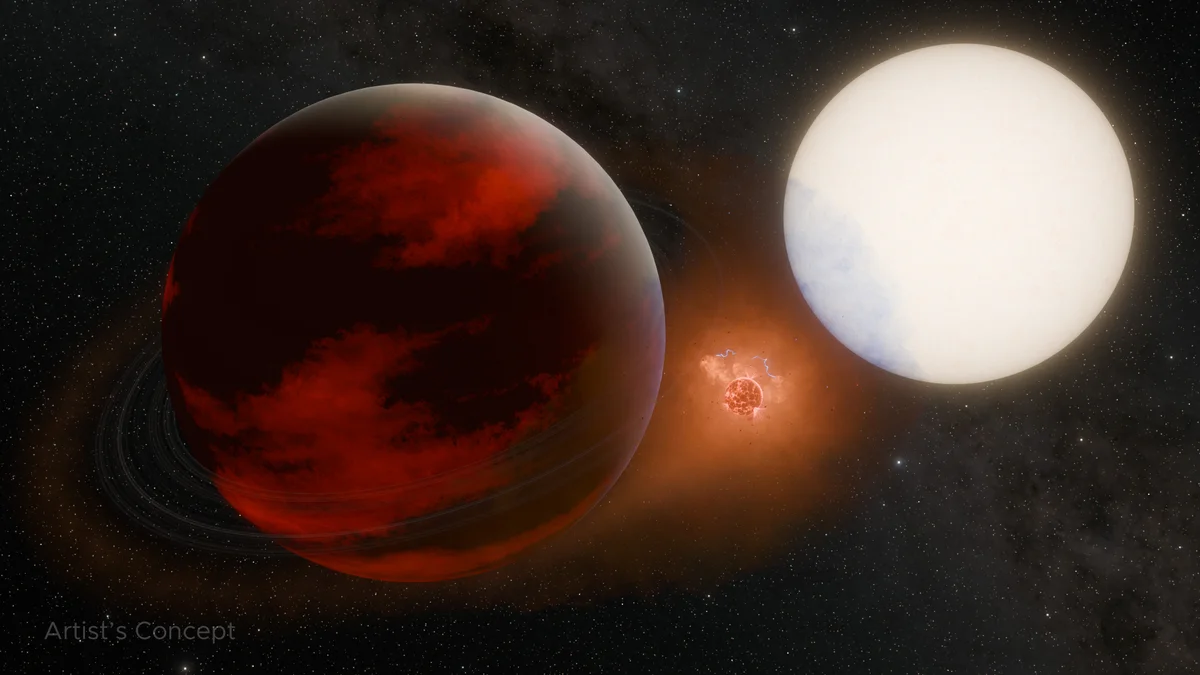
The giant planets of the Solar System are surrounded by moons and rings. Jupiter has roughly a hundred known moons and Saturn now has more than 270 confirmed satellites, a number that has climbed sharply with recent surveys. Some of these moons are enormous — Saturn’s Titan and Jupiter’s Ganymede are each about the size of the planet Mercury. All four giant planets also have ring systems; Saturn’s are the famous exception in being bright and obvious, while those of Jupiter, Uranus, and Neptune are far fainter. Given how common moons and rings are at home, a natural question follows: do planets around other stars — exoplanets — have exomoons and exorings of their own?
Why exomoons are so hard to find
Detecting a moon around a planet that is itself only an indirect smudge of data is extraordinarily difficult. Most exoplanets are found by the transit method: when a planet’s orbit is edge-on from Earth, it passes in front of its star once per orbit, causing a small, temporary dip in the star’s brightness. Plotting that brightness over time produces a “light curve,” and a clean transit shows up as a U- or V-shaped dip. A moon would add only a tiny secondary signal on top of that, so finding one means teasing out subtle anomalies in already-faint data.
The leading candidates
The best-known exomoon candidate is associated with the planet Kepler-1625b, flagged in 2017. Astronomers noticed odd bumps in its light curve that were hard to explain, and proposed that a large orbiting moon — potentially comparable to Neptune in size, around a “super-Jupiter” host — could account for them. A second candidate was later proposed for Kepler-1708b. Both remain unconfirmed, and the field is genuinely divided: a 2023 reanalysis argued the statistical evidence for both is weaker than first claimed, while the original researchers maintain the candidates are still viable. New instruments may settle the question; an upgraded version of the GRAVITY interferometer, GRAVITY+, is among the tools expected to test such candidates more decisively.
Looking for volcanoes instead of moons
A different strategy searches for a moon’s effects rather than the moon itself. Jupiter’s moon Io is relentlessly volcanic, its interior heated by gravitational tides as it is pulled by Jupiter and neighbouring moons, and it spews sulfur into space. By analogy, astronomers using the James Webb Space Telescope have studied the hot exoplanet WASP-39b and detected sulfur dioxide and related compounds whose amounts appear to fluctuate. One hypothesis is that an episodic, external source — a highly volcanic “super-Io” exomoon — could be responsible, though other explanations remain on the table.
What about exorings?
Rings should also exist around exoplanets, and there have been suggestive cases, but confirmed detections are similarly elusive. A ring system would distort a transit light curve in characteristic ways, yet disentangling rings from other effects, such as an oblate planet or a moon, is challenging with current data.
Limitations and what to watch
The central caveat is that, as of now, no exomoon or exoring has been definitively confirmed; every example above is a candidate or a hypothesis under active debate. Claims rest on faint signals at the edge of what current instruments can measure, and at least one prominent candidate has been seriously questioned in the peer-reviewed literature. The Solar System makes a strong circumstantial case that moons and rings should be common elsewhere, but circumstantial expectation is not direct evidence. Next-generation instruments and continued observation will determine whether these tantalising hints become genuine discoveries.
A running catalogue is maintained in Wikipedia’s list of exomoon candidates, and the WASP-39b volcanic-exomoon idea is summarised by EarthSky. For related reading on this site, see coverage of how scientists reason under uncertainty.
