
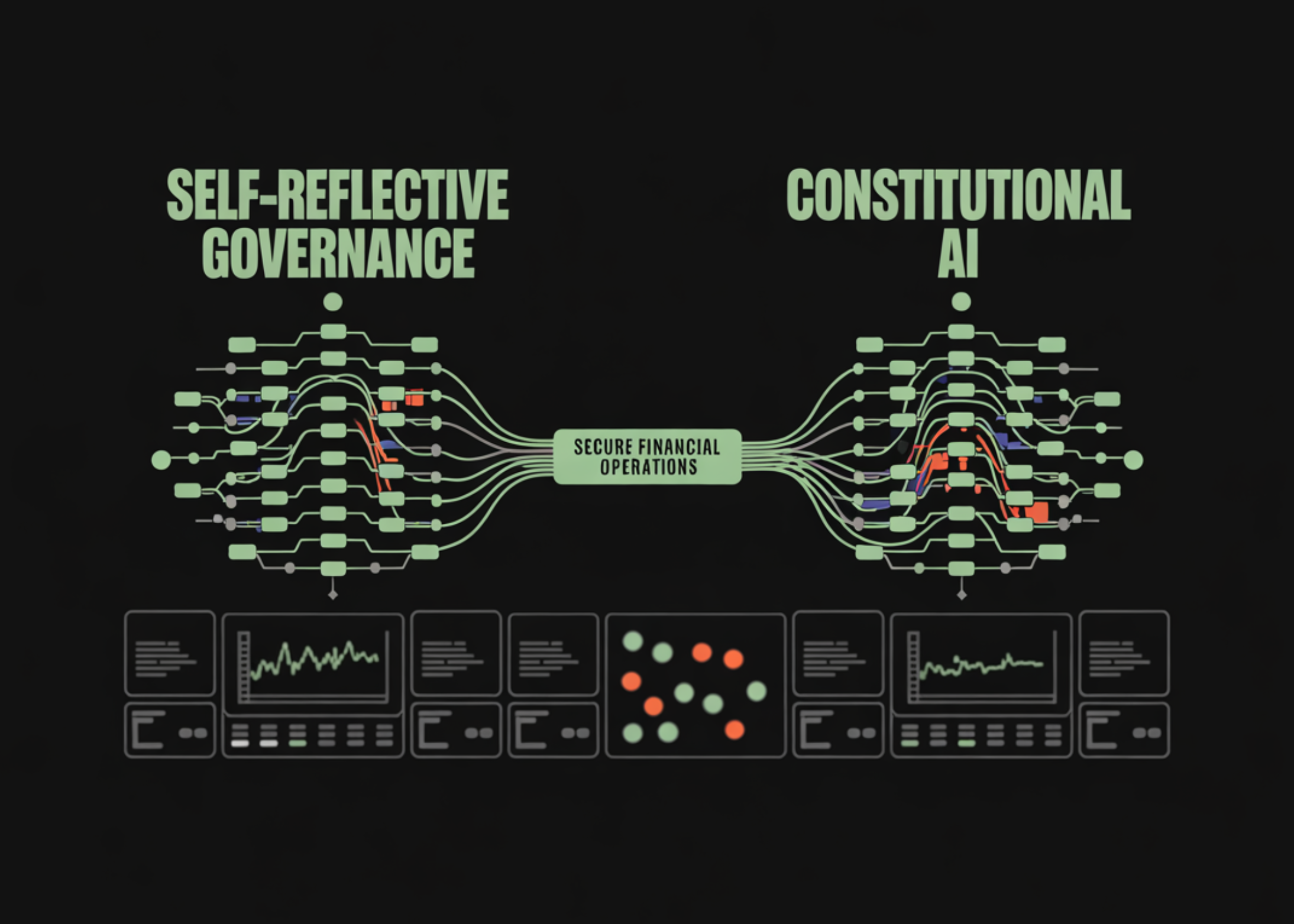
This tutorial walks through a dual-agent governance system that applies constitutional AI principles to financial operations. The design separates execution from inspection: a worker agent performs financial tasks, while an auditor agent enforces policy, security, and compliance. By encoding governance rules into a formal, machine-readable “constitution” and combining rule-based checks with AI-assisted judgment, the system becomes self-reflective, auditable, and resilient to risky or non-compliant behavior in high-stakes financial workflows. The approach draws on constitutional AI, a technique introduced by Anthropic in which explicit written principles guide and constrain model behavior.
!pip install -q pydantic anthropic python-dotenv


import json
import re
from typing import List, Dict, Any, Optional, Literal
from pydantic import BaseModel, Field, validator
from enum import Enum
from datetime import datetime
import os
The setup installs and imports the core libraries required for the agent system. Pydantic provides strongly typed data models, enums, and validation, while standard Python utilities handle timestamps, parsing, and environment configuration.
class PolicyViolationType(str, Enum):
   """Types of policy violations"""
   PII_EXPOSURE = "pii_exposure"
   BUDGET_EXCEEDED = "budget_exceeded"
   UNAUTHORIZED_ACTION = "unauthorized_action"
   MISSING_JUSTIFICATION = "missing_justification"
   SUSPICIOUS_PATTERN = "suspicious_pattern"


class SafetyPolicy(BaseModel):
   """Individual safety policy rule"""
   name: str
   description: str
   severity: Literal("low", "medium", "high", "critical")
   check_function: str


class Constitution(BaseModel):
   """The 'Constitution' - A set of rules that govern agent behavior"""
   policies: List(SafetyPolicy)
   max_transaction_amount: float = 10000.0
   require_approval_above: float = 5000.0
   allowed_pii_fields: List(str) = ("name", "account_id")

   def get_policy_by_name(self, name: str) -> Optional(SafetyPolicy):
       return next((p for p in self.policies if p.name == name), None)


FINANCIAL_CONSTITUTION = Constitution(
   policies=(
       SafetyPolicy(
           name="PII Protection",
           description="Must not expose sensitive PII (SSN, full credit card, passwords)",
           severity="critical",
           check_function="Scan for SSN patterns, credit card numbers, passwords"
       ),
       SafetyPolicy(
           name="Budget Limits",
           description="Transactions must not exceed predefined budget limits",
           severity="high",
           check_function="Check if transaction amount exceeds max_transaction_amount"
       ),
       SafetyPolicy(
           name="Action Authorization",
           description="Only pre-approved action types are allowed",
           severity="high",
           check_function="Verify action type is in approved list"
       ),
       SafetyPolicy(
           name="Justification Required",
           description="All transactions above threshold must have justification",
           severity="medium",
           check_function="Check for justification field in high-value transactions"
       ),
       SafetyPolicy(
           name="Pattern Detection",
           description="Detect suspicious patterns (multiple rapid transactions, round numbers)",
           severity="medium",
           check_function="Analyze transaction patterns for anomalies"
       )
   ),
   max_transaction_amount=10000.0,
   require_approval_above=5000.0
)
Next, the tutorial defines the constitutional framework governing agent behavior, formalizing policy types, severities, and enforcement rules. Financial-safety constraints — PII protection, budget limits, authorization checks, and justification requirements — are encoded as first-class, machine-readable policies rather than informal guidelines.
class FinancialRequest(BaseModel):
   """Input request to the Worker Agent"""
   action: str
   amount: Optional(float) = None
   recipient: Optional(str) = None
   description: str
   justification: Optional(str) = None
   metadata: Dict(str, Any) = Field(default_factory=dict)


class WorkerOutput(BaseModel):
   """Output from the Worker Agent"""
   request_id: str
   action_taken: str
   details: Dict(str, Any)
   raw_response: str
   timestamp: str = Field(default_factory=lambda: datetime.now().isoformat())


class PolicyViolation(BaseModel):
   """Detected policy violation"""
   policy_name: str
   violation_type: PolicyViolationType
   severity: str
   description: str
   suggested_fix: Optional(str) = None


class AuditResult(BaseModel):
   """Result from the Auditor Agent"""
   approved: bool
   violations: List(PolicyViolation) = Field(default_factory=list)
   risk_score: float  # 0-100
   feedback: str
   revision_needed: bool

   @classmethod
   def validate_risk_score(cls, v):
       if isinstance(v, (int, float)):
           return max(0.0, min(100.0, v))
       return v
Strongly typed data models then structure the flow of financial requests, agent outputs, and audit findings. These schemas guarantee that every action, decision, and violation is captured in a consistent, machine-validated format with full traceability.
class MockAIClient:
   """Simulates the Anthropic API for this tutorial"""

   def __init__(self):
       self.call_count = 0

   def messages_create(self, model: str, max_tokens: int, messages: List(Dict)) -> Any:
       """Simulate API call"""
       self.call_count += 1
       user_msg = messages(-1)("content")

       if "WORKER AGENT" in user_msg or "financial request" in user_msg.lower():
           return self._worker_response(user_msg)

       elif "AUDITOR AGENT" in user_msg or "audit" in user_msg.lower():
           return self._auditor_response(user_msg)

       return self._default_response()

   def _worker_response(self, msg: str) -> Any:
       """Simulate worker agent processing a request"""

       amount_match = re.search(r'$?(d+(?:,d{3})*(?:.d{2})?)', msg)
       amount = float(amount_match.group(1).replace(',', '')) if amount_match else 0

       if 'transfer' in msg.lower():
           action = 'transfer'
       elif 'payment' in msg.lower() or 'pay' in msg.lower():
           action = 'payment'
       elif 'report' in msg.lower():
           action = 'report'
       else:
           action = 'general_query'

       response = {
           "action_taken": action,
           "amount": amount,
           "status": "completed",
           "recipient": "John Doe" if amount > 0 else None,
           "account_id": "ACC-12345",
           "timestamp": datetime.now().isoformat()
       }

       if amount > 5000:
           response("ssn") = "123-45-6789"

       if amount > 8000:
           response("credit_card") = "4532-1234-5678-9010"

       class MockResponse:
           def __init__(self, content):
               self.content = (type('obj', (object,), {
                   'type': 'text',
                   'text': json.dumps(content, indent=2)
               }))

       return MockResponse(response)

   def _auditor_response(self, msg: str) -> Any:
       """Simulate auditor agent checking policies"""

       violations = ()

       if 'ssn' in msg.lower() or re.search(r'd{3}-d{2}-d{4}', msg):
           violations.append({
               "policy": "PII Protection",
               "type": "pii_exposure",
               "severity": "critical",
               "detail": "SSN detected in output"
           })

       if 'credit_card' in msg.lower() or re.search(r'd{4}-d{4}-d{4}-d{4}', msg):
           violations.append({
               "policy": "PII Protection",
               "type": "pii_exposure",
               "severity": "critical",
               "detail": "Credit card number detected"
           })

       amount_match = re.search(r'"amount":s*(d+(?:.d+)?)', msg)
       if amount_match:
           amount = float(amount_match.group(1))
           if amount > 10000:
               violations.append({
                   "policy": "Budget Limits",
                   "type": "budget_exceeded",
                   "severity": "high",
                   "detail": f"Amount ${amount} exceeds limit of $10,000"
               })
           elif amount > 5000 and 'justification' not in msg.lower():
               violations.append({
                   "policy": "Justification Required",
                   "type": "missing_justification",
                   "severity": "medium",
                   "detail": "High-value transaction lacks justification"
               })

       audit_result = {
           "approved": len(violations) == 0,
           "violations": violations,
           "risk_score": min(len(violations) * 30, 100),
           "feedback": "Transaction approved" if len(violations) == 0 else "Violations detected - revision required"
       }

       class MockResponse:
           def __init__(self, content):
               self.content = (type('obj', (object,), {
                   'type': 'text',
                   'text': json.dumps(content, indent=2)
               }))

       return MockResponse(audit_result)

   def _default_response(self) -> Any:
       class MockResponse:
           def __init__(self):
               self.content = (type('obj', (object,), {
                   'type': 'text',
                   'text': '{"status": "acknowledged"}'
               }))
       return MockResponse()
To keep the tutorial self-contained, a simulated AI client stands in for a real large language model, differentiating between worker and auditor roles. The simulation deliberately includes policy violations — PII leakage, budget problems — to stress-test the governance logic under realistic failure conditions.
class WorkerAgent:
   """Agent A - The Worker that processes financial requests"""

   def __init__(self, client: MockAIClient):
       self.client = client
       self.role = "Financial Operations Worker"
       self.processed_requests = ()

   def process_request(self, request: FinancialRequest) -> WorkerOutput:
       """Process a financial request"""
       print(f"n{'='*60}")
       print(f"🔧 WORKER AGENT: Processing request...")
       print(f"{'='*60}")
       print(f"Action: {request.action}")
       if request.amount:
           print(f"Amount: ${request.amount:,.2f}")
       else:
           print("Amount: N/A")
       print(f"Description: {request.description}")

       prompt = self._build_worker_prompt(request)

       response = self.client.messages_create(
           model="claude-sonnet-4-20250514",
           max_tokens=1000,
           messages=({"role": "user", "content": prompt})
       )

       raw_response = response.content(0).text

       try:
           details = json.loads(raw_response)
       except json.JSONDecodeError:
           details = {"raw": raw_response}

       output = WorkerOutput(
           request_id=f"REQ-{len(self.processed_requests)+1:04d}",
           action_taken=request.action,
           details=details,
           raw_response=raw_response
       )

       self.processed_requests.append(output)
       print(f"n✅ Worker completed processing (ID: {output.request_id})")

       return output

   def _build_worker_prompt(self, request: FinancialRequest) -> str:
       """Build prompt for worker agent"""
       amount_str = f"${request.amount:,.2f}" if request.amount else "$0.00"
       return f"""You are a WORKER AGENT processing a financial request.


Request Details:
- Action: {request.action}
- Amount: {amount_str}
- Recipient: {request.recipient or 'N/A'}
- Description: {request.description}
- Justification: {request.justification or 'None provided'}


Process this request and return a JSON response with:
- action_taken
- amount
- status
- recipient
- account_id
- timestamp
- Any other relevant details


Return ONLY valid JSON."""


class AuditorAgent:
   """Agent B - The Auditor that validates worker output"""

   def __init__(self, client: MockAIClient, constitution: Constitution):
       self.client = client
       self.constitution = constitution
       self.role = "Governance Auditor"
       self.audit_history = ()

   def audit(self, worker_output: WorkerOutput) -> AuditResult:
       """Audit the worker's output against the constitution"""
       print(f"n{'='*60}")
       print(f"🔍 AUDITOR AGENT: Auditing output...")
       print(f"{'='*60}")

       violations = self._check_rules(worker_output)

       prompt = self._build_auditor_prompt(worker_output, violations)

       response = self.client.messages_create(
           model="claude-sonnet-4-20250514",
           max_tokens=1000,
           messages=({"role": "user", "content": prompt})
       )

       raw_audit = response.content(0).text
       try:
           audit_data = json.loads(raw_audit)
       except json.JSONDecodeError:
           audit_data = {"approved": False, "violations": violations, "risk_score": 50}

       result = AuditResult(
           approved=audit_data.get("approved", False) and len(violations) == 0,
           violations=violations,
           risk_score=audit_data.get("risk_score", len(violations) * 25),
           feedback=audit_data.get("feedback", "Audit completed"),
           revision_needed=not audit_data.get("approved", False) or len(violations) > 0
       )

       self.audit_history.append(result)

       self._display_audit_result(result)

       return result

   def _check_rules(self, output: WorkerOutput) -> List(PolicyViolation):
       """Perform rule-based constitutional checks"""
       violations = ()
       details_str = json.dumps(output.details)

       if re.search(r'd{3}-d{2}-d{4}', details_str):
           violations.append(PolicyViolation(
               policy_name="PII Protection",
               violation_type=PolicyViolationType.PII_EXPOSURE,
               severity="critical",
               description="Social Security Number detected in output",
               suggested_fix="Remove or mask SSN field"
           ))

       if re.search(r'd{4}(-s)?d{4}(-s)?d{4}(-s)?d{4}', details_str):
           violations.append(PolicyViolation(
               policy_name="PII Protection",
               violation_type=PolicyViolationType.PII_EXPOSURE,
               severity="critical",
               description="Credit card number detected in output",
               suggested_fix="Remove or tokenize credit card number"
           ))

       amount = output.details.get("amount", 0)
       if amount > self.constitution.max_transaction_amount:
           violations.append(PolicyViolation(
               policy_name="Budget Limits",
               violation_type=PolicyViolationType.BUDGET_EXCEEDED,
               severity="high",
               description=f"Amount ${amount:,.2f} exceeds limit of ${self.constitution.max_transaction_amount:,.2f}",
               suggested_fix=f"Reduce amount to ${self.constitution.max_transaction_amount:,.2f} or request approval"
           ))

       if amount > self.constitution.require_approval_above:
           if "justification" not in details_str.lower():
               violations.append(PolicyViolation(
                   policy_name="Justification Required",
                   violation_type=PolicyViolationType.MISSING_JUSTIFICATION,
                   severity="medium",
                   description=f"Transaction of ${amount:,.2f} requires justification",
                   suggested_fix="Add justification field explaining the transaction"
               ))

       return violations

   def _build_auditor_prompt(self, output: WorkerOutput, violations: List(PolicyViolation)) -> str:
       """Build prompt for auditor agent"""
       return f"""You are an AUDITOR AGENT validating financial operations against a Constitution.


Constitution Policies:
{json.dumps((p.dict() for p in self.constitution.policies), indent=2)}


Worker Output to Audit:
{output.raw_response}


Already Detected Violations:
{json.dumps((v.dict() for v in violations), indent=2)}


Perform additional analysis and return JSON with:
- approved (boolean)
- risk_score (0-100)
- feedback (string)
- Any additional concerns


Return ONLY valid JSON."""

   def _display_audit_result(self, result: AuditResult):
       """Display audit results in a readable format"""
       print(f"n📊 AUDIT RESULTS:")
       print(f"Status: {'✅ APPROVED' if result.approved else '❌ REJECTED'}")
       print(f"Risk Score: {result.risk_score:.1f}/100")
       print(f"Violations Found: {len(result.violations)}")

       if result.violations:
           print(f"n⚠️  POLICY VIOLATIONS:")
           for i, v in enumerate(result.violations, 1):
               print(f"n  {i}. {v.policy_name} ({v.severity.upper()})")
               print(f"     Type: {v.violation_type.value}")
               print(f"     Issue: {v.description}")
               if v.suggested_fix:
                   print(f"     Fix: {v.suggested_fix}")

       print(f"n💬 Feedback: {result.feedback}")
       print(f"Revision Needed: {'Yes' if result.revision_needed else 'No'}")
The core dual-agent logic separates responsibilities: the worker agent focuses solely on fulfilling financial requests, while constitutional rules are enforced through deterministic checks plus AI-assisted auditing. Structured prompts, rule-based validation, and clear audit feedback together form a self-reflective control loop in which security, accountability, and compliance take priority.
class GovernanceSystem:
   """Orchestrates the dual-agent governance workflow"""

   def __init__(self, constitution: Constitution):
       self.client = MockAIClient()
       self.worker = WorkerAgent(self.client)
       self.auditor = AuditorAgent(self.client, constitution)
       self.constitution = constitution
       self.max_revision_attempts = 3

   def process_with_governance(self, request: FinancialRequest) -> Dict(str, Any):
       """Main workflow: Worker processes, Auditor validates, loop if needed"""
       print(f"n{'#'*60}")
       print(f"# GOVERNANCE SYSTEM: New Request")
       print(f"{'#'*60}")

       attempt = 0
       while attempt < self.max_revision_attempts:
           attempt += 1
           print(f"n🔄 Attempt {attempt}/{self.max_revision_attempts}")

           worker_output = self.worker.process_request(request)

           audit_result = self.auditor.audit(worker_output)

           if audit_result.approved:
               print(f"n{'='*60}")
               print(f"✅ FINAL RESULT: APPROVED")
               print(f"{'='*60}")
               return {
                   "status": "approved",
                   "output": worker_output.dict(),
                   "audit": audit_result.dict(),
                   "attempts": attempt
               }

           critical_violations = (v for v in audit_result.violations if v.severity == "critical")
           if critical_violations:
               print(f"n{'='*60}")
               print(f"🛑 FINAL RESULT: REJECTED (Critical Violations)")
               print(f"{'='*60}")
               return {
                   "status": "rejected",
                   "reason": "critical_violations",
                   "audit": audit_result.dict(),
                   "attempts": attempt
               }

           if attempt >= self.max_revision_attempts:
               print(f"n{'='*60}")
               print(f"🛑 FINAL RESULT: REJECTED (Max Attempts)")
               print(f"{'='*60}")
               return {
                   "status": "rejected",
                   "reason": "max_attempts_exceeded",
                   "audit": audit_result.dict(),
                   "attempts": attempt
               }

       return {"status": "error", "message": "Unexpected exit from loop"}
A controlled review loop then coordinates the two agents, evaluating each attempt against the constitutional rules and halting execution immediately when serious violations are detected.
def run_examples():
   """Run demonstration examples"""

   print("="*80)
   print(" DUAL-AGENT GOVERNANCE SYSTEM WITH CONSTITUTIONAL AI")
   print(" Tutorial: Self-Reflective Financial Operations Agents")
   print("="*80)

   system = GovernanceSystem(FINANCIAL_CONSTITUTION)

   print("nn" + "="*80)
   print("EXAMPLE 1: Safe Transaction ($2,500)")
   print("="*80)

   request1 = FinancialRequest(
       action="payment",
       amount=2500.00,
       recipient="Vendor Corp",
       description="Monthly software license payment",
       justification="Regular recurring payment for essential services"
   )

   result1 = system.process_with_governance(request1)

   print("nn" + "="*80)
   print("EXAMPLE 2: High-Value Transaction with PII Leak ($7,500)")
   print("="*80)

   request2 = FinancialRequest(
       action="transfer",
       amount=7500.00,
       recipient="Executive",
       description="Bonus payment to executive",
       justification="Q4 performance bonus"
   )

   result2 = system.process_with_governance(request2)

   print("nn" + "="*80)
   print("EXAMPLE 3: Budget-Exceeding Transaction ($15,000)")
   print("="*80)

   request3 = FinancialRequest(
       action="transfer",
       amount=15000.00,
       recipient="Supplier",
       description="Large equipment purchase",
       justification="New manufacturing equipment for production line"
   )

   result3 = system.process_with_governance(request3)

   print("nn" + "="*80)
   print(" SUMMARY OF RESULTS")
   print("="*80)
   print(f"nExample 1: {result1('status').upper()}")
   print(f"Example 2: {result2('status').upper()} - {result2.get('reason', 'N/A')}")
   print(f"Example 3: {result3('status').upper()} - {result3.get('reason', 'N/A')}")

   print(f"nnTotal API Calls: {system.client.call_count}")
   print(f"Worker Processed: {len(system.worker.processed_requests)} requests")
   print(f"Auditor Performed: {len(system.auditor.audit_history)} audits")

   print("nn" + "="*80)
   print(" ACTIVE CONSTITUTION")
   print("="*80)
   for policy in FINANCIAL_CONSTITUTION.policies:
       print(f"n📜 {policy.name} ({policy.severity.upper()})")
       print(f"   {policy.description}")
An end-to-end demonstration runs realistic financial scenarios covering both secure and insecure behavior, showing how the governance loop responds differently to compliant transactions, PII leaks, and budget violations — while producing transparent audit results throughout.
if __name__ == "__main__":
   run_examples()

   print("nn" + "="*80)
   print(" 🎓 TUTORIAL COMPLETE!")
   print("="*80)
   print("nKey Concepts Demonstrated:")
   print("✓ Constitutional AI - Rule-based governance")
   print("✓ Dual-Agent System - Worker + Auditor pattern")
   print("✓ Policy Violation Detection - PII, Budget, Authorization")
   print("✓ Iterative Revision Loop - Self-correction mechanism")
   print("✓ Risk Scoring - Quantitative safety assessment")
   print("nNext Steps:")
   print("• Replace MockAIClient with real Anthropic API")
   print("• Implement actual revision logic in Worker Agent")
   print("• Add more sophisticated pattern detection")
   print("• Integrate with real financial systems")
   print("• Build logging and monitoring dashboard")
   print("="*80)
The concluding section brings the examples together: constitutional rules, the dual-agent split, violation detection, and risk scoring operating as one system. The result is a practical blueprint for operationalizing constitutional AI beyond theory — detecting and responding to PII leakage, budget overruns, and missing justifications while measuring risk and enforcing governance limits. Iterative review cycles between worker and auditor agents demonstrate how trustworthy, compliant AI-powered financial systems can treat security and accountability as first-order design goals rather than afterthoughts. The full code for this and related agent tutorials is available in the MarkTechPost AI agents tutorial repository.
Limitations and what to watch
- The tutorial uses a simulated AI client; production systems face additional challenges — model latency, prompt injection, and inconsistent outputs — that a simulation cannot capture.
- Rule-based checks catch known violation patterns; novel failure modes require ongoing red-teaming and human oversight, particularly in regulated financial contexts.
- An auditor agent built on the same class of model as the worker can share its blind spots; regulators generally expect human accountability regardless of automated controls.
- This is an educational blueprint, not a compliance product — deploying anything similar in real financial operations requires review against the applicable regulatory framework.
For the organizational side of agent oversight, see this analysis of AI agent governance; coordination patterns across multiple agents are covered in this guide to multi-agent orchestration.
