

Enterprise AI is changing rapidly as organizations move from chatbots to agentic architectures built to deliver accurate results on real business tasks. To navigate the shift, data leaders are recalibrating their agent strategies around two questions: what does it take to put AI agents to work in a business, and what are the leading companies doing differently from those that are stagnating?
The State of AI Agents report
Databricks’ 2026 State of AI Agents report draws on usage data from more than 20,000 global customer organizations — including a majority of the Fortune 500 — to identify how enterprises are actually interacting with AI agents: the most common use cases, the role of evaluation and governance, the transformation of databases, and more. The highlights below summarize the company’s findings.
AI deployment focuses on core, routine tasks
Across sectors, companies are automating important but routine work — functions ranging from market intelligence to customer advocacy to regulatory reporting. Forty percent of the top 15 use cases center on customer experience and engagement, and applications are strongly domain-specific: analyzing medical literature is a leading use case among healthcare and life-sciences companies, while predictive maintenance dominates in automotive, energy, and utilities.
Evaluation and governance are the building blocks of production
A 2024 global survey by Economist Impact found that 40 percent of respondents considered their organization’s AI governance program inadequate — failing to properly define data, set guardrails, or establish accountability. Without strong checks and balances, enterprises struggle to scale agents into production. Consistent with that, Databricks reports that AI governance and security products saw the fastest usage growth over the past year, and that companies using AI governance tools get 12 times more AI projects into production.
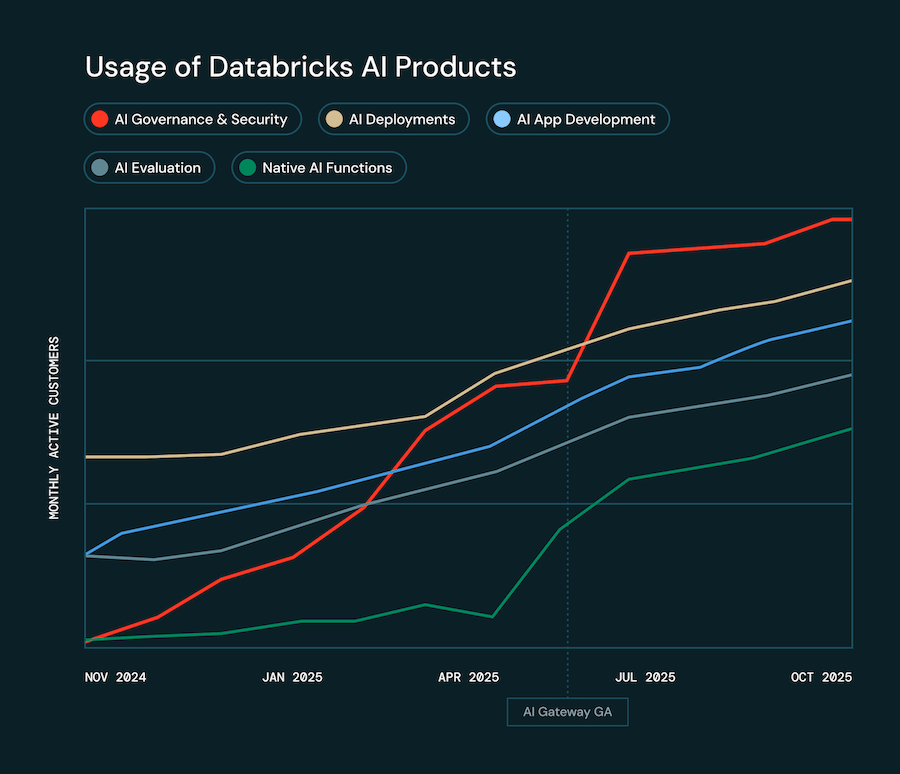
Evaluation shows a similar pattern: assessments are critical for the output quality production agents require, and organizations using evaluation tools are nearly six times more likely to move AI systems into production. The practical reasons ungoverned agent projects stall are explored in this analysis of agent governance.
Rethinking agent architecture — and the database
As AI-assisted “vibe coding” grows in popularity, agent-driven development is rapidly changing how companies manage databases. Architectures now need the elasticity, programmability, and scale for agents — not just humans — to operate them.
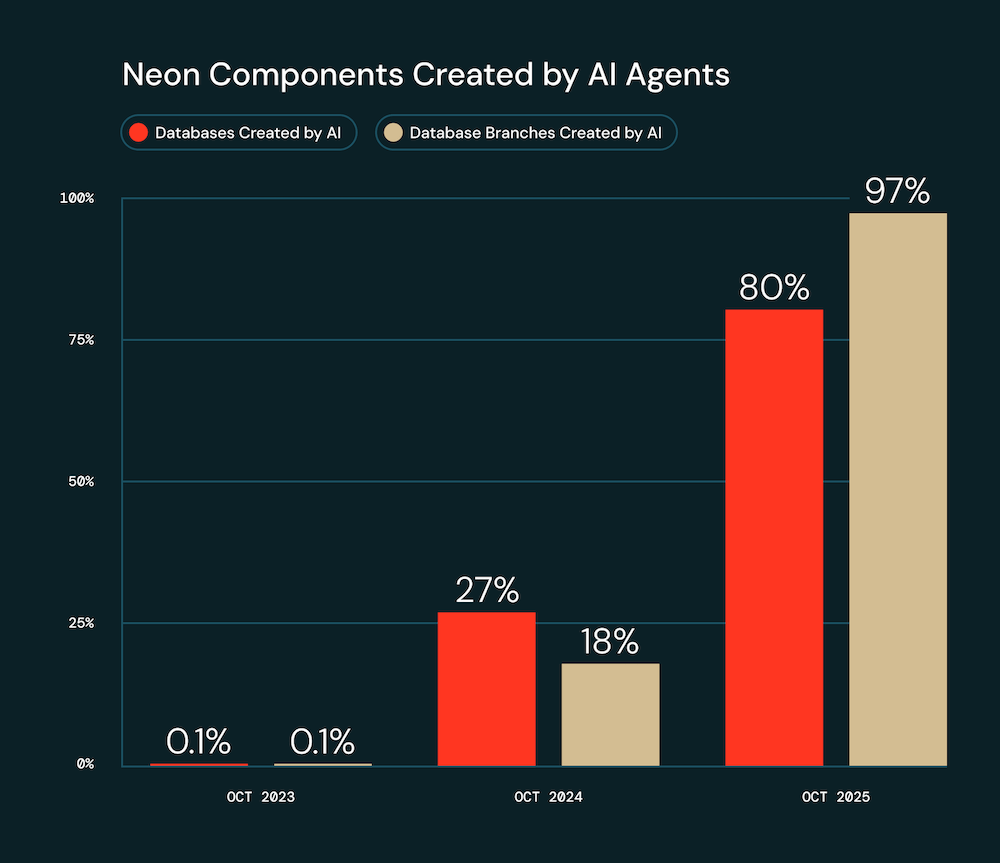
The report’s most striking data point comes from Neon, the serverless Postgres company Databricks acquired and the core technology behind Databricks Lakebase: AI agents now create 80 percent of all databases and 97 percent of database branches on the platform. Two years earlier, agent-created databases were a rounding error — a shift that shows machines becoming first-class users of infrastructure.
A 327% increase in multi-agent workflows
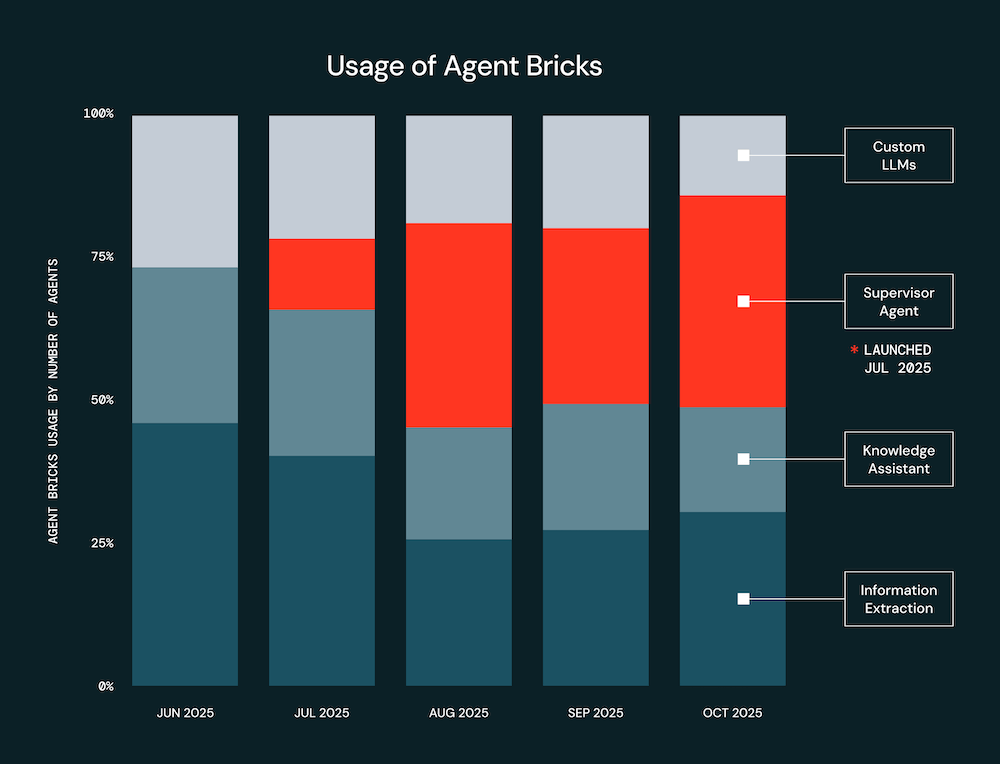
The value of enterprise agents lies in orchestrating complex workflows over an organization’s own data. Analyzing usage of four agent types on its Agent Bricks product, Databricks found multi-agent workflows grew 327 percent, and the top agent pattern — at 37 percent of usage — is the supervisor agent: a coordinator that automatically builds and optimizes systems of multiple agents, tuned on the organization’s data, that work together on domain-specific tasks. It is a structure that notably mirrors human management hierarchies. Coordination patterns like these are covered in this guide to multi-agent orchestration.
Limitations and what to watch
- The findings come from Databricks’ own customer base and product telemetry — a large but self-selected sample that skews toward organizations already invested in a unified data platform.
- Correlations such as “12x more projects in production” do not establish causation; mature organizations may simply adopt both governance tools and production discipline together.
- Platform-specific metrics (Neon database creation, Agent Bricks usage) may not generalize to the broader market.
Getting started
Building and deploying AI agents is no longer the barrier it once was; the challenge now is doing it safely, with governance and evaluation in place, in ways that genuinely add business value. The full findings are in the original Databricks post and the complete 2026 State of AI Agents report.
