
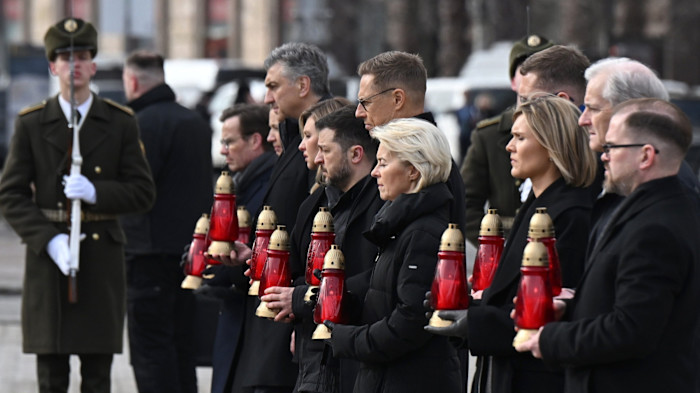
European leaders gathered in Kiev on Tuesday to mark four years since Russia’s full-scale invasion. But the Trump administration sent no senior officials — reflecting America’s more even-handed stance as its efforts to end the war have faltered.
The presidents of the European Council and the European Commission, Antonio Costa and Ursula von der Leyen, arrived by train on Tuesday morning along with the eight prime ministers and presidents of the EU and several other senior officials to mark the day and pay respect to the thousands who died in the war.
In a video address, President Volodymyr Zelensky reflected on the anniversary with a mixture of sadness and pride.
“We have defended our independence, we have not lost our statehood,” he said from inside a wartime bunker as Russian troops entered Ukraine in February 2022. “Ukraine does not just exist on the map… Our capital stands.
“Putin has not achieved his goals,” he said. “He has not broken the Ukrainians. He has not won this war.”
According to Interfax, Russian President Vladimir Putin’s spokesman Dmitry Peskov told reporters that the war “has turned into a very large-scale confrontation between Russia and Western countries, which still aim to destroy our country.”
Peskov acknowledged that Russia had not yet achieved all of its goals in the war and said the fighting would continue.
Peskov said Russia was willing to end the war peacefully but would do so only if Ukraine agreed to Putin’s extreme demands.
Zelensky and his wife Olena Zelenska, as well as other top Ukrainian officials, were set to meet with European leaders to step up efforts to end Russia’s aggression.
The Ukrainian president’s office said the visiting leader would also tour an energy facility destroyed by Russian missile and drone attacks in recent weeks that have brought Kiev to the brink of disaster during its harshest winter in more than a decade.
EU leaders arrived in Kiev mostly empty-handed after Hungary vetoed a €90bn loan as well as new sanctions against Russia over a deepening conflict with Ukraine, which Ukraine accuses of blocking Russian pipeline oil shipments.
Hungarian Prime Minister Viktor Orban posted a video message on Tuesday, saying: “Don’t trust us – we won’t give money, we won’t give soldiers, we won’t make war.” Orban, who faces contested elections in April, has made Ukraine a central element of his campaign.
“Orbán has previously refused to allow weapons to transit through his country,” Zelensky told the FT in an interview on Monday. “You were playing with Putin, we tossed him aside. Now you are blocking €90bn… We need money for weapons, to survive. We need this money to survive, and you withheld it. How should we treat you?”
Several rounds of peace talks, including three rounds of trilateral talks between US, Ukrainian and Russian officials, have so far failed to achieve any significant breakthrough. Putin has stuck to his maximalist position and is demanding more territory than his troops are able to capture by force, while Zelensky has insisted that no land can be simply given up.
Zelensky told the FT that, to his dismay, the US is pursuing a strategy of putting pressure on “both sides” and placing itself “in the middle” in an effort to force a compromise.
“My hope for President Trump – for him and his country – is that he will put pressure on Russia and stop Putin,” he said. “Ukraine needs a ceasefire – yesterday, today, tomorrow.
“We don’t need a truce,” he said. “We need an end to the war.”
The Ukrainian president has said Washington is pressing for an end to the war by the summer so the White House and Republicans can focus on the midterm elections. The US Embassy in Kiev declined to comment on Tuesday about the absence of any senior Trump administration officials.
Russia’s aggression has now lasted longer than the Soviet Union’s involvement in the Second World War against Nazi Germany – and it has come at a tremendous human cost. A report last month from the Center for Strategic and International Studies estimated that total casualties on both sides could reach 2 million by spring, with Russia suffering the highest military losses of any major power since the Second World War.
Zelensky told the FT that Russia’s military could lose an average of 167 soldiers “for every kilometer of occupied land” in 2025.
Speaking from Brussels, NATO Secretary General Mark Rutte said that “it is vital that Ukraine continues to receive military, financial and humanitarian assistance, so that Ukraine can defend itself against Russian terror from the skies and remain on the front line.”
“The promise of aid does not end the war,” he said, calling on Kiev’s Western partners to provide more support for the war-torn nation.
“Ukraine needs ammunition today and every day until the bloodshed stops.”
The British government on Tuesday announced its largest sanctions package against Russia since the start of the war, as part of an ongoing effort to force the Russian leader to end its war. It targeted Russian energy revenues, including oil exports and major suppliers of military equipment fueling the war effort.
Russian oil revenues are currently at their lowest level since 2020, after the UK and its international partners increased sanctions pressure on Moscow.
Additional reporting from Max Seddon in Berlin, Laura Dubois in Brussels and Marton Dunai in Budapest
