
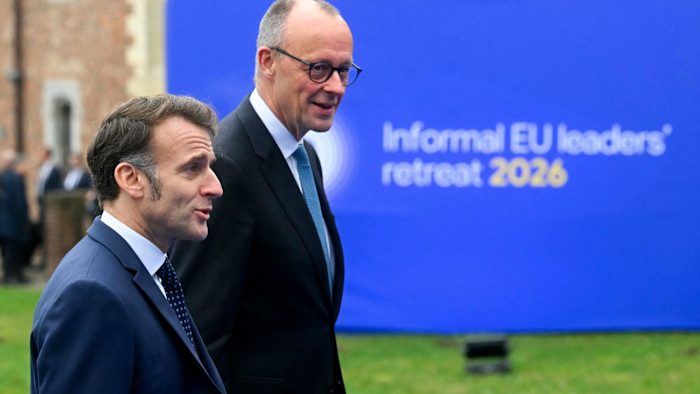
German Chancellor Friedrich Merz has launched talks with France to strengthen Europe’s nuclear deterrent as he urged the continent to strengthen its security and “repair” strained relations with the US.
The discussions centered on the possibility of Germany joining France’s nuclear umbrella, underscoring growing concern in Europe over an expected reduction in the US military presence on the continent as Russia’s full-scale war on Ukraine enters its fifth year.
Opening the Munich security conference on Friday, Merz said Europe must “become a global political power with its own security strategy”.
“I have started preliminary talks with French President Emmanuel Macron about the European nuclear deterrent,” he said, emphasizing that these discussions were “strictly embedded in our nuclear partnership within NATO” and stressed that Germany “will not create separate security zones in Europe”.
He reminded the largely American and European audience of policymakers and security experts that the EU treaties include a mutual defense clause – Article 42 – in the event of “armed aggression” against one of the EU member states.
“Now we have to explain how we want to organize it in a European way – not as an alternative to NATO, but as a self-reliant strong pillar within the alliance,” he said.
His comments come as European governments are trying to close a potential deterrent gap amid Washington’s repeated signals that it intends to reduce its defense posture in Europe and shift resources and troops toward the Indo-Pacific and its immediate neighborhood.
The US nuclear arsenal includes more than 100 gravity bombs deployed in Europe. These are under US control, but in accordance with nuclear sharing agreements within NATO, they are designed to be dropped by warplanes flown by Belgium, Germany, Greece, Italy, the Netherlands and Turkey.
Macron plans to give a speech about nuclear deterrence later this month, according to multiple people familiar with the matter.
Unlike Britain’s nuclear deterrent, France’s arsenal lies outside NATO’s nuclear sharing arrangement and is not dependent on US technology. Although Britain has full autonomy in the use of weapons, it cannot manufacture, maintain or modernize them without US cooperation.
Paris has long said that its “vital interests”, which underpin its nuclear doctrine, have a “European dimension”, deliberately maintaining ambiguity over the circumstances in which a French president could authorize the use of nuclear weapons.
Last year, Macron offered to “start a strategic debate” with interested European countries to determine “whether new cooperation could emerge”.
Addressing the conference later on Friday, Macron confirmed he was holding a “strategic dialogue” with Merz and other countries to “see how we can clarify our national (nuclear) principle”.
These discussions are part of efforts to reorganize Europe’s security architecture as previous discussions were “entirely designed in Cold War times”, he said. The nuclear deterrence talks were “a way to create convergence in our strategic approach and strategic culture between Germany and France,” Macron said.
Three people familiar with the matter told the FT that the discussions are tentative and exploratory rather than focused on any specific goal. They are not considering deploying French weapons to other European states, the two people said, but rather exploring how France’s posture and principles might change to better protect non-French territory.
“(France) has said they are open and willing to discuss their capabilities in a slightly broader scope,” said a person briefed on the confidential discussions. “Many Europeans consider it a great thing that France and Britain have these weapons.”
Merz stressed that France’s and Europe’s efforts to develop their own defense strategy do not mean “rejecting” NATO. Although he declared an end to the old world order, he called for “repairing and revitalizing” transatlantic relations.
“A chasm has opened between Europe and the United States,” he said, referring to US Vice President JD Vance’s speech in Munich last year, who attacked Europe for allegedly betraying its democratic values.
“The culture war of the MAGA movement is not ours,” Merz said.
“For us, freedom of speech ends when that speech goes against human dignity and basic law. We believe in free trade, not tariffs and protectionism. We stand behind climate agreements and the World Health Organization,” he said to applause.
Despite tensions, Merz argued that transatlantic relations would remain preferable to isolation in the new era of “great powers”.
Europe is too vulnerable without the US, he said, and Washington also needs allies to contain China, which is “claiming global leadership”.
“China systematically exploits others’ dependence on others. It is reinterpreting the international order to suit its interests,” said Merz, who is traveling to Beijing later this month.
Macron reiterated Merz’s call for Europe to become a “geopolitical actor” and the need to rearm. But he also appeared to warn Germany’s leader about the temptation to go it alone rather than pursue common European defense projects after Berlin has poured hundreds of billions of dollars into its military.
The French leader said he believes in the Future Combat Air System, a €100 billion project between France, Germany and Spain that is on the verge of collapse due to tensions between the companies involved. Berlin and Paris are discussing whether to proceed with the next phase as planned, or significantly scale down the project by removing the normal jet component.
“It is difficult for me to understand how we will create new normal solutions if we destroy some of the solutions we have,” Macron said.
