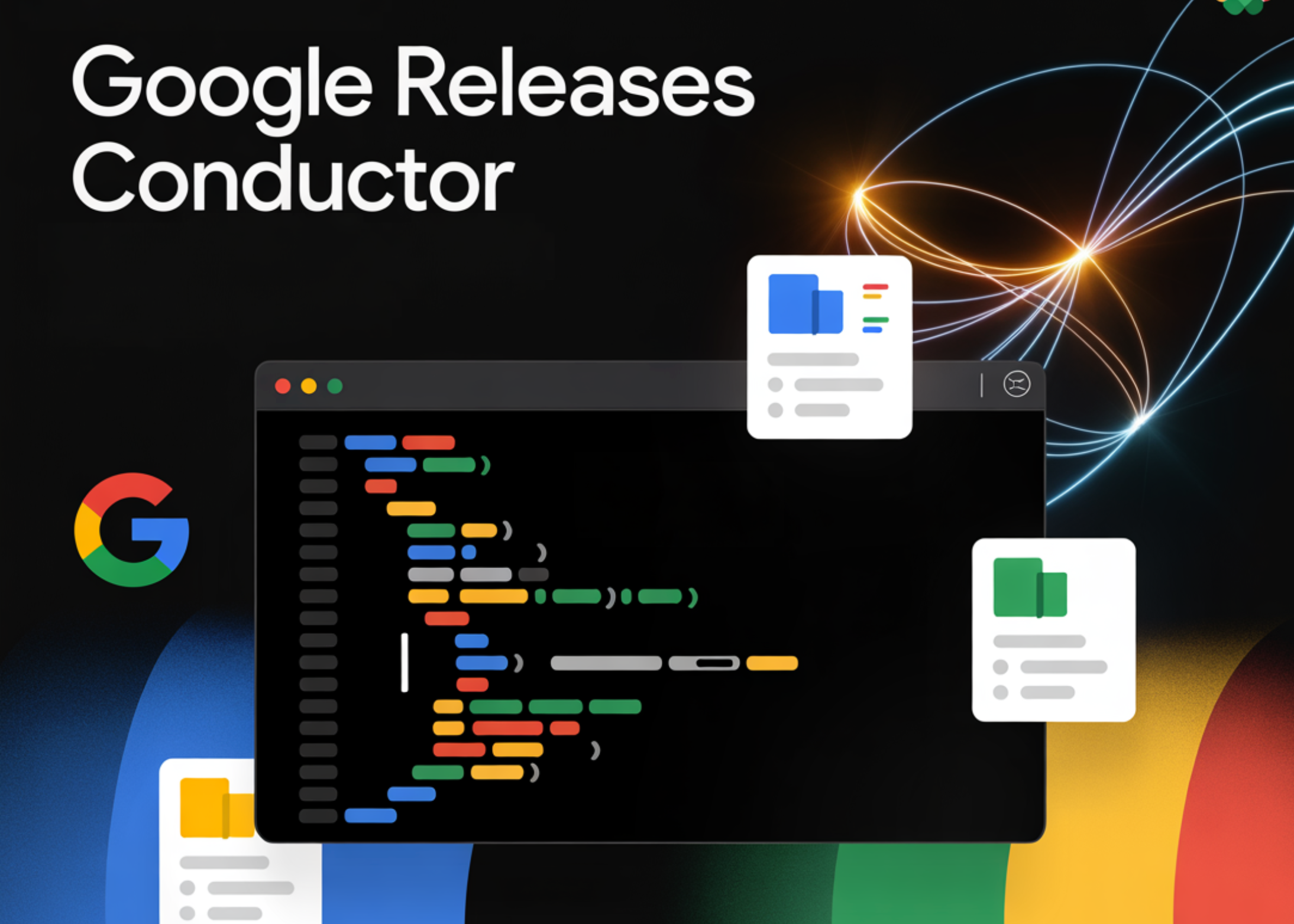
Google has introduced Conductor, an open source preview extension for the Gemini CLI that turns AI code generation into a structured, context driven workflow. Conductor stores product knowledge, technical decisions, and action plans as versioned Markdown inside the repository, then lets Gemini agents extract those files instead of ad-hoc chat prompts.
From chat based coding to context driven development
Most AI coding today is session based. You paste the code into the chat, describe the task and the context disappears when the session ends. The conductor considers this a major problem.
Instead of ephemeral pointers, Conductor maintains a persistent reference directory inside the repo. It captures product goals, constraints, tech stack, workflow rules, and style guides as Markdown. After this, Gemini reads these files every time. This makes AI behavior repeatable across machines, shells, and team members.
Conductor also implements a simple lifecycle:
Context → Envision and Plan → Implementation
The extension does not go directly from natural language requests to code editing. It first creates a track, writes a description, prepares a plan and only then executes it.
Installing Conductor in Gemini CLI
Conductor runs as a Gemini CLI extension. Installation is a command:
gemini extensions install https://github.com/gemini-cli-extensions/conductor --auto-update --auto-update The flag is optional and keeps the extension synchronized with the latest release. After installation, conductor commands are available inside the Gemini CLI when you are in the project directory.
project setup with /conductor:setup
The workflow starts with project level setup:
This command runs an interactive session that creates a base context. The conductor asks about the product, users, requirements, technology stack, and development practices. From these answers it arises conductor/ a directory containing many files, For example:
conductor/product.mdconductor/product-guidelines.mdconductor/tech-stack.mdconductor/workflow.mdconductor/code_styleguides/conductor/tracks.md
These artifacts define how the AI should reason about the project. They describe the target users, high-level features, accepted technologies, testing expectations, and coding conventions. They live in Git with the rest of the source code, so changes to the context are reviewable and auditable.
Tracks: specification and planning as first class artifacts
the conductor introduces tracks To represent units of work such as features or bug fixes. You create a track with:
Or with a short description:
/conductor:newTrack "Add dark mode toggle to settings page"For each new track, Conductor creates a directory conductor/tracks/ Containing:
spec.mdplan.mdmetadata.json
spec.md Lays out detailed requirements and constraints for the track. plan.md It involves a step-by-step execution plan divided into steps, tasks and sub-tasks. metadata.json Stores identifiers and status information.
Conductor helps with drafting and planning using existing reference files. The developer then edits and approves them. The important thing is that all implementations should follow a plan that is clear and version controlled.
implementation with /conductor:implement
Once the plan is ready, You hand over control to the agent:
the conductor reads plan.mdSelects the next pending task, and runs the configured workflow. Typical cycles include:
- Inspect relevant files and references.
- Propose code changes.
- run a test or check according to
conductor/workflow.md. - Update job status
plan.mdand globaltracks.md.
The expansion phase also includes checkpoints at the boundaries. At these points the conductor stops for human verification before proceeding further. This prevents the agent from implementing large, unreviewed refactors.
Several operational commands support this flow:
/conductor:statusTracks and shows work progress./conductor:reviewHelps validate completed work against product and style guidelines./conductor:revertUses Git to roll back a track, step, or task.
Reverts are defined in terms of tracks, not raw commit hashes, which is easier to reason about in a multi change workflow.
Brownfield Projects and Team Workflows
Conductor is designed to work on brownfield codebases, not just fresh projects. when you run /conductor:setup In existing repositories, the context session becomes a way to extract knowledge contained in explicit Markdown from the team. Over time, as more tracks are run, the reference directory becomes a concise representation of the system’s architecture and constraints.
Team level behavior is encoded workflow.md, tech-stack.mdand style guide files. Any engineer or AI agent who uses Conductor in that repo inherits the same rules. This is useful for testing strategies, meeting expectations, or enforcing agreed upon frameworks among contributors.
Because references and plans are in Git, they can be reviewed, discussed, and changed code with the same process as source files.
key takeaways
- Conductor is a Gemini CLI extension for context-driven development: This is an open source, Apache 2.0 licensed extension that runs inside the Gemini CLI and triggers AI agents from a repository-local Markdown context instead of ad-hoc prompts.
- The project reference is stored as versioned markdown below
conductor/:like filesproduct.md,tech-stack.md,workflow.mdAnd code style guides define product goals, technology options, and workflow rules that the agent reads on each run. - The work is organized into tracks
spec.mdAndplan.md: :/conductor:newTrackCreates a track directory containingspec.md,plan.mdAndmetadata.jsonRequirements and execution plans were made clear, reviewable, and linked to Git. - Implementation is controlled through
/conductor:implementand track-aware ops:Agent executes the task as per its ownplan.mdUpdate in progresstracks.mdand supports/conductor:status,/conductor:reviewAnd/conductor:revertFor progress monitoring and Git-supported rollback.
check it out repo And technical details. Also, feel free to follow us Twitter And don’t forget to join us 100k+ ml subreddit and subscribe our newsletter. wait! Are you on Telegram? Now you can also connect with us on Telegram.
Michael Sutter is a data science professional and holds a Master of Science in Data Science from the University of Padova. With a solid foundation in statistical analysis, machine learning, and data engineering, Michael excels in transforming complex datasets into actionable insights.
