
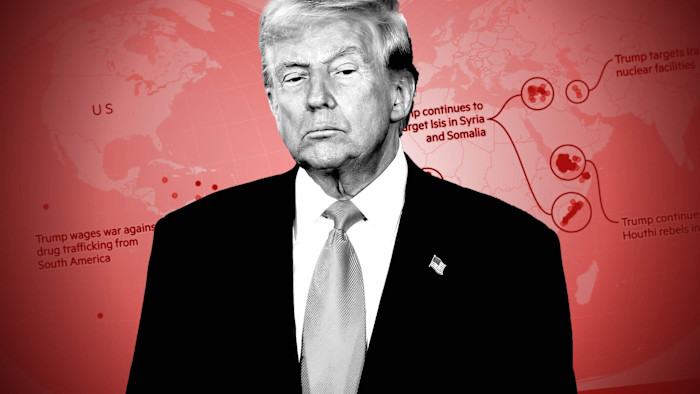
Time and again, Donald Trump has talked about the failures and disgraces of US presidents who got caught up in foreign misadventures, from Joe Biden’s chaotic withdrawal from Afghanistan to George W Bush’s ill-fated invasion of Iraq.
Even on the issue of Iran, Trump has a long memory, reflecting in recent months on how Jimmy Carter’s 1980 re-election bid was ruined by a failed attempt to rescue 52 American hostages being held in Tehran.
“Jimmy Carter, think about the great Jimmy Carter, who had helicopters crashing, hostages everywhere. Remember that?” He said in January. “Think about Sleepy Joe Biden with Afghanistan. What a disaster, the most shameful day in our country’s history.”
Yet whatever reticence Trump — who repeatedly vowed during the campaign to put “America first” and stay out of foreign entanglements — may have shown toward foreign interference now seems far-fetched.
Trump’s newly rebranded War Department has been busier during the past 12 months than during his first presidency, intervening in new areas and taking more risks than before.
“We’ve done more for the military than any other administration has ever done,” Trump told reporters on the first anniversary of his second presidency.
Much of this is inspired by the philosophy of rapid, surgical intervention that can be wrapped up with a quick declaration of victory, most spectacularly exemplified by the operation to remove Nicolas Maduro from among his Cuban bodyguards in Venezuela in January.
But Trump has now launched what appears to be his most consequential intervention yet: Operation Epic Fury, a massive, overt campaign to topple Iran’s regime.
On Saturday, when Iran’s Ayatollah Ali Khamenei was killed in the first day of joint US and Israeli air strikes, Trump acknowledged that he may be entering a very long campaign. The attacks will continue throughout the week or “as long as necessary to achieve our objective of peace in the Middle East and, indeed, throughout the world!” He wrote on Truth Social.

A former senior defense official said, “He was very reluctant to use force during his first presidency”. “He’s become very comfortable with it now.”
Trump gradually bought into this new appetite for deploying US military power overseas, disliking anything more than air strikes in support of a specific mission in his first term.
It was against Iran that Trump carried out one of the decisive military interventions of his first term, when he responded to the near-attack on the US embassy in Baghdad by Shia protesters suspected of ties to Iran by ordering the assassination of Revolutionary Guards commander Qassem Soleimani.
Their courage was rewarded by Iran’s relatively muted response, in which it launched a telegraphed bombardment of missiles at American targets, causing structural damage but no casualties.
Elliott Abrams, who was previously special representative for Iran and Venezuela during the Trump administration, said the Suleimani operation taught Trump that he could use military force to his advantage.
Trump voters “don’t want defeat, or American deaths, or years of war, but they are happy to see a good use of power,” Abrams said.

This time, Iran has responded more forcefully, firing hundreds of drones and missiles at US and Israeli targets across the region, including military bases.
While most have been stopped, the US military said on Sunday that three soldiers were killed and five seriously wounded, an outcome Trump acknowledged when he said US troops “could be lost”.
However, Republican Congressman Tom Cotton, who chairs the Senate Intelligence Committee, told CBS News on Sunday morning that Trump had “no plans for any kind of massive ground force inside Iran,” except for targeted missions.
Speaking before the US and Israeli strikes, retired General Stanley McChrystal, former commander of the US Joint Special Operations Command, said Trump had “fallen into a trap” into thinking that covert or surgical operations, air strikes and massing warships on shores were effective.
“I think they’re being seduced by something that historically doesn’t produce long-term results,” he said.
Since taking office, Trump has ordered attacks on ISIS targets in Iraq, Syria and Nigeria, launched a campaign against alleged drug-trafficking boats in Latin America and, in the months before Maduro’s capture, created the largest US naval presence in the region in decades.
This is a clear contradiction with the Pentagon’s new National Defense Strategy, which, while making clear that it is prepared to take “unilateral decisive action”, says the US will no longer be deterred by “intervention” and “regime change”.

His administration has also threatened to use military force to take Greenland from US ally Denmark, putting the future of NATO in doubt. Writing to the Prime Minister of Norway after failing to win the Nobel Peace Prize, Trump said he no longer felt “an obligation to think holistically about peace.”
In preparation for his attack on Iran, Trump’s objectives appeared to change repeatedly – from protecting anti-regime protesters and ending Iran’s nuclear program to curbing its ballistic missile arsenal and forcing it to end support for regional proxies.
Trump appeared to be reluctant until the last moment to use the “armada,” which he had deployed a long distance from Iran, insisting he had not yet made up his mind.
Yet, despite indirect talks with Iran on Thursday, in which both Tehran and mediator Oman reported progress, by Saturday morning it was clear that Trump was no longer interested in a diplomatic solution.
“In his first term, he became more cautious over time,” said Michael O’Hanlon, a defense and strategy expert at the Brookings Institution think-tank. “In his second term, so far, all bets seem to have failed.”
Additional reporting by Abigail Hauslohner, James Politi and Lauren Feder in Washington
