Wildfire prevention has traditionally relied on rigorous monitoring cycles and blunt tools such as emergency power shutoffs. Now a new generation of technology start-ups is offering a more targeted approach: using artificial intelligence to help utility companies decide what to inspect — and where to intervene — before a spark becomes a fire.
The stakes are rising. More than 77,000 wildfires were reported in the US in 2025 – significantly higher than the average for the previous decade – and more than five million acres burned. For several months, there was a shortage of firefighting resources. Droughts are becoming more frequent as the climate continues to warm, and wildfires are now a nearly year-round threat.
Forces ranging from weather and vegetation structure to electric grid infrastructure and human activity make wildfires difficult to predict. Amsterdam-based company Overstory has developed AI-powered vegetation monitoring to help utility companies identify dangerous trees that are most likely to fall near power lines. The goal is to prevent sparks that could turn into a wildfire.
On supporting science journalism
If you enjoyed this article, consider supporting our award-winning journalism Subscribing By purchasing a subscription, you are helping ensure a future of impactful stories about the discoveries and ideas shaping our world today.
This is a very big challenge. In California’s most at-risk fire areas, a large portion of utility-generated ignitions are caused by vegetation contact. Combustible vegetation like trees, grass or shrubs is the primary fuel for wildfires and is one of the factors that utilities have control over, says Sonya Sachdeva, a cognitive scientist at Overstory who focuses on wildfire decision-making.
To manage vegetation, utility companies typically send crews to walk over power lines or fly helicopters periodically to collect information using lidar (Light Detection and Ranging), a technology used to accurately map terrain with high-resolution, three-dimensional images. But both methods can be slow, expensive, and ineffective.
Overstory takes a different approach. To provide a targeted map-based view, the company acquires high-resolution satellite imagery based on the locations of the utility company’s power network. It then runs a set of proprietary computer-vision models to identify wildfire-related factors such as dead grass, bushes and moisture levels, as well as tree height, encroachment, health and mortality.
Overstory CEO Fiona Spruill says the goal isn’t to replace people, but to help utility companies know where to send their employees. She says, “We are giving our suggestions based on our analysis. But ultimately the decisions are taken by the humans standing in front of the trees in the field.”
The results are promising. One of Overstory’s customers, Pacific Gas & Electric (PG&E), sees a nearly 50 percent decline in the number of fires with vegetation as a suspected trigger in 2025 compared to last year, according to Andrew Branches, PG&E’s vice president of wildfire suppression.
But the technology has limitations. Overstory’s data provides continuous snapshots, but it is not a live feed; Satellite imagery still lags behind real-time alerts from camera networks. “As with any modeling effort, there is some degree of uncertainty,” Sachdeva says. “But there’s always a human being there when we suggest something.”
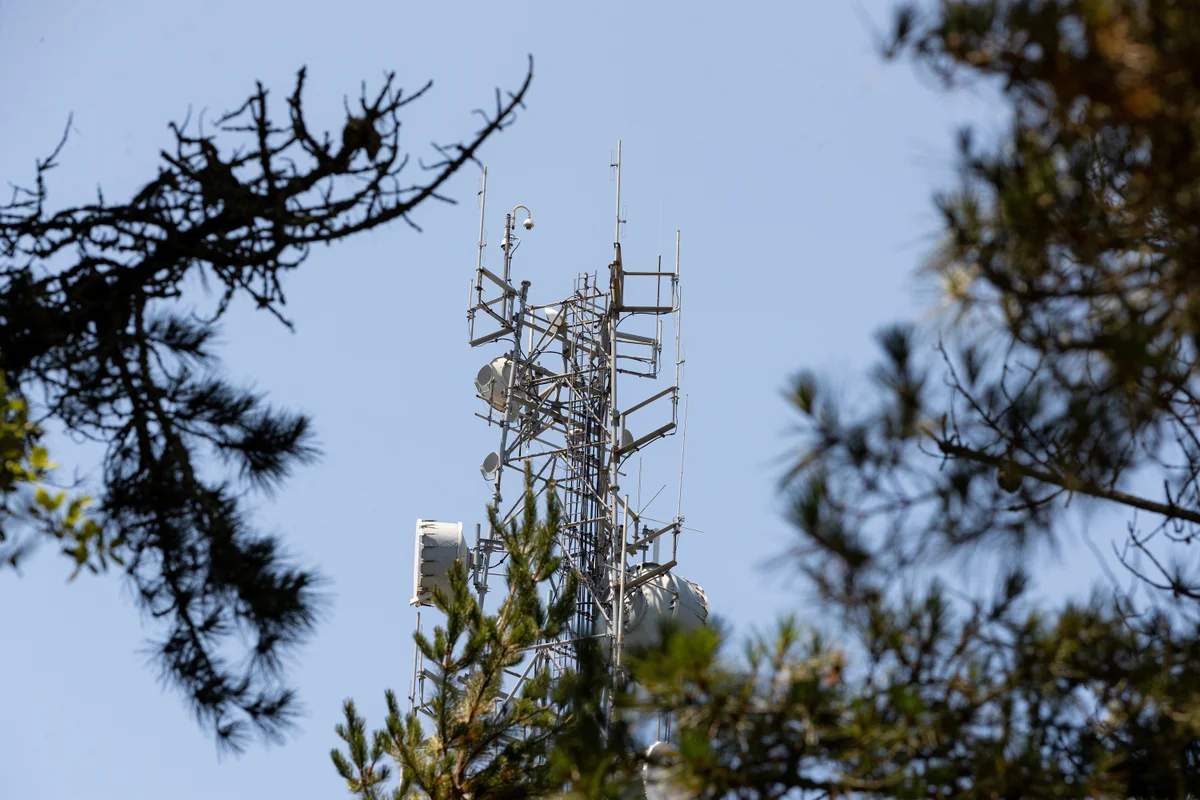
Another frontier in fire targeting technology, sometimes called firetech, is the emphasis on developing AI-powered detection tools. San Francisco-based wildfire detection company Pano AI has designed its own pan-tilt-zoom cameras that can scan 360 degrees to look for anomalies. Sets of images are uploaded 24/7 to its cloud-based AI monitors for daytime smoke and nighttime heat signals, complemented with additional feeds such as geostationary satellite data and information from emergency services.
AI models feed alerts to command hubs like PG&E’s Hazard Awareness Warning Center in San Ramon, California, where analysts confirm hazards before dispatching crews.
Jason Henry/Bloomberg via Getty Images
Sonia Kastner, CEO of Pano AI, says experts cross-reference each AI detection with camera footage to differentiate between smoke and those that look like fog, dust or clouds. “Once a human has verified that it is indeed a fire, they send alerts by text and e-mail,” she says.
Pano AI’s partnership with Arizona Public Service (APS), Arizona’s largest utility company, has reduced fire response times over the past two years. Scott Bordenkircher, APS’ director of forestry and fire suppression, says Pano (AI) has consistently beaten out 911 callers, and has sometimes done so by “10 to 15 to 25 minutes,” allowing firefighters to respond sooner.
However, Bordenkircher says the effectiveness of AI-powered detection cameras also depends on clear line of sight, meaning the smoke must rise high enough to be visible to the camera. Investigations have been limited to areas where cameras have been installed, leaving parts of Arizona without coverage.
Pano AI was built on ideas that were first explored in academic wildfire research. One of those early efforts was ALERTCalifornia, a public safety program led by the University of California, San Diego that uses cameras and AI to help local fire departments confirm wildfires in real time. Neil Driscoll, principal investigator for ALERTCalifornia, says that before AI came into play, fire detections often started with 911 calls. “You have to send a battalion to verify whether the fire is real or not and that takes a lot of time,” he says. But now, through detection systems, fires can be identified and monitored even before a 911 call comes.
“We’ve cut response times dramatically,” says Driscoll. The hope is that the time saved will translate into smaller fires.
