
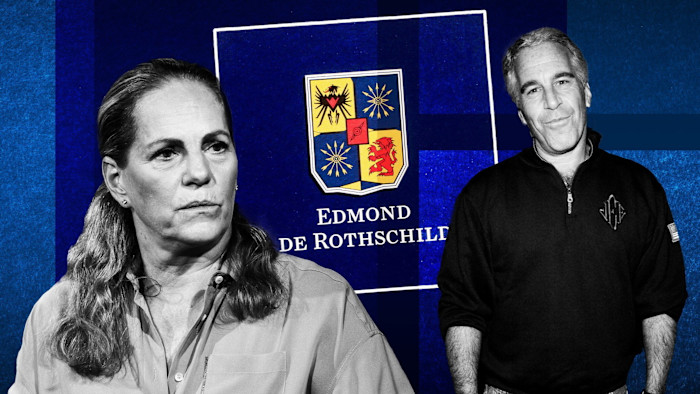
The Edmond de Rothschild group was in trouble. It was the end of 2015 and after months of turmoil, a Swiss private bank owned by a branch of the Rothschild dynasty was reaching a multi-million dollar settlement with the US Justice Department for helping wealthy Americans hide their assets.
Behind the scenes, Ariane de Rothschild, the group’s French head, had tasked Jeffrey Epstein and the lawyer he introduced him to, Kathy Ruemmler, with closing the deal.
“45 million (million)?” de Rothschild asked Epstein in a December 2015 email exchange. He responded that, counting the fees of $10 million for the lawyers involved and $25 million for himself, “I think you’ll find that… all under 80 is pretty good”. “Thank you very much for your wonderful help,” de Rothschild replied.
A few days later, the US DOJ announced a $45 million settlement with Edmond de Rothschild.
Epstein’s crucial – and lucrative – role in the DOJ deal is an example of the deep relationship he developed with the Baroness, who married into the Rothschild family but now runs a financial group that by 2024 had assets of SFr184 billion between its private banking and asset management arms.
Over the six years of their relationship, from 2013 until shortly before his arrest in 2019, Epstein became a personal confidant as well as a key business advisor, giving her a privileged position of influence at the center of one of Europe’s most powerful banking families.
Epstein assistant Leslie Groff wrote in 2014, “I know that Baroness Ariane de Rothschild is very important.”
In Geneva, Edmond de Rothschild holds a unique position – neither a universal bank like UBS nor a pure boutique, but a prestigious private banking house with deep roots in the city’s wealth-management ecosystem.
In early 2015, when Benjamin de Rothschild handed over operational control of his father’s bank to his wife, it was in crisis.
Ariane de Rothschild later told the FT that “it was not my intention to become chief executive of Edmond de Rothschild”, stressing that she only agreed to step into the role to show the family’s commitment as shareholders amid the DOJ investigation and broader restructuring.
But she had already discussed the move with Epstein. De Rothschild wrote in December 2014, a few weeks before the announcement, “Had a long conversation with him (Benjamin). He accepted: leaving the boards of all subsidiaries and the holding, GVA, Paris, with me as interim CEO on a strategic committee.”
“Okay,” Epstein replied. “Next Discussion Estate Planning.”
Benjamin de Rothschild remained chairman of the group until his death from a heart attack in 2021 at the age of 57. But from the time of her appointment as chair of the executive committee in January 2015, it was clear that Ariane was in charge.

After securing the DOJ settlement, in the months that followed de Rothschild led efforts to restructure the bank’s operations, took steps to consolidate her power internally and prosecuted her husband’s cousin David de Rothschild over who could use the family name — all with Epstein’s advice in the background.
In 2023, de Rothschild described her relationship with Epstein in the Wall Street Journal as one in which she had sought his advice on “a few occasions”. Hundreds of emails and other messages between the pair now made public by the DoJ paint a different picture, in which the French banker shared private confidences with Epstein.
“I am nervous and afraid I won’t be able to get to work,” de Rothschild wrote in February 2015, shortly after taking over leadership of the bank. “You never have to hide from me, I can listen, give advice or just listen, there’s nothing you can tell me that will surprise me,” he said in another message in May that year in response to a comment about difficulties in his marriage.
There were gifts, meetings and dinners. They swapped lifestyle tips, contacts for their daughter’s university admissions, holiday ideas and snippets of their daily lives, from the mundane – de Rothschild had a “fabric man” for Epstein’s upholstery projects and gardeners sent her way – to the eccentric. “Do you know anyone in Cuba who can help me buy tobacco land?” de Rothschild asked Epstein in 2015.
He even forwarded the private emails of the head of the family’s London wing, Lord Jacob Rothschild, amid a sensitive dispute over who could use the family name for their banking business; The messages are signed “Love Jacob”. (Edmond de Rothschild is separate from the London and Paris Rothschild & Co. It would take three years for each group to agree to use its full name.)
De Rothschild and Epstein also discussed concerns about Benjamin de Rothschild. In several emails to Ariane de Rothschild, Epstein suggested that private investigators were looking into her husband’s alleged substance abuse issues. They led him to further break corporate ties.

Epstein wrote in April 2015, “I think you should file a conservatorship motion against Benjamin, and give him the option of filing the motion or resigning.” “He is out of control and a danger to you and the family.” Benjamin de Rothschild remained in place.
The Edmond de Rothschild Group told the FT that Ariane de Rothschild met Epstein “as part of his normal duties” at the bank. It added, “Ariane de Rothschild was the only person at the time to understand the magnitude of the issue in the DoJ case,” and that Epstein “was compensated for providing strategic counsel and assistance in the bank’s overall business development”.
“In particular, (he) provided strategic advice on the management of the dispute resolution process with the DOJ,” said Edmond de Rothschild. His representatives said that de Rothschild had no knowledge of Epstein’s personal conduct or the allegations against him. “She unequivocally condemns these behaviors and the crimes they committed. She obviously deeply regrets not knowing all this,” he said.
Epstein will help guide De Rothschild through the private bank’s next round of turmoil, which has included a reshuffle of its leadership, a police raid and a €9 million fine from Luxembourg regulators for money laundering failures in relation to the Malaysian 1MDB scandal. “The shit is hitting the fan,” he wrote to her in 2016.
Epstein had his own ideas about how to reshape the Swiss family group. He encouraged approaches from UBS in 2015, had early-stage talks with Rockefeller & Company in 2016 and Julius Baer in 2017, and offered suggestions for senior staff. (Julius Baer said that the conversation by Epstein was preliminary, that the matter was never discussed in detail and was soon dropped.)
He gave them the idea of recruiting Jess Staley, then chief executive of Barclays and a frequent correspondent of Epstein’s, to the Swiss bank. In an earlier exchange in 2015, Epstein pushed de Rothschild to appoint Ruemmler, who was then a partner at Latham & Watkins and previously served as White House counsel under the Obama administration, permanently. Neither Staley nor Ruemmler joined Edmond de Rothschild. Ruemmler is now general counsel at Goldman Sachs; He declined to comment for this article.

He wrote in 2017, “It saddens me to see you squandering your amazing talents as part of the working class. I am sensitive to family obligations. But you need help. I hear again and again that the bank and its reputation, powerful, are you, but as a one-man band.”
“I know you’re completely right and I know I have to find a way to get over this. This is too delicate to be the only thing that involves me,” she said.
Epstein also pointed de Rothschild to another promising American contact in his Rolodex: Apollo Global Management, the private equity firm whose co-founder Leon Black counted Epstein as a trusted adviser.
In January 2016, Epstein arranged a corporate conference between the two parties at his Manhattan townhouse. (De Rothschild’s representatives said the meetings were part of “normal business”, and fell within Epstein’s various strategic consulting and business development missions for the group. Apollo has acknowledged that a meeting took place but said Epstein did not attend it and it had never done any business with him.)
Epstein saw what value both parties could bring to each other: Apollo with his extensive group of private investment funds, Edmond de Rothschild with his distribution network of wealthy European clients yearning for a piece of high-yielding American investments.
But he also appeared to be pitching a bigger plan: a corporate tax “inversion” involving Edmond de Rothschild at Apollo. Whether Edmond de Rothschild was a potential merger target or merely an advisor is not clear from the communications, but the hypothetical tax inversion proved elusive – as did any broader cooperation between Apollo and Edmond de Rothschild.
“(Ariane) de Rothschild is fully committed to the unique and independent family model of Edmond de Rothschild Bank,” the company said.
Epstein’s own problems sometimes surfaced in the messages. But in large part the exchanges portray a concerned advisor who offers unique solutions – and comfort – to the executive needing a trusted confidant among unreliable colleagues.
At one point in 2015, Epstein sought advice from the lawyer to whom he had introduced him, Kathy Ruemmler, on how to provide moral support to de Rothschild without appearing paternalistic. Ruemmler advised: “Just be her friend. You’re good at it.”
In another exchange that year, de Rothschild reflected on his friendship with Epstein. “I have also been disappointed by friends who turned out to be worthless,” she wrote to Epstein in 2015. “No problem.”
Additional reporting by Harriet Agnew, Ortenka Aliaz and Mercedes Ruehl
