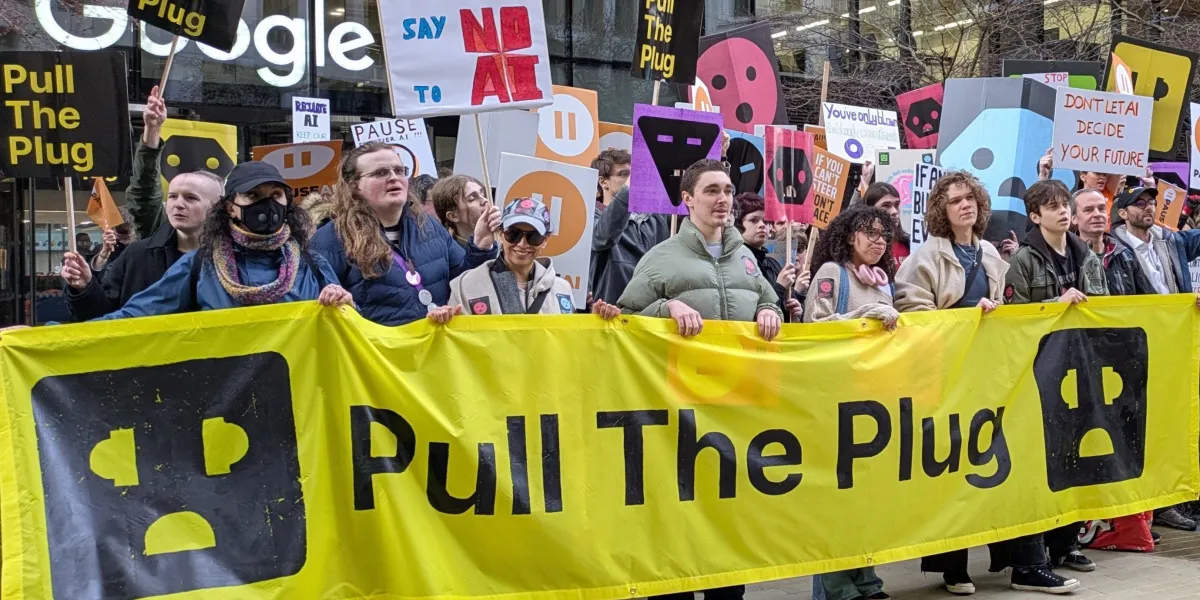
Most people I spoke to agreed that technology companies probably wouldn’t pay any attention to such protests. “I don’t think pressure on companies will ever work,” Maxime Fornes, global head of Paws AI, told me when I met him in March. “They’re conditioned not to care about this problem.”
But Fornes, who worked in the AI industry for 12 years before joining Paws AI, thinks he can make it harder for those companies. “We can slow down the race by creating protections for whistleblowers or showing the public that working in AI is not a sexy job, in fact it is a terrible job – you can drain the talent pipeline.”
In general, most protesters hoped to make more people aware of the issues and use that publicity to push for government regulation. Organizers had billed the march as a social event, encouraging anyone interested to attend.
It seemed to work. I met a guy who works in finance who tagged along with his roommate. I asked why he was there. “Sometimes you don’t have as much to do on a Saturday,” he said. “If you can see the logic of the argument, it makes sense to you, then it’s like ‘Yeah, sure, I’ll come along and see how it is.'”
He thought it was difficult for anyone to fully oppose raising concerns about AI. “It’s not like a pro-Palestine protest, where you’ll have people who may disagree with the issue,” he said. “With that, I feel like it’s very hard for anyone to be completely opposed to what you’re pushing for.”
After winding its way through King’s Cross, the march ended at a church hall in Bloomsbury, where tables and chairs were set up in rows. Protesters wrote their names on stickers, stuck them to their chests and made awkward introductions to their neighbors. They came here to learn how to save the world. But I had a train to catch and I left them at that.
