
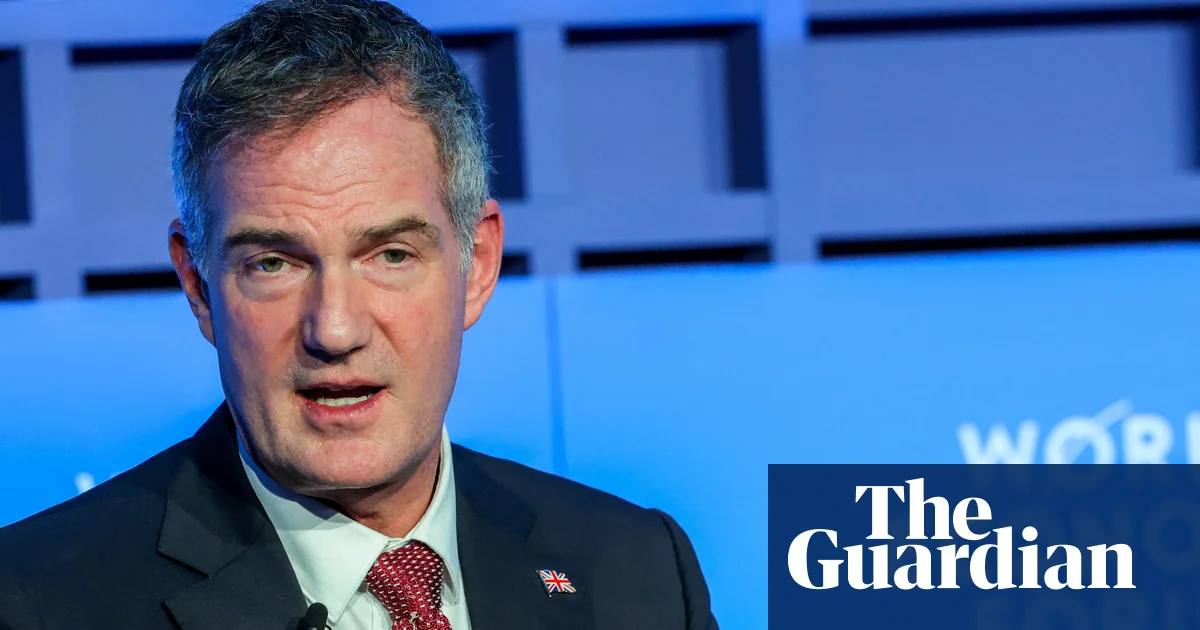
The UK Business Secretary, Peter Kyle, has said he is “betting big” and “picking winners” as the government takes direct stakes in growing businesses to boost economic growth.
Speaking at the World Economic Forum in Davos, where he and Chancellor Rachel Reeves were talking up Britain’s prospects, Kyle said ministers were taking a “proactive” approach to industrial policy.
The idea of ”picking winners” is closely linked to Conservative Prime Minister Margaret Thatcher’s attacks on Labour’s 1970s strategy and her argument that it should be the private sector that decides which companies go ahead.
Kyle did not hesitate to use this phrase and argued that a strong approach could accelerate economic growth. “I want to ensure that the benefits of growth are felt faster than at present. We are projected to have 1.5% growth this year. That is not enough.”
He highlighted recent decisions to allow the £26bn state-owned British Business Bank to buy equity stakes in companies, including last week’s announcement of a £25m investment in Kraken, the software spin-off of energy supplier Octopus.
“The biggest potential for our economy in the short and medium term is for scale-up companies,” Kyle said. “I was at Octopus yesterday. They now employ 1,500 people in their head office in London alone.
“We can find other companies that are on that kind of trajectory and we can accelerate their growth. Then it will create thousands of new jobs, and it will create enormous amounts of wealth, recycling through the economy really fast.”
“I’m betting big. And I’m picking winners,” he said. “It’s more proactive. And there will definitely be things that won’t work. But for a healthy economy, failure leads to success.”
This week’s summit in a Swiss ski resort has been overshadowed by Donald Trump’s threat to impose tariffs on eight European countries if they stand in the way of his hopes of annexing Greenland.
The president backed away from the idea of punitive import taxes on Wednesday evening after discussions with NATO Secretary General Mark Rutte, but many leaders at the Swiss ski resort said the global economic order has irreversibly changed.
Kyle stressed that international uncertainty was no reason not to move forward on Labour’s agenda, highlighting the prospects of “the wave of opportunity that all these huge, huge, positive waves of technology and life sciences and innovation are going to present to us”.
He said: “If we are too intimidated by global challenges, if we are too distracted by domestic political back-and-forth, we will take our eye off the ball, and we will miss the opportunity of a lifetime, and that means real things to real people.
“There will be kids growing up like me who won’t be as successful as I was. These will be communities that are poor right now, and have no hope of ever becoming prosperous. And I won’t stand for that. I’ll literally do anything. And if that means betting on winners and making mistakes from time to time, I’ll take it.”
Announcing plans to strengthen the government’s “global talent workforce” in her department, the Business Secretary suggested the UK hoped to exploit the instability caused by Trump’s policies to help attract jobs and investment.
He said, “I’ll pull the best talent wherever it is, and talent goes both ways across the Atlantic. And I want to make sure we have a good balance in it because for too long it’s been one way.”
Highlighting the need to attract innovators in particular, Kyle said: “The US is being disruptive with tariffs, but the US is not the most favorable place for scientific endeavor at the moment in any case. Do the math and add up where we’re going with this. We’re going out there and we’re saying: ‘Actually, we have one of the best regulatory environments in the world for life sciences and across the board.'”
Keir Starmer has taken a tough stance on migration – despite opposition from some quarters in the party – promising to reduce it and condemning Boris Johnson’s administration for what the prime minister has called “the experiment of open borders”.
But Kyle said he doesn’t think public skepticism about immigration extends to wealthy entrepreneurs. He said, “People are deeply concerned about the immigration system and asylum system we inherited, which was broken, and poorly administered by the Tories, and therefore broken.”
“I’ve never found anyone who would say that people who have a lot of money to invest in our country, who want to come here and create jobs, create businesses, shouldn’t come to do that.”
He added: “I have a taskforce doing this, which taps into our global network. We can offer a special package to the world’s brightest people to come to the UK rapidly, embed them, and then, of course, become part of a rich funding landscape.”
The 55-year-old MP for Hove and Portslade has been business secretary since Starmer’s September reshuffle, replacing Jonathan Reynolds, who spent several years in the opposition.
Kyle is politically close to the Health Secretary, Wes Streeting – who has repeatedly been floated as a potential challenger to Starmer – but has publicly been staunchly loyal to the Prime Minister.
Earlier this week, the Business Secretary rejected the suggestion that the UK try to negotiate a customs union with the EU, for which Streeting has signaled his support, telling the FT: “I think it would be foolish to slide towards simplistic solutions at this time.”
Kyle has dyslexia and left his state school “with no useful” qualifications, as he puts it. He attended university at the age of 25 and gained a PhD, then worked in the charity sector before entering politics.
In his previous job as technology secretary, he was forced to defend his closeness to powerful tech companies. He is a regular user of the chatbot ChatGPT and an evangelist for the opportunities offered by technology – and is often seen in the casual attire favored by “tech bros”.
Soon after taking up his current role, Kyle struck a deal with business groups and trade unions to ease Labour’s implementation of the Employment Rights Act, introducing a six-month probationary period before promised “day-tone rights” were implemented.
He continues to work closely with his successor and friend Liz Kendall and is said to have insisted that the connecting door blocking the corridor between their two offices be opened.
Asked whether AI would lead to mass layoffs as companies decide they can manage without entry-level employees – a hot topic at Davos – Kyle said: “People are worried and it’s going to be painful and difficult because change is always painful and difficult.”
Kyle said Labor was prepared to intervene to ensure that the adoption of AI was less painful for poor communities than the de-industrialisation of the 1980s, which cast a long shadow.
He said: “Waves of industrial change have always gone badly when governments stand on the sidelines and are not partners. And I will not let that happen.
“As technical secretary I was negotiating deals for investment in digital infrastructure, insisting that it happen in poorer parts of the country. I am the gatekeeper to our country for a lot of investors. And if they want to come to our country and benefit, they can also contribute to it.”
