
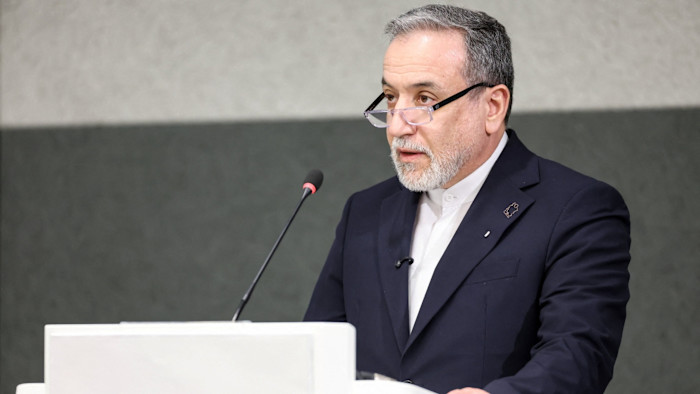
Iran’s top diplomat said the US and the Islamic republic have reached an “agreement” on principles to guide negotiations for a deal on Tehran’s nuclear program after discussions between the rivals on Tuesday.
Iranian Foreign Minister Abbas Araghchi told reporters in Geneva that “good progress” had been made in the talks, but he cautioned that this did not mean a deal would be reached soon.
“Ultimately we reached a common understanding on some principles to guide us going forward and help draft the text of a potential agreement,” he said.
“We hope this will happen soon, and we are prepared to devote sufficient time to it. However, once we start drafting the text, it becomes more difficult and detailed.”
Brent crude fell more than 2 percent to $67.18 a barrel after the conclusion of the talks.
A US official said that “progress has been made, but there are still many details left to discuss”.
“The Iranians said they will come back in the next two weeks with detailed proposals to address some of the shortcomings in our position,” the official said.
During several rounds of indirect talks between the Trump administration and Tehran last year, both sides expressed optimism that they were reaching an agreement.
But the diplomatic effort was derailed after Israel launched a 12-day war against the Islamic Republic in June, 48 hours before the sixth round of talks was to take place.
The US briefly joined Israel in bombing Iran’s main nuclear sites.
The latest talks came after President Donald Trump reiterated his warning of “consequences” if Tehran fails to agree to the deal.
Tuesday’s talks, which were facilitated by Oman, followed a round of indirect talks – the first since the war – in Muscat earlier this month and come as the US continues its military buildup in the region.
Araghchi said it was unclear when the next round would take place, adding that the two sides would work on relevant drafts of a potential agreement and exchange texts.
Oman’s Foreign Minister Badr Albusaidi said, “Together we made serious efforts to define a number of guiding principles for the final deal.” “There is still a lot of work to be done.”
Trump, who last week said he was deploying a second aircraft carrier strike group to the Middle East, said Monday night that he would be involved “indirectly” in the talks.
“I think they want to make a deal. I don’t think they want the consequences of not making a deal,” Trump told reporters aboard Air Force One.
Trump has repeatedly threatened military action against Iran if no deal is reached following Tehran’s brutal crackdown on mass anti-regime protests last month that left thousands dead.
The US has sent additional warships, fighter jets and air defenses to the Middle East in the past month.
Iranian officials have said they want a deal, but also that they are prepared for war.
The Revolutionary Guards this week began a naval exercise in the Strait of Hormuz, a major maritime trade route through which about a third of the world’s marine raw materials pass.
State television reported Tuesday that the Guardsmen were prepared to clear parts of the strait for several hours to test anti-war cruise missiles and rehearse the possible closure of the strategic waterway.
Alireza Tangsiri, commander of the Guards Navy, said his forces are ready to close the waterway whenever Iran’s leaders order them to do so.
In a speech on Tuesday, Iran’s supreme leader Ayatollah Ali Khamenei rejected US threats, and suggested the Islamic republic’s armed forces were capable of launching powerful retaliatory strikes.
“Even the most powerful armies in the world can be attacked in such a way that they become unable to stand back,” he said, drawing applause from supporters.
Diplomats have warned that there are major challenges to achieving a deal given deep mistrust between the rivals.
Iran, which is in its weakest position in decades, has decided that it will not be seen bowing down to Trump.
A key obstacle has been the US’s long-standing demand that Iran permanently give up its ability to enrich uranium, a process that can yield both nuclear fuel and weapons-grade material.
Tehran has rejected this, insisting it has a right to prosper as a signatory to the Nuclear Non-Proliferation Treaty, and denying it is trying to develop nuclear weapons.
Turkish Foreign Minister Hakan Fidan, who is involved in mediation efforts, told the FT last week that “the Americans appear willing to tolerate Iranian enrichment within clearly set limits”.
Washington has also sought to curb Iran’s ballistic missile program and its support for regional militants in the talks, while Tehran says they should focus only on the nuclear issue.
However, Trump’s messaging has been mixed, with the President suggesting that a deal covering only Iran’s nuclear program might be “acceptable.”
Araghchi spoke on Monday with Rafael Grossi, director general of the International Atomic Energy Agency, who is trying to gain access to three sites bombed by the US and Israel in June.
Last week, Iranian President Massoud Pezeshkian said Tehran was willing to open its nuclear sites to “any verification” to prove it was not trying to build nuclear weapons.
Iran has blocked the IAEA from accessing the sites since the bombing, amid Western concerns about the fate of a stockpile of more than 400 kilograms of enriched uranium at purity close to weapons-grade levels.
Araghchi said after the talks ended on Tuesday that it would “take time” for the US and Iran’s positions to “come closer”.
“This is not a roadmap, but we now have a clear picture of what needs to be done along the way,” he said.
Additional reporting by Mercedes Ruehl in Geneva and Abigail Hauslohner in Washington
