
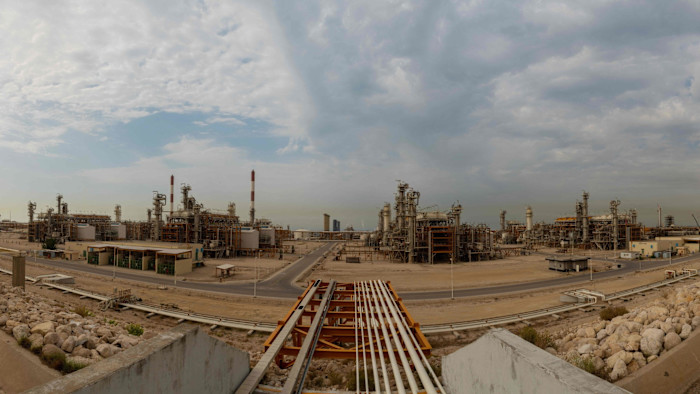
Iran is trying to woo Donald Trump with financial incentives, including investments in its vast oil and gas reserves, as part of efforts to persuade the US President to agree to a deal on its nuclear program and avoid war.
A person briefed on the talks described it as a “commercial bonus” offer, in which Tehran wanted to appeal to Trump’s penchant for deals promising financial dividends for the US.
Iranian Foreign Minister Abbas Araghchi will hold another round of indirect talks with US envoys Steve Witkoff and Jared Kushner in Geneva on Thursday.
The dangling of investment opportunities was “specifically directed at Trump, a major economic gainer in oil and gas and mining rights, critical minerals and all that,” the person said.
A second person said Iran had discussed offering US investments in gas and oil but the proposal had not been formally presented to Washington.
“(Iran) is looking at Venezuela as a case study,” the person said, referring to Trump’s pressure to get U.S. companies oil deals in the Latin American country after the U.S. seized control of Nicolas Maduro last month. The White House declined to comment on the potential investment proposal.
The idea is part of Iran’s efforts to convince Washington that it is serious about a deal and can stop US attacks as it faces increasing pressure from Trump.
It also comes as Iranian officials have threatened to escalate any conflict with the US in the wake of the US strike, signaling they will reconsider their previous principle of limiting retaliation.
Trump, who has staged the largest military buildup in the Middle East since the US-led invasion of Iraq in 2003, warned Tehran last week that it had a “maximum” of 15 days to reach a deal otherwise “bad things will happen”.
In his State of the Union address on Tuesday, Trump condemned Iran’s “sinister” nuclear ambitions and accused Tehran of “working to build missiles that will soon reach the United States.”
“My priority is to solve this problem through diplomacy,” he said. “But one thing is for sure, I will never allow the number one sponsor of terrorism in the world, which they are, to have nuclear weapons. Can’t let that happen.”
Iran insists its program is for civilian purposes, but it was enriching uranium to near weapons grade levels before the US and Israel bombed its nuclear facilities last year.
Iran is also discussing the possibility of a multinational verification mechanism for its nuclear program, which could include the U.N. watchdog, the International Atomic Energy Agency, as well as a U.S. team or a third country representing it, people briefed on the talks said.
Araghchi said Tuesday that Iran “will not develop nuclear weapons under any circumstances” and would seek a “fair and equitable settlement in the shortest possible time.”

“We have a historic opportunity to reach an unprecedented agreement that addresses mutual concerns and achieves mutual interests,” Araghchi said on X. “A deal is within reach, but only if diplomacy is given priority.”
Iran’s Foreign Ministry spokesman Ismail Baghai declined to provide details about what Tehran is offering, but cited Araghchi’s opinion about possible economic cooperation with the US.
“In those articles, Araghchi talks about oil, gas and energy, where we have advantages and need modern technology, and where there is strong potential,” Baghai told the FT.
According to the US Energy Information Administration, Iran is ranked as the holder of the planet’s third-largest oil and second-largest gas reserves in 2023. It shares the world’s largest natural gas field with Qatar.
Deputy Foreign Minister Hamid Ghanbari told Iranian businessmen this month that “common interests in the field of oil and gas, including joint fields (with neighboring countries), as well as investments in mining and even the purchase of civilian aircraft, have been included in the talks with the US.”

Ghanbari said that unlike the 2015 nuclear deal, which Tehran signed with the Obama administration and other world powers, it was necessary to “leverage areas that provide high and quick returns for the US” to secure a “durable agreement”.
After that agreement took effect, Iran briefly opened the door to foreign investment, with Boeing signing a $20 billion deal to supply aircraft to Iran Air.
But it collapsed before any planes were delivered in 2018 after Trump left the nuclear deal and imposed severe sanctions on Iran and halted foreign investment.
As part of any new nuclear deal, Iran would want relief from sanctions. Ghanbari said Tehran expects the US to free up its oil money held abroad, amounting to billions of dollars.
The Trump administration and Iran have held two rounds of indirect talks this month, the first since the US briefly got involved in Israel’s 12-day war against Iran last June. Before that conflict they had held five rounds of talks.
A long-standing obstacle to progress has been whether Iran can maintain its ability to enrich uranium. The US has been insisting that Tehran permanently eliminate its enrichment capacity.
Iran has rejected the condition, saying it is its right as a signatory to the Nuclear Non-Proliferation Treaty. Fulfilling the demand is considered a red line for Supreme Leader Ayatollah Ali Khamenei.
Regional officials, including Turkey’s top diplomat, told the FT that the Trump administration had signaled it could be flexible, suggesting Iran could be allowed to enrich to a token level if a deal is agreed. Trump administration officials have disputed this.
Araghchi told MSNBC last week that Washington had not asked Tehran to permanently suspend enrichment.
“We have not offered any suspension and the US side has not asked for zero enrichment,” he said. But Trump’s chief negotiator Witkoff said over the weekend that the president’s “red lines” include “zero enrichment” and said Iran would have to hand over its enriched uranium reserves.
Additional reporting by Abigail Hauslohner in Washington
