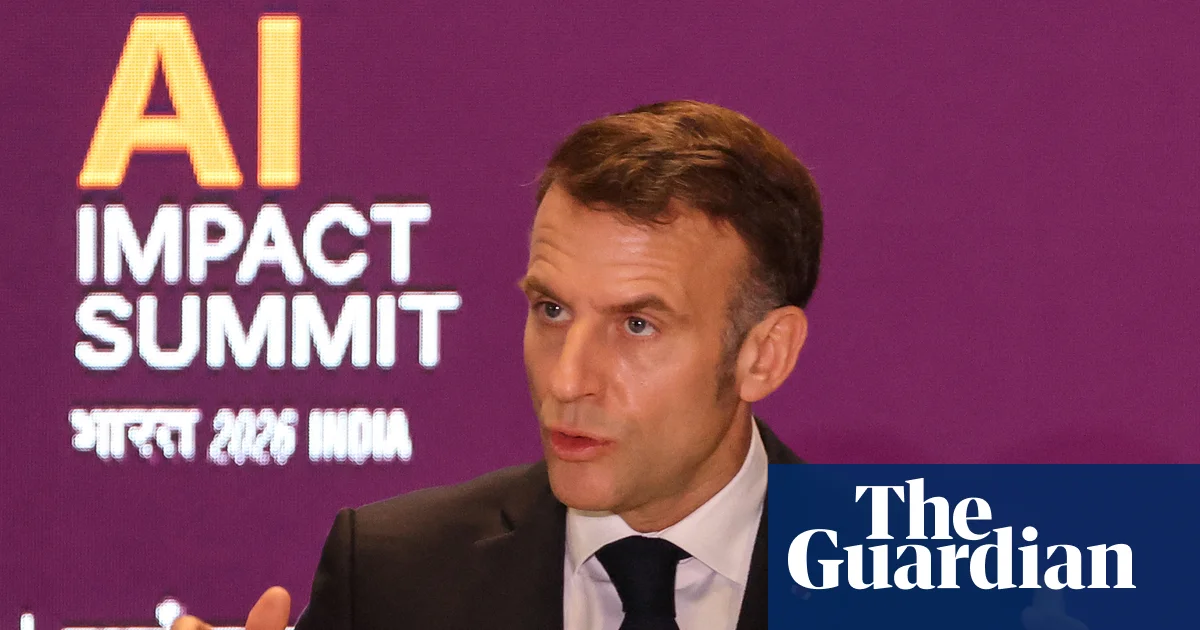
Emmanuel Macron has hit back at US criticism of Europe’s efforts to regulate AI, vowing to protect children from “digital abuse” during France’s presidency of the G7.
Speaking at the AI Impact summit in Delhi, the French president called for stricter safeguards following a global outcry over Elon Musk’s Grok chatbot being used to generate thousands of sexually explicit images of children and growing concern about the concentration of AI power in a handful of companies.
His comments were echoed by UN Secretary-General Antonio Guterres, who told delegates – who also included several US tech billionaires – that “no child should be the subject of testing for unregulated AI”.
“The future of AI cannot be decided by a few countries or left to the will of a few billionaires,” Guterres said. “AI should be everyone’s”.
Bill Gates was scheduled to speak, but he backed out at the last minute amid renewed scrutiny of his past ties to convicted child sex offender Jeffrey Epstein.
Meanwhile, an attempt by India’s Prime Minister Narendra Modi to demonstrate unity among major tech billionaires backfired when the rival chiefs of OpenAI and Anthropic awkwardly refused to hold each other’s hands on stage.
Modi stood at the center of a line of 13 tech executives, including the leaders of Google, Meta and Microsoft, in addition to Sam Altman and Dario Amodei, who stood with folded hands. Amodei split from OpenAI in 2021 due to differences over how to manage security risks.
On Wednesday, the White House’s senior AI adviser, Sriram Krishnan, reiterated the Trump administration’s criticism of AI regulation, highlighting the EU’s AI Act. He told delegates that he would continue to “lobby” against legislation that is not “friendly to entrepreneurs wanting to create innovative technology”.
But Macron told the intergovernmental summit: “Contrary to what some misinformed friends are saying, Europe is not blindly focused on regulation. Europe is a place for innovation and investment, but it is a safe place, and safe places win in the long run.”
Research published this month UNICEF and Interpol across 11 countries found that at least 1.2 million children reported having their images manipulated to create sexually explicit deepfakes last year. In some countries, one in 25 children – the equivalent of one child in every classroom – was affected.
“There is no reason for our children to be exposed online to things that are legally prohibited in the real world,” Macron said. “Our platforms, governments and regulators must work together to make the internet and social media a safer place. That’s why, in France, we are starting the process of banning social networks for children under 15.”
Tech executives attending also included Sam Altman, chief executive of OpenAI, which is facing a legal challenge from the family of 16-year-old Adam Raine, who took his own life after discussing suicide with ChatGPIT.
Altman told delegates that the rapid pace of AI development means “by the end of 2028, more of the world’s intellectual capacity could reside inside datacenters than outside them”. He also stressed the urgent need for “regulation or safeguards” and called for the creation of a body similar to the International Atomic Energy Agency to oversee international coordination of AI.
Dario Amodei, co-chief executive of Anthropic, said he was “concerned about the autonomous behavior of AI models, the potential for their misuse by individuals and governments, and their potential for economic displacement”.
Modi said it is “imperative that AI be safe for children and family-directed”, comparing the emergence of AI to the discovery of fire and calling it a “profound change in human history”.
As India seeks to establish itself as the world’s third AI power after the US and China, Google this week announced a $15 billion investment in datacenters and subsea cables connecting India to the US and other countries.
Modi said that “a level of authenticity must be established for content within the digital world…people must know what is authentic, and what is generated by AI”.
The intervention comes amid growing public concern about the societal risks of AI, as the most advanced models remain largely controlled by about four US companies and a handful of Chinese rivals.
Modi set out an alternative approach, taking advantage of India’s 1.4 billion population as a huge growth market for tech companies. He said: “We must prevent the monopolization of AI. Many countries consider AI a strategic asset, and so it is developed confidentially and its availability is carefully managed.”
“However, our country India takes a different view. We believe that technology, like I, will only truly benefit the world when it is shared and when open source code is available.”
His comments appear to be directed at the US, where major AI models are not open-source and cannot be used or adapted without permission. In contrast, China’s major systems, such as DeepSeek and Quon, are largely open-source.
