
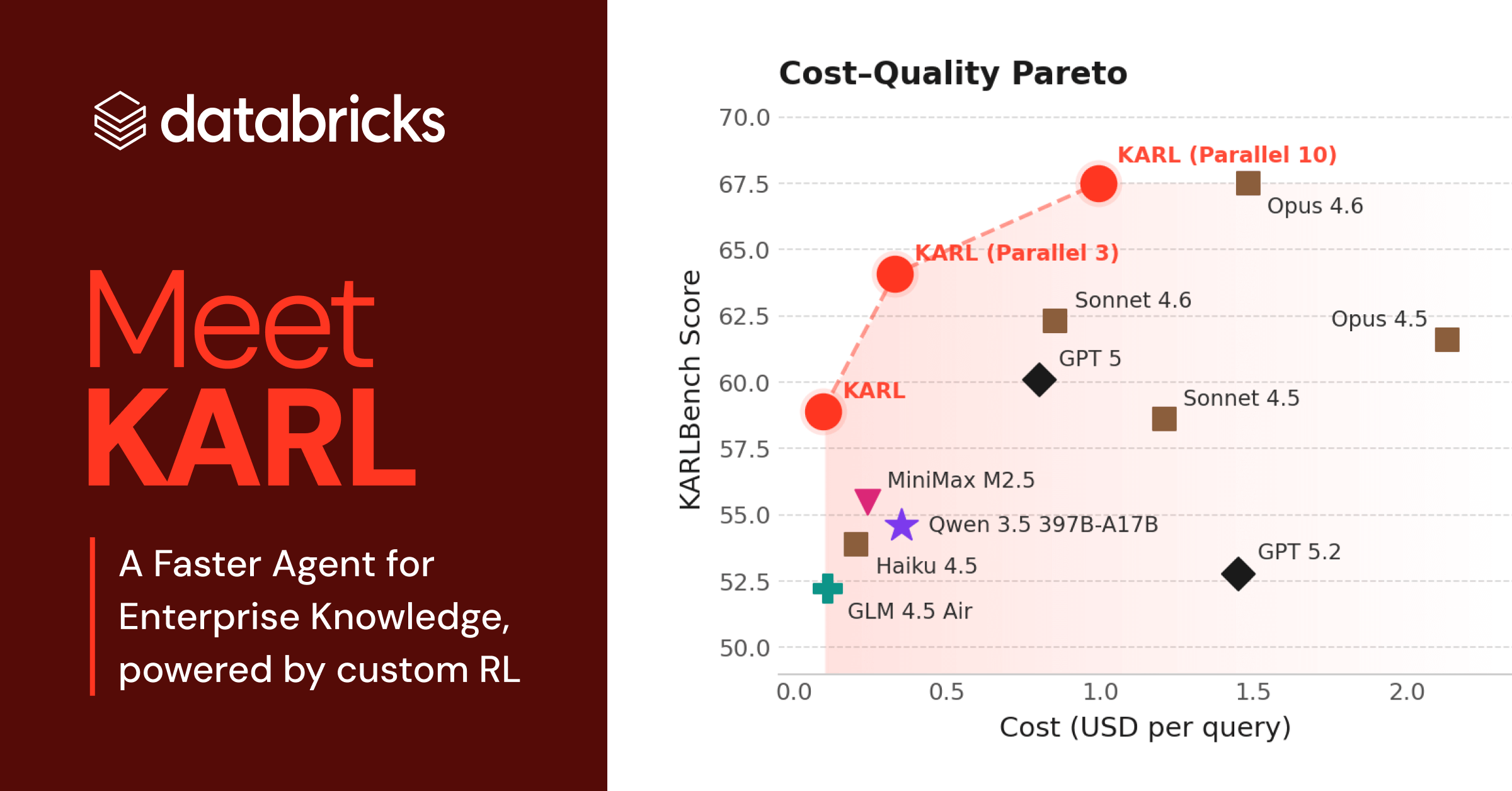
Databricks has introduced KARL — short for Knowledge Agent via Reinforcement Learning — a model built to handle the kind of enterprise search and reasoning that tends to break conventional retrieval systems. Rather than answering a single question from a single passage, KARL is designed for grounded reasoning: searching across documents, finding and cross-referencing facts, and working through problems that can span dozens or hundreds of steps. It powers parts of the company’s Agent Bricks product and is currently offered in preview.
The problem it targets
Improvements in model reasoning have pushed organisations to deploy agents for cognitive work such as writing code, querying internal data, and automating routine workflows. The frontier models behind those agents are capable but expensive, and for high-volume use cases the inference cost can climb faster than the value the agent returns. KARL is an attempt to keep the quality of a strong general model while bringing the running cost and response time down to something sustainable at scale.
How it was trained
According to Databricks, KARL was trained with a custom reinforcement-learning approach spanning several distinct search behaviours, which lets a single model piece together information from fragmented internal documents, reconstruct the history of a deal, and answer detailed questions about an account. Notably, the company says the model was trained on synthetic data it generated itself, without human labelling, using only a few thousand GPU hours — a far smaller training budget than a frontier model from scratch.
The efficiency claim
Databricks reports that, on a purpose-built benchmark, KARL matched a leading frontier model (Anthropic’s Claude Opus 4.6) while cutting cost per query by roughly 33 percent and latency by roughly 47 percent. These are vendor-reported figures measured on Databricks’ own benchmark rather than an independent evaluation, so they are best read as an indication of the approach’s potential rather than a settled comparison. The underlying method is described in more detail in the company’s technical report.
A reusable pipeline for customers
The same RL pipeline and infrastructure used to build KARL is being made available to Databricks customers who want to improve performance and reduce cost on high-volume agent workloads. Many real-world enterprise tasks are difficult to verify automatically, and Databricks frames KARL as evidence that custom RL can be applied to such tasks. Through a private preview backed by serverless GPU compute, customers can use the same approach to build more efficient, domain-specific versions of their own agents. This sits within the broader wave of enterprise AI agents that vendors are racing to commercialise.
Limitations and what to watch
Several caveats are worth keeping in mind. The headline performance numbers come from Databricks’ own benchmark, so independent testing on real workloads will be the truer measure. A model trained largely on self-generated synthetic data can inherit blind spots from whatever produced that data, which makes ongoing evaluation against real questions important. The custom-RL pipeline is also tied to the Databricks platform and, at the time of writing, parts of it remain in preview, so availability, pricing and feature scope may change. As with any retrieval agent, answer quality still depends heavily on the quality, freshness and access controls of the underlying enterprise data. Organisations considering the approach are best served by running their own evaluations before relying on it for high-stakes decisions. Full details are available on the Databricks blog.
