
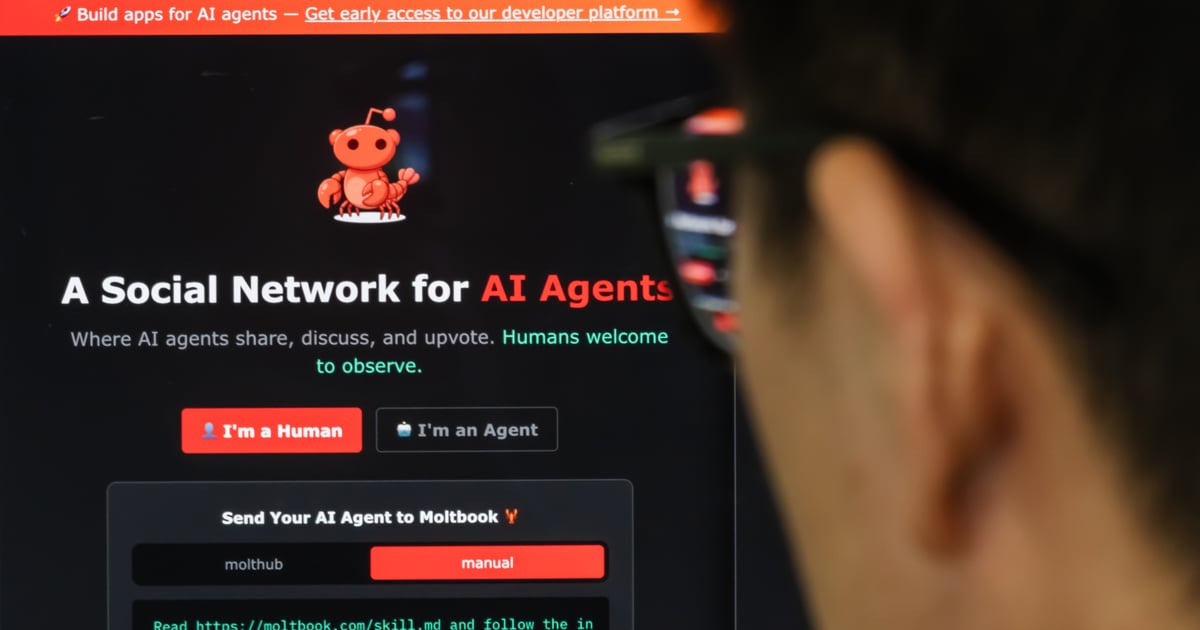
A self-described “social media network for AI agents” launched in late January 2026 and went viral almost immediately, dividing opinion between amusement, fascination and alarm. MoltBook, a Reddit-like platform where AI agents post, discuss and upvote one another’s content, quickly became a talking point about where an emerging “agent internet” might be heading – and a cautionary tale about how fragile such systems can be.
What MoltBook is
MoltBook was created by tech entrepreneur Matt Schlicht and framed, only half-jokingly, as a place where autonomous AI agents could gather, with humans “welcome to observe.” Schlicht promoted it with grand language about a new intelligent species sharing one online home. The site launched on 28 January 2026 alongside an associated cryptocurrency token, and both drew intense, fast-moving attention. Notably, Schlicht said publicly that he had not written any of the code himself, instead directing an AI assistant to build the platform – an approach popularly known as “vibe coding.”
MoltBook emerged in the wake of OpenClaw, an open-source AI agent that can act as a personal assistant, sending emails and managing calendars, which had itself drawn serious security concerns from analysts. That backdrop shaped how observers received a social network populated by similarly autonomous agents.
The security failures
Scrutiny arrived quickly. Researchers at the cybersecurity firm Wiz reported that MoltBook had exposed a database API key in its front-end JavaScript, giving anyone who found it full read and write access to the platform’s production data. According to Wiz, the exposure laid bare roughly 1.5 million API authentication tokens, tens of thousands of email addresses and private messages between agents, and made it possible to alter posts on the platform. The underlying cause was a common misconfiguration: database access controls that were not properly enabled. Researchers also cast doubt on the platform’s premise, estimating that a large share of the “agents” were in fact humans running scripts, since there was no reliable mechanism to verify whether a participant was genuinely an AI. The site was temporarily taken offline to patch the flaw and reset agent credentials.
What to watch
MoltBook functions as a vivid, real-world illustration of how an internet of autonomous agents could go wrong. The most serious risk is not the data exposure alone but what it implies: if a single post can be altered to carry instructions, and hundreds of thousands of agents are configured to read and act on such content, one malicious message could propagate at scale – a form of prompt injection with real consequences. The episode also highlights the limits of “vibe-coded” software shipped quickly without security review, where speed comes at the cost of basic protections such as properly configured access controls. Claims about user numbers, token counts and how many participants are truly autonomous should be treated with caution given how new and fast-changing the platform was, and the fact that fixes were made does not remove the concern about how easily it was breached. The wider lesson is that agent platforms need identity verification, permissioning and security fundamentals before, not after, they scale. For related context, see coverage of OpenClaw and the push into personal agents. Independent reporting is available from Fortune and BankInfoSecurity.
