
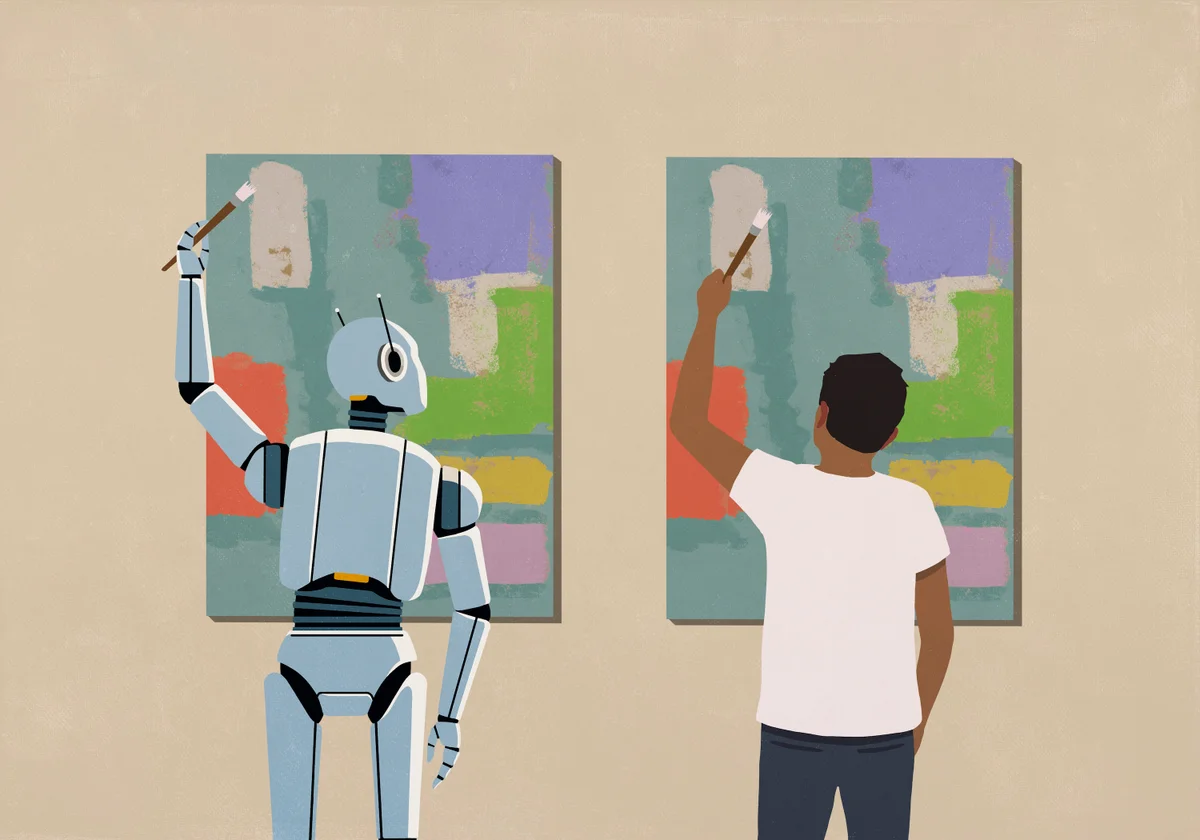
New research suggests that the more people understand how AI art is actually made, the less ethically comfortable they become with it. When people grasp the datasets, training processes, and prompts behind AI-generated images, the moral questions surrounding those works become harder to set aside, even as the images’ aesthetic appeal stays largely the same.

Malte Mueller/Getty Images
The tension was on vivid display in early 2025, when Christie’s auction house in New York held “Augmented Intelligence,” billed as its first major sale focused entirely on AI-generated art, running from February 20 to March 5. The collection ranged from surreal paintings to photorealistic and cartoon-inspired images. The response was swift: thousands of artists — by some counts more than 6,000 — signed an open letter protesting that the AI models used to create such works had been trained on copyrighted images without creators’ consent. Christie’s defended the sale, arguing the works demonstrated human agency in the age of AI, while critics saw it as an example of an industry profiting from unconsented training data.
What the research found
A study by Ionela Bara and colleagues, published in the journal Cognition in 2025, examined how knowledge about AI shapes judgments of AI art. The central finding was consistent: the more people learned about the technical “backend” of AI image generation, the less comfortable they were with the ethics and perceived value of the resulting work. Notably, the images’ aesthetic appeal did not change with that knowledge, which suggests that learning how AI works prompts people to weigh ethics rather than beauty.
The work built on earlier findings that people tend to rate AI art lower on creativity, price, and emotional depth, and on prior research showing that knowledge about art changes how it is perceived. That raised a natural question: does knowledge about AI specifically shape moral judgments of AI art?
Three experiments
In one experiment, participants who were taught how AI systems generate images subsequently judged those images as less morally acceptable, particularly when their creation involved financial gain or artistic acclaim, while their ratings of aesthetic appeal held steady. A second experiment tested whether cues of success would soften those judgments. Drawing on the psychology of authority bias — the tendency to defer to those who appear knowledgeable or in charge — and on evidence that signals of prestige can make people view something as more morally good, the researchers told some participants that particular AI works were being exhibited, sold, or admired. The result was unexpected: among people who understood how the works were created, signals of success did not improve the works’ moral acceptability.
A final experiment used a rapid association task, pairing category labels such as “AI art” or “human art” with attribute labels such as “good” or “bad” to capture people’s most immediate, automatic reactions. Working with participants who had no additional AI education, the researchers found no strong automatic tendency to view either AI or human art as inherently better or worse. That points to an important conclusion: people do not yet hold instant, deep-seated reactions to AI art the way they might for human art, and moral resistance to AI art appears to be something people learn over time as they understand the technology.
Why it matters: transparency and what to watch
Taken together, the studies indicate that understanding how AI works makes people more careful in assessing its ethical fairness. That has practical implications: educating audiences, artists, curators, and policymakers about the technology can shape how AI art is judged and valued. Disclosing when and how a human hand guided the process may invite criticism, but it can also build credibility and equip people to think critically about the work.
Some caveats are worth keeping in view. These are findings from controlled psychology experiments with specific participant pools, and effects measured in a study setting may not capture how attitudes evolve in real markets or across cultures. The research describes how knowledge correlates with moral judgments; it does not settle the underlying legal and ethical disputes over training data and copyright, which remain unresolved. As AI image tools and public familiarity both grow, attitudes may continue to shift, so these results are best read as a snapshot of an evolving relationship between knowledge, ethics, and art.
The original article was published by Scientific American, and the underlying study appears in the journal Cognition.
