
Unlock the free White House Watch newsletter
Your guide to what Trump’s second term means for Washington, business and the world
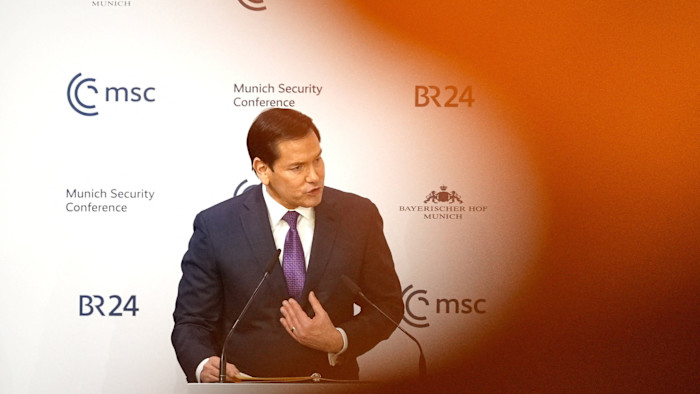
US Secretary of State Marco Rubio has called for a “revitalized” partnership between the US and Europe based on a shared “great civilization”.
In a speech at a security conference in Munich on Saturday, Rubio tried to reassure Europeans rattled by Donald Trump’s tariffs and a year of threats to the NATO international alliance.
He stressed Washington’s willingness to work “together with you, our friends in Europe,” describing “a sacred heritage, an unbreakable link” uniting the US and its European partners.
“We are together,” he said. “We are part of one civilization, Western civilization. We are bound together by centuries of shared history, Christianity, culture, heritage, language, ancestry and the deepest bonds created by the sacrifices made by our ancestors that nations can share.”
If US President Donald Trump “demands seriousness and reciprocity”, he said, it will be “because we care deeply”.
Rubio’s address sought to reinvigorate European audiences still reeling from Trump’s threats to invade Greenland last month, which created the deepest rift between the US and the continent in decades.
It also departed from aggressive comments made at the forum last year by US Vice President JD Vance, who accused Europe of suppressing free speech and retreating from its “fundamental values”.
Conference chairman Wolfgang Ischinger said Rubio’s “reassurance of partnership” and conciliatory message of “interconnected relationships” “brought a sigh of relief to this hall”.
Ischinger told Rubio that his comments reminded him of “statements made by your predecessors decades ago.”
Rubio also said: “At a time of headlines announcing the end of the transatlantic era, it must be known and clear to all that this is neither our goal nor our desire, because for us Americans, our home may be in the Western Hemisphere, but we will always be Europe’s children.”
However, he reiterated many of the same ideas and policy goals set forth by Vance last year.
He lamented the outsourcing of American industry, non-Western dominance of critical supply chains, and green energy policies, which he said sought to “appease the climate cult” while “making our people poorer.”
Above all, he stressed that Europe and America face the threat of mass migration and the possibility of “the extinction of civilization”.
“National security… is not just a series of technical questions,” he said. What are we really protecting? . . . We are protecting a great civilization. . . “Only if we are unapologetic about our heritage and proud of this shared heritage can we together begin to imagine and shape our economic and political future.”
Rubio said, “Mass migration … remains a crisis that is transforming and destabilizing societies across the West.”
But he stressed that it “is not an expression of xenophobia. It is not hatred. It is a fundamental act of national sovereignty”.
Pia Fuhrhop, a political scientist at the German think tank SWP, said Rubio’s speech seemed polite on the surface, but he was trying to draw Europe into his MAGA mentality. “It’s a poisonous gift,” he said of their message of working together.
Rubio also criticized “welfare states”, which he said Europe has pushed forward at the expense of funding its own security.
“What we want is a revitalized coalition that recognizes that what has damaged our society is not just a set of bad policies, but a disease of despair and complacency,” Rubio said.
His comments were warmly welcomed by some attendees.
A German diplomat commented, “This is not the answer we were looking for,” adding that the speech was aimed more at an American “domestic” audience than “for us.”
Another senior European official said, “It was maga but without any insight.” “No mention of Russia, no mention of Ukraine.”
But Jürgen Hardt, a senior member of the German parliament, said that “Rubio believes in NATO, which is positive. However, we Europeans will not get involved in the American culture wars.”
Additional reporting by Laura Pittel in Munich
