
This weekly science roundup covers four developments: NASA’s return to crewed lunar spaceflight, an AI-powered wearable that helps stroke patients speak, the oldest cave art yet dated, and new insight into how bats navigate cluttered spaces. The stories are drawn from Scientific American’s Science Quickly and verified against the underlying research and reporting.
Artemis II: humans return beyond low-Earth orbit
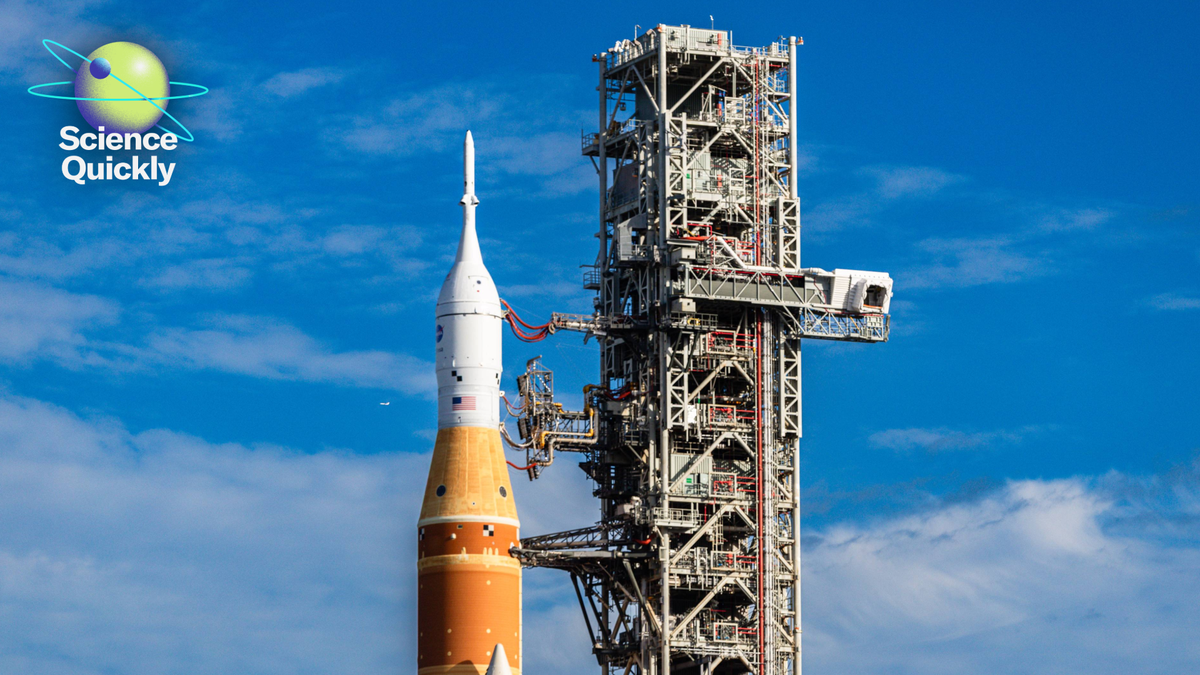
Artemis II is NASA’s mission to send astronauts around the Moon — the first crewed flight beyond low-Earth orbit since Apollo 17 in 1972. The program has been in development, in various forms, for roughly two decades, and Artemis II is where crewed hardware finally meets deep space.
The mission does not land on the Moon or even orbit it. Instead it follows a free-return trajectory, using lunar gravity to loop the four-person Orion crew around the Moon and slingshot the capsule back toward Earth. That path sets records: the crew travels farther from Earth than any humans in history, and returns fastest, hitting the atmosphere at roughly 25,000 miles per hour — a demanding test of Orion’s heat shield. The flight is heavily instrumented for human and space-medicine research, with the crew monitored by extensive biometrics throughout.
Motivations for returning to the Moon are both geopolitical — with India and China pursuing their own lunar ambitions — and scientific, including study of regions never before visited. When this roundup first aired, the launch window was still ahead. NASA subsequently launched Artemis II on April 1, 2026, and the crew — Reid Wiseman, Victor Glover, Christina Koch and Canada’s Jeremy Hansen — splashed down safely on April 10 after a roughly 10-day flight, which NASA declared a historic success.
An AI wearable that helps stroke patients speak
About half of stroke patients develop dysarthria, a weakening of the muscles that control speech and breathing that can leave speech slurred, slow or strained. The difficulty is physical, not cognitive: patients know what they want to say but struggle to produce it. Recovery is often possible through rehabilitation, but it can take months or years.
Researchers at the University of Cambridge developed ReVoice, a soft, flexible collar fitted with sensors that track tiny throat-muscle vibrations and heart rate and feed the data to two AI agents built on large language models. One agent reconstructs words from silently mouthed speech and throat vibrations; the second expands those fragments into full sentences, using the wearer’s physiological signals to infer emotional state and context. Together the system can propose what the person intends to say, letting them confirm with a simple head movement — far faster than the letter-by-letter input many existing tools require.
The study, published in Nature Communications, was small — five stroke patients with dysarthria alongside healthy controls — but reported strong accuracy, with a word error rate around 4% in the trial, per the University of Cambridge. The researchers plan larger clinical trials and note the approach could also help people with other neurological conditions, including Parkinson’s disease and motor neuron disease. It is an example of applied AI — multiple cooperating agents interpreting noisy real-world signals — a pattern that also appears in how AI agents make decisions under real constraints.
The oldest cave art yet dated
A study published in Nature reported what is, on current dating, the oldest known cave art. The previous record — a scene of a pig and three human-like figures on the Indonesian island of Sulawesi — was thought to be more than 51,000 years old. The new find comes from the same region: a hand stencil on the ceiling of the Liang Metanduno cave on Muna, an island off Sulawesi, that had been overlooked in earlier surveys.
Dating cave paintings is notoriously difficult, but the region’s limestone caves make it more tractable. Laser-ablation uranium-series dating of calcite overlying the stencil established a minimum age of about 67,800 years — roughly 15,000 years older than the previous record, according to the published research. The discovery may help clarify when humans first reached Australia, since archaeologists believe migrants passed through the Indonesian archipelago, and it adds to evidence linking symbolic art to early human cognition.
How bats navigate a cluttered world
Bats famously navigate in the dark using echolocation — emitting calls and locating objects from the returning echoes. But how they cope in cluttered, object-rich spaces, where a single call bounces back off many surfaces at once, has long puzzled researchers.
To investigate, a team at the University of Bristol built a “bat accelerator”: an eight-meter track lined with roughly 8,000 movable acoustic reflectors, or artificial leaves, that could mimic flight through dense foliage. Over three nights they recorded pipistrelle bats traversing the full length of the track. The results, published in Proceedings of the Royal Society B, showed the bats are sensitive to Doppler shift — the same pitch change heard as a siren passes — and use these movement-driven sound changes to gauge their surroundings and control their speed, slowing as apparent acoustic flow increased. The researchers suggest the findings could inform future drone navigation technology.
Why these stories matter together
Two of the four developments — the ReVoice collar and the bat-navigation work — sit squarely at the intersection of biology and computation. ReVoice shows AI agents turning faint physiological signals into usable speech, while the bat study reverse-engineers a biological navigation strategy that engineers may one day copy. Both are reminders that some of the most consequential AI progress is happening not in chatbots but in systems that sense and act in the physical world.
Limitations and what to watch
Several of these findings are early. ReVoice rests on a five-patient study and awaits larger clinical trials before its accuracy can be considered established. The Sulawesi date is a minimum age derived from overlying mineral deposits, and archaeological dates of this kind are periodically revised as methods improve. The bat research demonstrates a mechanism in a controlled setup; its role in fully natural environments, and its transfer to engineered drones, remains to be shown. As always, single studies mark a direction of travel rather than a settled conclusion.
