
Why current audio AI models often perform poorly when they generate long arguments instead of basing their decisions on actual sound. The StepFun research team has released Step-Audio-R1, a new audio LLM designed for test time compute scaling. Step-Audio-R1 addresses this failure mode by showing that accuracy degradation along the thought chain is not an audio limitation but a training and modality grounding problem.
The root problem, the reason for the audio model over text surrogates
Most current audio models derive their reasoning behavior from text training. They learn to reason as they read the transcript, not as they listen. The StepFun team calls this textual surrogate reasoning. The model uses hypothetical words and descriptions rather than acoustic cues such as pitch contour, rhythm, timbre or background noise patterns.
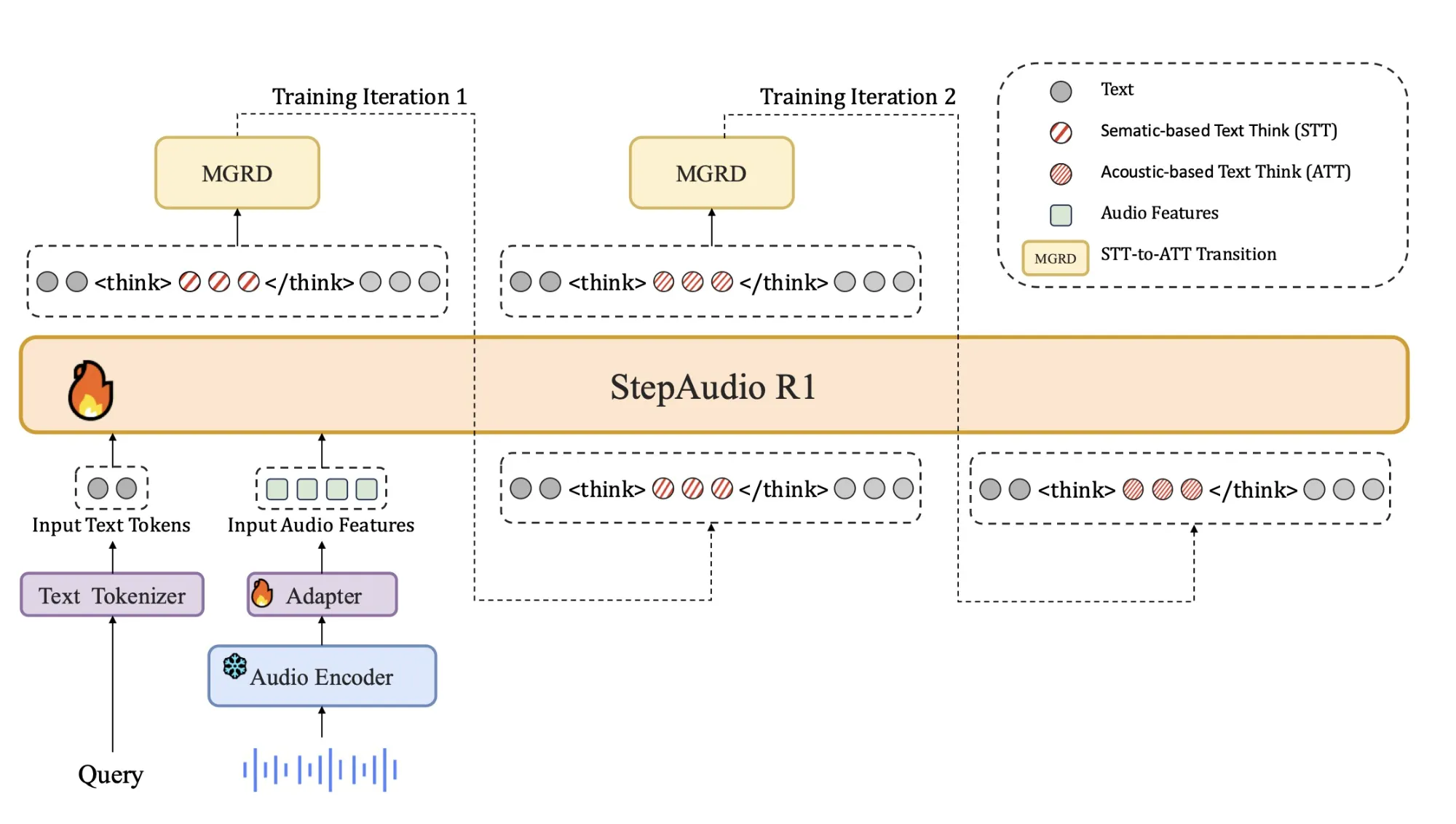
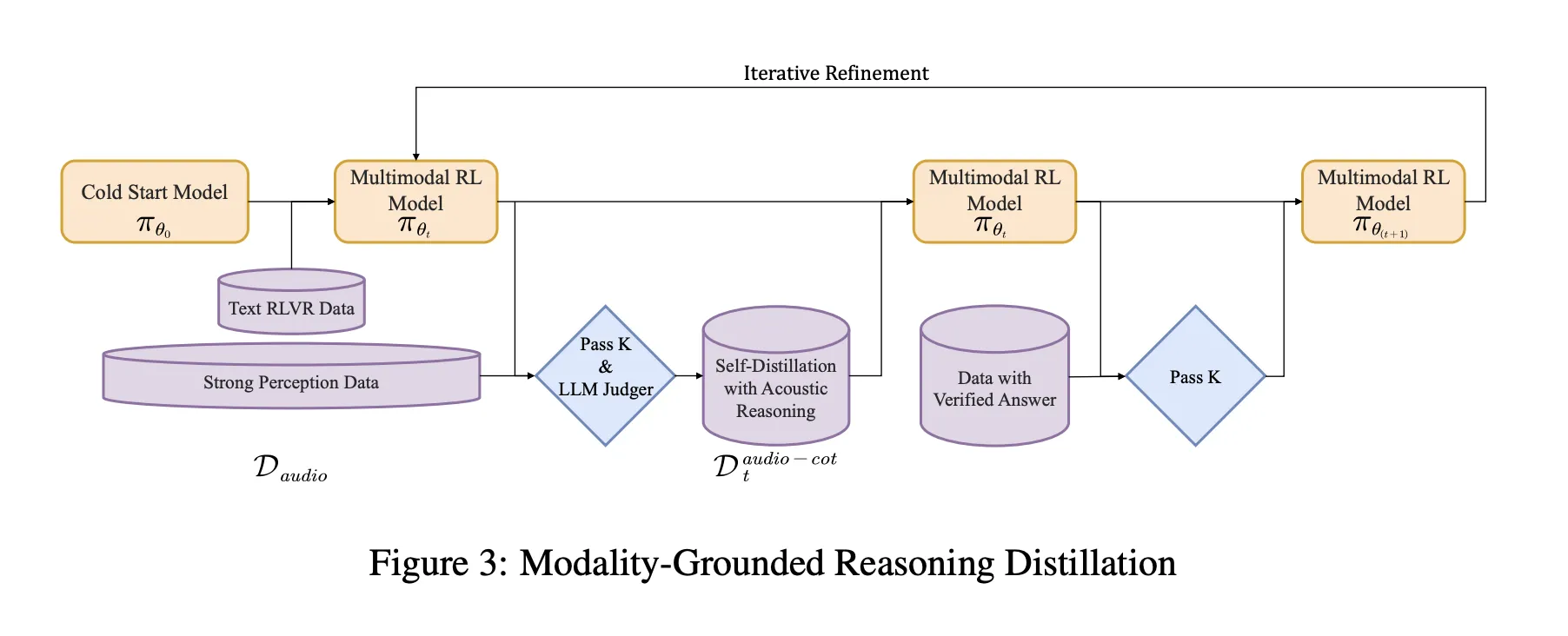
This mismatch explains why long chains of views often hurt performance in audio. The model spends more tokens elaborating incorrect or formally irrelevant assumptions. Step-Audio-R1 attacks this by forcing the model to justify answers using acoustic evidence. The training pipeline is organized around Modality Grounded Reasoning Distillation, MGRD, which selects and distills reasoning traces that explicitly reference audio features.
architecture
Architecture remains close to previous Step Audio systems,
- The Qwen2 based audio encoder processes raw waveforms at 25 Hz.
- An audio adapter reduces the encoder output by a factor of 2 to 12.5 Hz, and aligns the frames to the language token stream.
- A Qwen2.5 32B decoder consumes audio features and produces text.
The decoder always generates an explicit logic block inside tags, followed by the final answer. This separation lets training objectives shape the structure and content of reasoning without losing focus on task accuracy. The model is released as a 33B parameter audio text to text model on Hugging Face under Apache 2.0.
Training Pipeline, from Cold Start to Audio Grounded RL
The pipeline has a supervised cold start stage and a reinforcement learning stage that both mix text and audio tasks.
Cold start uses about 5 million examples, covering 1 billion tokens of text only data and 4 billion tokens from audio paired data. Audio tasks include automatic speech recognition, paralinguistic understanding and audio question text answer style dialogs. A fraction of the audio data carries audio chain of thought traces generated by an earlier model. Text data covers multi turn dialog, knowledge question answering, math and code reasoning. All samples share a format where reasoning is wrapped in
Supervised learning trains Step-Audio-R1 to follow this format and generate useful logic for both audio and text. This idea gives a basic range of behavior, but it is still biased towards text-based reasoning.
Modality Grounded Reasoning Distillation MGRD
MGRD is implemented in several iterations. For each round, the research team samples audio queries where the label depends on actual acoustic properties. For example, questions about the speaker’s emotion, background events in sound scenes, or musical structure. The current model prepares multiple arguments and answering candidates per question. A filter keeps only those series that satisfy three constraints:
- They refer to acoustic signals, not just textual descriptions or imaginary transcripts.
- They are logically coherent as concise step-by-step explanations.
- Their final answers are correct as per the label or programmatic check.
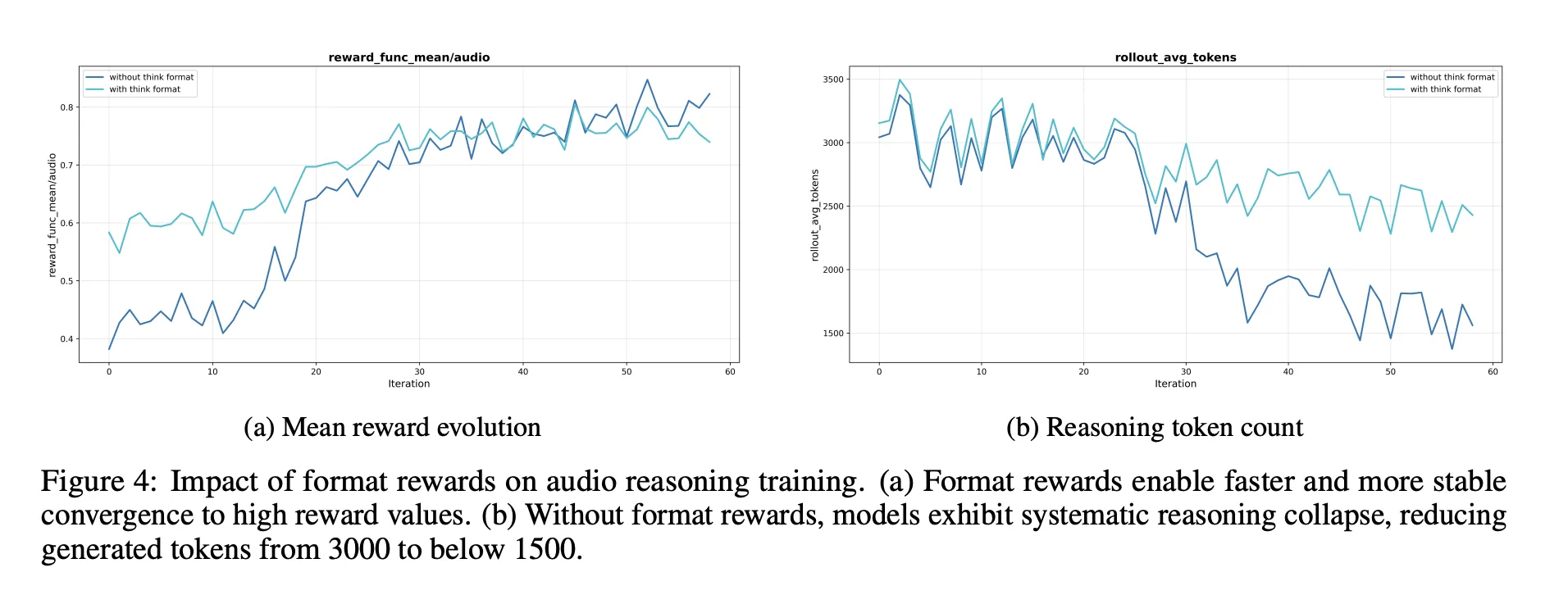
These accepted marks create a distilled audio series of idea datasets. The model is fine tuned on this dataset with original text logic data. Next comes RLVR, reinforcement learning with verified rewards. For text questions, rewards are based on the correctness of the answer. For audio questions, the award blends accuracy of answers and reasoning format, with a general weighting of 0.8 for accuracy and 0.2 for reasoning. Training uses PPO with a sample of approximately 16 responses per prompt and supports sequences up to approximately 10,240 tokens to allow longer deliberations.
Benchmarks, closing the gap with the Gemini 3 Pro
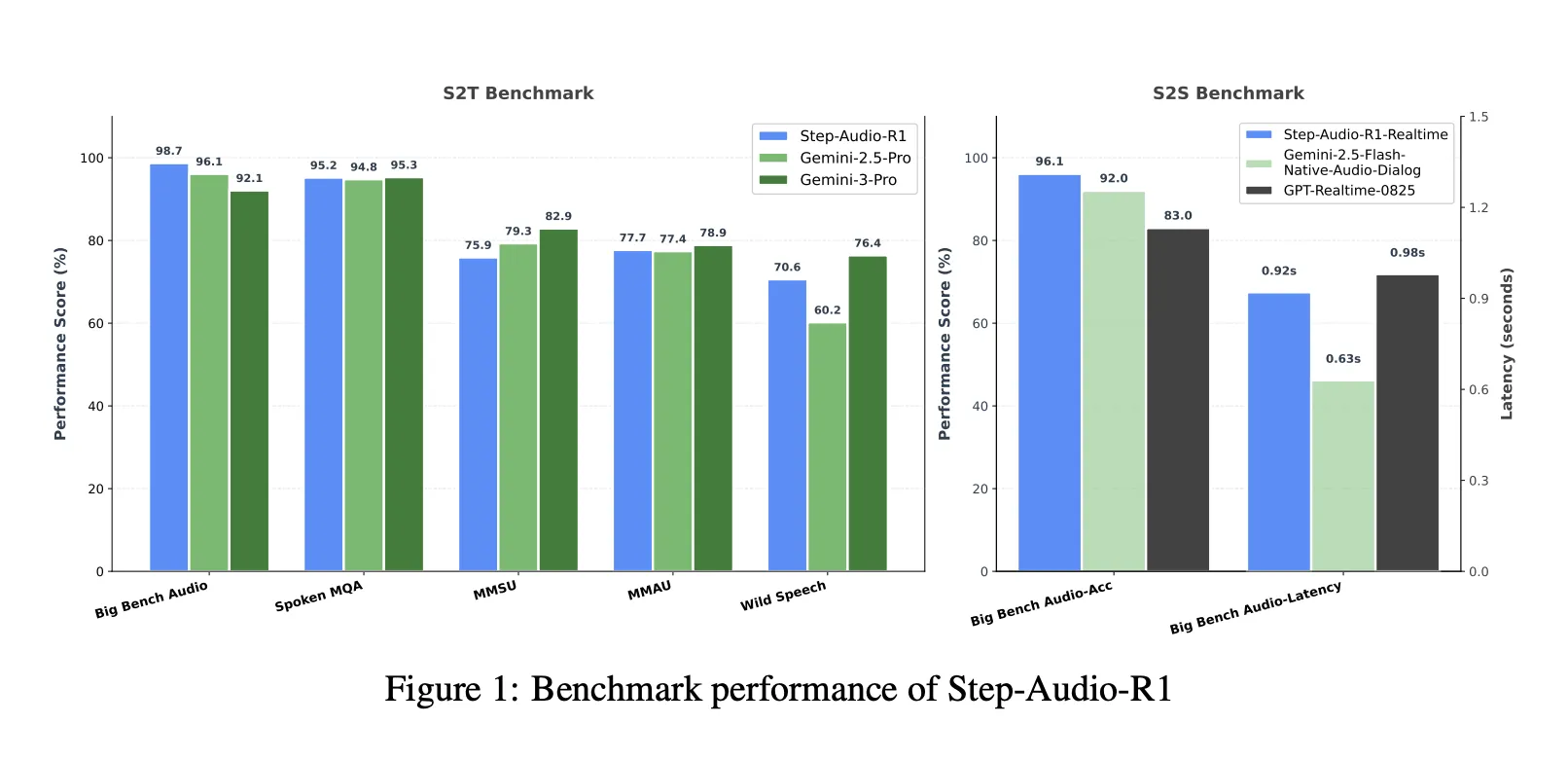
On the combined speech to text benchmark suite that includes Big Bench Audio, Spoken MQA, MMSU, MMAU, and Wild Speech, Step-Audio-R1 reaches an average score of approximately 83.6 percent. The Gemini 2.5 Pro reports around 81.5 percent and the Gemini 3 Pro reports around 85.1 percent. On Big Bench Audio alone, the Step-Audio-R1 reaches about 98.7 percent, which is higher than both Gemini versions.
For speech-to-speech reasoning, the Step-Audio-R1 Realtime Edition adopts listen-while-thinking and think-while-speaking style streaming. On Big Bench Audio speech to speech, it reaches approximately 96.1 percent logic accuracy with a first packet latency of approximately 0.92 seconds. The score surpasses GPT based realtime baselines and Gemini 2.5 Flash style native audio dialogue while maintaining sub second interactions.
What does ablation mean for audio logic?
The ablation section provides several design hints for engineers:
- A rationale format award is required. Without this, reinforcement learning shortens or removes the train of thought, leading to lower audio benchmark scores.
- RL data should target moderate difficulty problems. Choosing questions where passing at 8 in the middle band gives more stable rewards and maintains reasoning longer.
- Without such selection scaling RL audio data does not help. The quality of signs and labels matters more than raw size.
The researchers also describe a self-perception improvement pipeline that reduces the frequency of answers like ‘I can only read text and not listen to audio’ in models trained to process sound. It uses direct preference optimization on curated preference pairs where the correct behavior is to accept and use the audio input.
key takeaways
- Step-Audio-R1 is one of the first audio language models that transforms long chains of thought into consistent accuracy gains for audio tasks, solving the inverse scaling failure seen in previous audio LLMs.
- The model explicitly targets textual surrogate reasoning using Modality Grounded Reasoning Distillation, which filters and distills only those reasoning traces that rely on acoustic cues such as pitch, timbre, and rhythm rather than on hypothetical transcripts.
- Architecturally, the Step-Audio-R1 combines a QWEN2 based audio encoder with an adapter and a QWEN2.5 32B decoder that always produces
- Across comprehensive audio understanding and logic standards covering speech, environmental sounds and music, Step-Audio-R1 surpasses Gemini 2.5 Pro and reaches performance equivalent to Gemini 3 Pro, while also supporting a real-time version for low latency speech-to-speech interactions.
- The training recipe combines reinforcement learning with large-scale supervised thought chains, modality-based distillation, and verified rewards, providing a solid and reproducible blueprint for building future audio logic models that truly benefit from scaling test time computations.

Editorial Notes
Step-Audio-R1 is an important release because it moves the chain of thought from accountability to a useful tool for audio reasoning that directly addresses textual surrogate reasoning with modality grounded reasoning distillation and reinforcement learning with verified rewards. This shows that scaling test time calculations can benefit audio models when the logic is anchored in acoustic features and provides benchmark results comparable to Gemini 3 Pro while remaining open and practically usable for engineers. Overall, this research work transforms the extended discussions in audio LLM from a persistent failure mode to a controllable and reproducible design pattern.
check it out paper, repo, project page And model weightFeel free to check us out GitHub page for tutorials, code, and notebooksAlso, feel free to follow us Twitter And don’t forget to join us 100k+ ml subreddit and subscribe our newsletterwait! Are you on Telegram? Now you can also connect with us on Telegram.

Asif Razzaq Marktechpost Media Inc. Is the CEO of. As a visionary entrepreneur and engineer, Asif is committed to harnessing the potential of Artificial Intelligence for social good. Their most recent endeavor is the launch of MarketTechPost, an Artificial Intelligence media platform, known for its in-depth coverage of Machine Learning and Deep Learning news that is technically robust and easily understood by a wide audience. The platform boasts of over 2 million monthly views, which shows its popularity among the audience.
