

The science behind Hoppers, the 2026 Disney and Pixar animated comedy, raises a genuine question: how much of its central premise reflects real research? The film follows Mabel Tanaka, an animal-loving college student who transfers — or “hops” — her consciousness into the body of a robotic beaver, gaining the ability to talk with animals. On a mission to protect a patch of nature from development in the fictional town of Beaverton, her beaver-bodied alter ego inadvertently sparks a rebellion among the local wildlife.
(Note: this article discusses plot details.)
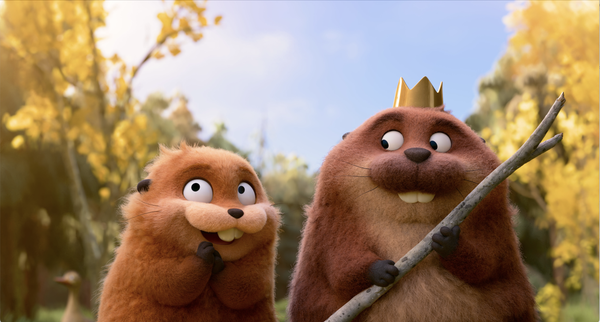
a scene from the movie hopper.
Can consciousness really be transferred?
The honest starting point is that scientists do not agree on what consciousness is or how it works. Even so, parts of Hoppers echo real consciousness research underway today.
Alysson Muotri, a professor of cellular and molecular medicine at the University of California, San Diego and a pioneer in brain-organoid research, has noted that no one has transferred consciousness from one nervous system to another or shown that doing so is possible. What researchers can begin to study, he has suggested, is experience itself. In Muotri’s lab, scientists are working to “teach” brain organoids — small clusters of lab-grown neural tissue — to sense light in a way loosely analogous to human eyes. In principle, that line of work raises the distant possibility of capturing aspects of a brain’s experience and representing them in a computer or another brain.
Whether a person’s consciousness could ever move into an animal’s brain is a separate and far more speculative question. For that to work, consciousness would need to behave like an informational pattern that can be copied from one substrate to another, an idea that remains unproven and contested.
Talking with animals: what AI can and cannot do
The film’s other premise — communicating with animals — connects to active work in animal communication, though here too definitions are slippery. Just as researchers disagree about consciousness, they do not all agree on what counts as “language.” Scientists can record animal sounds and correlate them with observed behavior, and a growing number are applying artificial intelligence to help decode those signals.
One prominent effort is Project CETI (the Cetacean Translation Initiative), which uses AI to analyze the vocalizations of sperm whales. In 2025, members of the project published research suggesting that the acoustic structure of sperm-whale clicks shares features with human vowels. “Sperm whales have highly complex vocalizations that we are learning about, and that’s probably a sign that their internal life is also complex,” Gašper Beguš, the project’s linguistics lead and an associate professor of linguistics at UC Berkeley, has said.
Beguš has framed the broader goal as deepening human appreciation of the natural world — much like Mabel’s journey into animal life in Hoppers. “Animals are closer to us than we thought,” he has noted, adding that the assumption humans are uniquely capable of language or complex thought may not hold.
What the science actually shows — limitations and context
It is worth separating the film’s imagination from current evidence. No technology can transfer a human mind into another body, robotic or biological, and brain-organoid research, while advancing, is far from replicating whole-brain experience. AI analysis of animal communication has identified intriguing statistical patterns in whale vocalizations, but recognizing structure is not the same as translating meaning, and researchers remain cautious about claiming animals possess “language” in the human sense. The most accurate reading of the science is that Hoppers exaggerates real and fascinating research threads rather than depicting anything achievable today.
The original reporting that inspired this overview was published by Scientific American, and details on the sperm-whale findings are available from UC Berkeley and Project CETI.
