
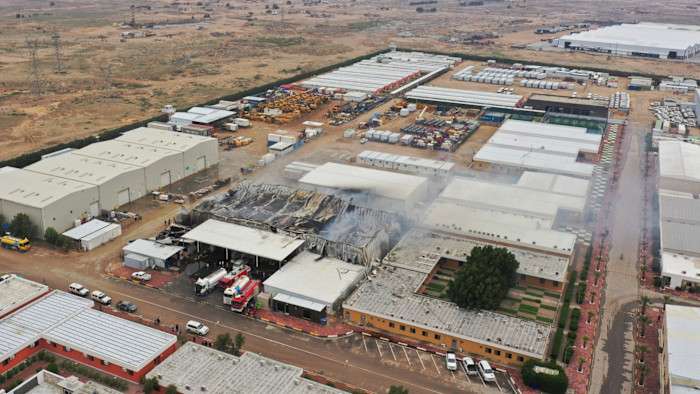
The six-week Iran war struck the heart of the world’s most energy-rich region, with both sides targeting oil and gas facilities and rising fuel prices sparking a new global energy shock.
As the dust begins to settle on the two-week temporary ceasefire, the full scale of the damage with long-term implications for the world economy is beginning to become clear.
Saudi Arabia, the world’s largest oil exporter, has said that its production capacity has suffered significant damage. Qatar, one of the world’s largest liquefied natural gas producers, has lost about a fifth of its output, which will take years to restore.
Some of the world’s largest oil refineries, which are needed to turn the region’s thick black crude into the fuel that powers the world economy, have suffered multiple hits, with 2.4 million barrels of capacity per day estimated to be offline.
At peace talks in Islamabad this weekend, much will focus on whether the US and Iran can reach a deal that would reopen the Strait of Hormuz, the vital waterway that has remained a barrier to recovery as long as it remains under Tehran’s de facto control.
About 10 percent of world crude oil production is still shut in and there is little chance of a quick recovery while the Strait is closed.
“Even if there is a durable ceasefire tomorrow and the strait reopens, markets will not return to normal for at least six months,” said George Lyon, head of geopolitical analysis at Rystad Energy.
“And in some cases it can take much longer.”
saudi arabia
The world’s top oil exporter confirmed this week that a series of attacks had cut its oil production capacity by 600,000 b/d and reduced flows on the vital East-West pipeline by 700,000 b/d.
The pipeline from Abqaiq to Yanbu on the Red Sea, a lifeline for oil exports during the war, was attacked the day after the ceasefire, damaging a pumping station.
The attacks at the offshore Manifa oil field and the Khurais oil field north of Riyadh reduced output at each site by about 300,000 barrels per day, according to a rare statement from Saudi Arabia’s energy ministry.
Helima Croft at RBC Capital Markets said the fact that at least some attacks occurred after the initial ceasefire would keep the market on edge.
“How do you compensate for significant physical damage in a stressful environment?” Croft said. “I don’t think we can equal it.”
The attacks on the fields mean Saudi Arabia’s normal 12 million b/d production capacity has been cut by at least 5 percent – indefinitely. This means that even if the Strait of Hormuz is reopened soon, the kingdom will not be able to pump flats to replace the barrels lost since late February.
It would also reduce the world’s excess capacity buffer, of which Riyadh has historically maintained the lion’s share to help counter the threat of supply disruptions elsewhere.
Saudi Arabia also confirmed attacks on four major refining facilities, although most were able to continue operations.
The kingdom, which is widely expected to pressure the US Trump administration to ensure Iran is not left in control of the Strait of Hormuz, has warned that the attacks have affected “the security of supplies for consumer countries” – a clear message it is expected to echo in Washington.

Queue
QatarEnergy’s Ras Laffan giant industrial site was attacked with missiles on 18 and 19 March, after Israel bombed petrochemical facilities and the South Pars gasfield in Iran.
The Iranian retaliatory strike marked one of the most significant escalations of the war, with ballistic missiles hitting the world’s largest LNG facility in two waves.
The company said the damage to the LNG facility would affect about 17 percent of its exports and would take three to five years to repair.
With losses of LNG production totaling 12.8 million tonnes per year, QatarEnergy said the gas-to-liquids plant it operates with Shell was damaged in the attacks and would lose capacity for at least a year.
Wood Mackenzie analysts believe it will take several months to bring non-damaged parts of its LNG sites back up and running.
“The ceasefire means it may be possible for 14 LNG cargoes stuck in the Gulf to exit the Strait of Hormuz and provide some relief to the global gas market,” said Tom Marzek-Manser, Europe gas and LNG analyst at Wood Mackenzie.
But he said there would be “no real structural change in supply” until Ras Laffan restores its remaining production.

united arab emirates
Abu Dhabi’s 922,000 b/d Ruwais refinery, one of the world’s largest, was one of the first energy facilities to be targeted in the conflict. On March 10, drone strikes caused a fire at the facility, while debris from air-defense interception caused several fires again at the plant on April 5.
Operations at the Habshan gas processing plant, the largest of its kind in the UAE, were suspended twice during the conflict, including on April 8 after multiple fires broke out due to falling debris from the blockade.
The incident occurred within an hour of a ceasefire being agreed between Washington and Tehran, immediately raising questions over the agreement’s effectiveness.
Two gas fields were also attacked in March, causing production to be suspended.
The UAE is able to continue exporting some oil through its Fujairah port, which lies outside the Strait of Hormuz and is accessible by pipeline. However, operations have been halted several times due to targeting of ports and oil storage facilities.

Kuwait
Kuwait’s two oil refineries – Mina Al Ahmadi and Mina Abdullah – suffered severe damage from multiple attacks, although both have continued to operate, according to people familiar with the matter.
Before the war both plants were important suppliers of jet fuel to Europe, especially Britain, as well as sending refined fuel to Asia. There have been warnings of jet fuel shortages in Asia and Europe in the coming weeks due to their supply shortages.
Iraq
Iraq, the second largest oil producer in OPEC, has been heavily affected by the effective closure of the Strait of Hormuz, due to the lack of alternative export routes.
The country has been forced to shut down more than three-quarters of its oil production, with volumes falling to just 800,000 b/d last month compared with 4.3 million b/d before the war.
The country has also faced direct attacks on its energy infrastructure. Drone strikes shut down Rumaila oil field.
A tanker carrying Iraqi crude oil successfully transited the Strait of Hormuz on April 5, pointing to a temporary agreement between Iraq and Iran that will allow the transit of crude through the strait.
iran
Israel targeted refineries on 8 March as well as three fuel depots in the capital and another depot in the nearby city of Karaj, west of Tehran. The attacks caused massive fires, causing thick dark clouds to gather over Tehran, plunging the capital into darkness.
Israeli attacks on the South Pars gasfield on 18 March forced Iran to take several units out of production.
Kharg Island, which hosts Iran’s main oil export hub, has also been attacked several times, but attacks have focused on military targets, leaving its energy facilities intact.
Oman and Bahrain
Oman has faced far fewer drone and missile attacks than its neighbors in the United Arab Emirates, and the country has historically had close ties with Iran.
However, several airstrikes succeeded in disrupting operations at the port of Salalah, where an attack on oil storage facilities injured one worker. Danish shipping giant Maersk suspended operations there after the attacks.
Bahrain declared a state of force majeure after the 400,000 b/d Sitra refinery, located in the east of the island, was attacked on March 9.
Analysts say the damage is serious and the full consequences will take months to emerge.
by visual journalism alan smith, Aditi Bhandari And dan clark
