
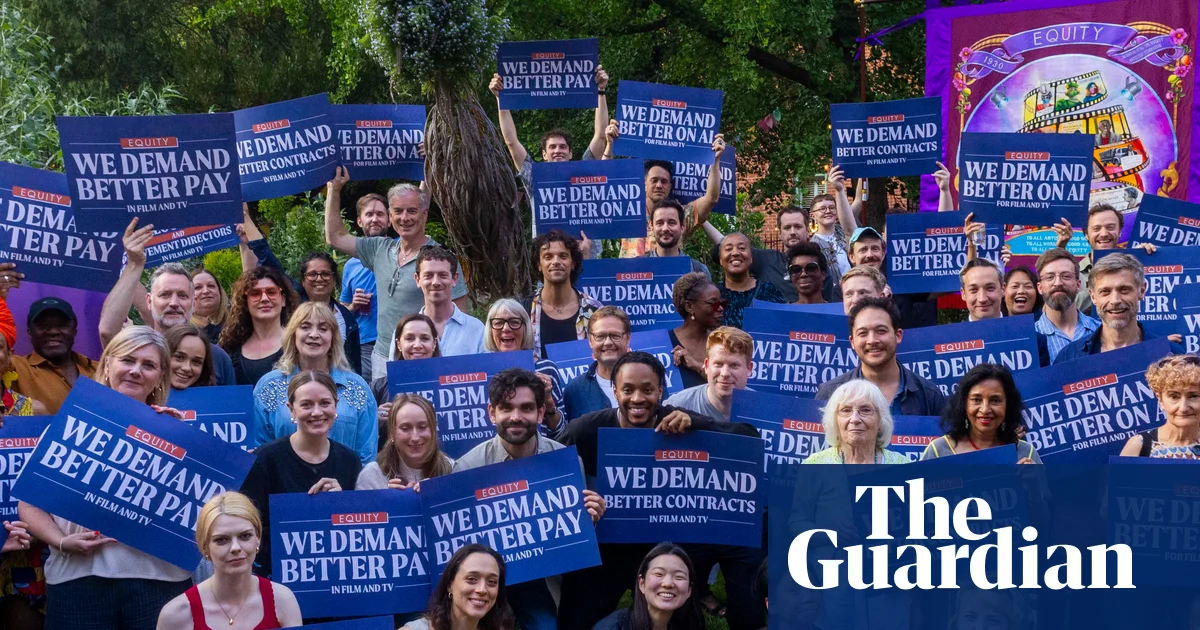
Actors have voted to refuse digital scanning to prevent likenesses being used by artificial intelligence in their reaction against AI in the arts.
Members of the performing arts union Equity were asked whether they would refuse to be scanned while on set, a common practice in which actors’ likenesses are captured for future use – the move resulted in a 99% vote in favor.
General Secretary, Paul Fleming, said: “Artificial intelligence is a generation-defining challenge. And for the first time in a generation, Equity’s film and TV members have shown they are willing to take industrial action.
“Ninety percent of TV and movies are made on these agreements. More than three-quarters of the actors working on them are union members. This shows that the workforce is prepared to significantly disrupt production until they are respected, and (if) the decades-long deterioration in terms and conditions begins to be reversed.”
The vote was a symbolic ballot designed to demonstrate the strength of feeling on the issue, with over 7,000 members voting at a 75% turnout. However, if actors refuse to undergo scanning they will not be legally protected.
The union said it would write to Pact, the trade body representing the majority of producers and production companies in Britain, to negotiate new minimum standards of pay, as well as terms and conditions, for actors working in film and TV.
Equity said it could hold a formal vote depending on the outcome of the negotiations, which if supported would give actors legal protection from being forced to accept digital scanning on set.
The decision comes after months of debate and growing concern about artists’ rights as AI becomes embedded in the creative industries, with high-profile actors urging Equity members to support a move to stop digital scanning.
Adrian Lester, Hugh Bonneville and Harriet Walter have supported the union’s campaign to ensure AI protections for artists are included in union agreements.
Bonneville said that actors’ likenesses and voices “should not be exploited for the benefit of others without license or consent”, while Lester said that actors early in their careers often found it difficult to push back against body scanning.
In October, Olivia Williams told the Guardian that cast members were regularly pressured to have their bodies scanned on set, without any attention to how the data was later used.
Dune Starr argued that actors should have as much control over data obtained from body scans as they have over nudity scenes. He said that some contracts include clauses that appear to give studios carte blanche over an artist’s likeness “on all platforms that currently exist or have yet to be created throughout the universe forever.”
The arrival of the first AI “actor” Tilly Norwood has further heightened concerns and demands for formal agreement on what is acceptable and what is not.
In 2023, concerns over AI were at the center of the Hollywood writers’ strike, with writers and actors warning that uncontrolled use of the technology could fundamentally reshape the industry and undermine their roles.
