
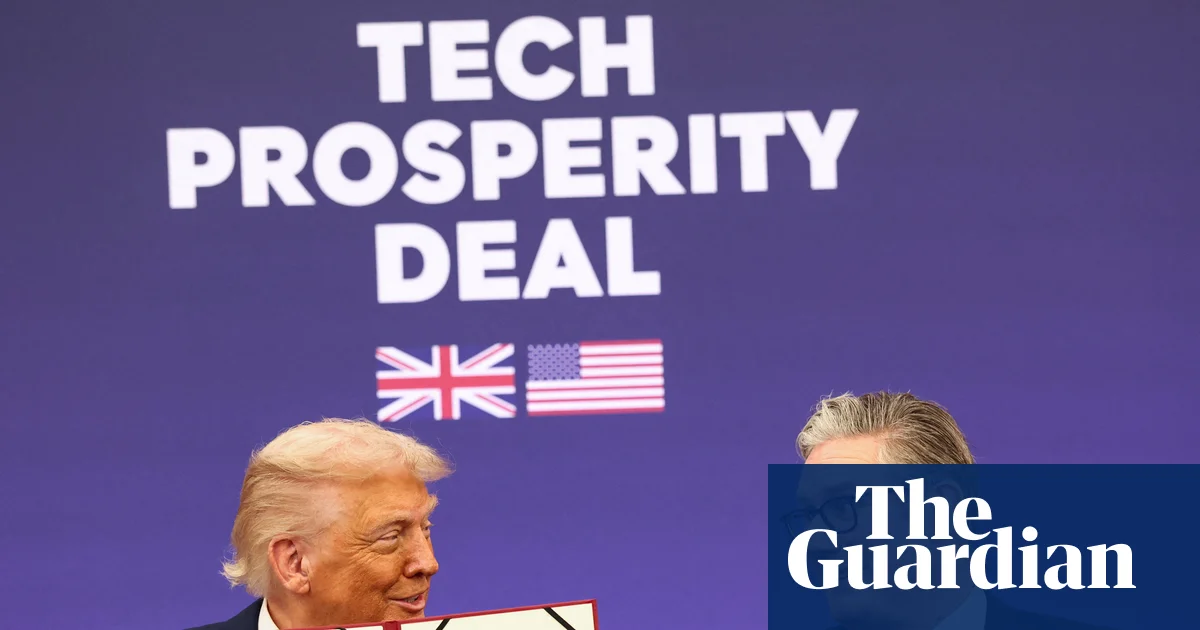
The US has halted its promised investment of billions of pounds in British technology due to trade disagreements, a serious blow to US-UK relations.
The £31 billion “tech prosperity deal”, which Keir Starmer hailed as “a generational step in our relationship with the US” when it was announced during Donald Trump’s state visit, has been shelved by Washington.
As part of the deal, US tech companies pledged to spend billions of dollars in the UK, including a £22 billion investment from Microsoft and £5 billion from Google. But Washington has blocked implementation of the agreement, citing a lack of progress by the UK in reducing trade barriers in other areas.
British officials tried to downplay the development, which was first reported By The New York Times. The newspaper said the Trump administration is unhappy with Britain’s imposition of a digital services tax on US technology companies and its food safety rules, which ban the export of some agricultural products.
A British government source said it was “hard negotiations as usual by the Americans” and added that the deal to allow tariff-free British pharmaceutical exports to the US was on and off before it was finalised.
“(U.S. Commerce Secretary) Howard Lutnick is a tough guy. We understand that the Americans talk incredibly hard, but we will stand our ground. They want what’s best for their country, we want what’s best for our country,” the source said.
A second government source said the development was “part of the shaping of talks” with Washington.
The prosperity agreement included the creation of an artificial intelligence “growth zone” in the north-east of England, which UK officials said could bring in up to £30 billion and create 5,000 jobs.
But the text of the agreement states that it “comes into force as soon as concrete progress is being made to formally implement and enforce it”.
The decision to put it on hold is a blow to the UK government, which touted the deal as a reward for its intense year-long engagement with the US to avoid punitive tariffs on British exports. As part of her diplomatic charm offensive, Starmer hosted Trump’s second state visit to Windsor Castle in September, an unprecedented honor for an American president.
Starmer has resisted US pressure to scrap or amend the digital services tax, a 2% levy on the revenues of tech companies including Amazon, Google and Apple that raises around £800m a year. Trump has repeatedly threatened to retaliate against countries with digital taxes, including Britain.
The Guardian revealed that during trade talks in the spring, the government prepared proposals to reduce the amount paid by US tech companies and impose the tax on a wider range of companies without reducing the overall stake. But till now the tax has remained unchanged.
The US has also put pressure on Britain’s online security rules, with officials promising to review their enforcement during talks.
A third area of contention is Britain’s food safety arrangements, which ministers acknowledged the US has objected to. As part of the trade deal the government agreed to reduce tariffs on some US agricultural products, including beef, but stands by its manifesto commitment not to lower farming standards.
Any decision to weaken these could open the door to American chlorine-washed chicken or hormone-treated beef being sold in Britain, a prospect that has long been highly controversial with farmers and consumer groups.
At a press conference at Checkers in September, where he unveiled the technological prosperity agreement, Starmer said it “has the power to change lives” and “renewed the special relationship for a new era”.
“This is our chance to ensure that technologies like AI, quantum and others enhance human potential, solve problems, cure diseases, make us rich and free, strengthen democracy, not tyranny,” the Prime Minister said. “This is the field on which the future will be won.”
Trump said at the time that the agreement would help the US and Britain “dominate” the world of artificial intelligence and “ensure that our countries lead the next great technological revolution side by side”.
Business and Trade Secretary, Peter Kyle, was in the US last week for talks with Lutnick, US Trade Representative, Jamieson Greer, and US Treasury Secretary, Scott Besant. They discussed whiskey and steel tariffs and cooperation on critical minerals. Kyle’s department said talks would continue into January.
A UK government spokesperson said: “Our special relationship with the US remains strong and the UK is strongly committed to ensuring that the Tech Prosperity Agreement provides opportunities for hard-working people in both countries.”
The Guardian reported over the weekend that Starmer was ready to choose his new ambassador to Washington after interviewing three finalists last week. The three shortlisted candidates are Varun Chandra, trade advisor to the Prime Minister, who was at the center of negotiations on the prosperity accord; Christian Turner, visiting ambassador to the United Nations; and Nigel Casey, Ambassador to Russia.
