
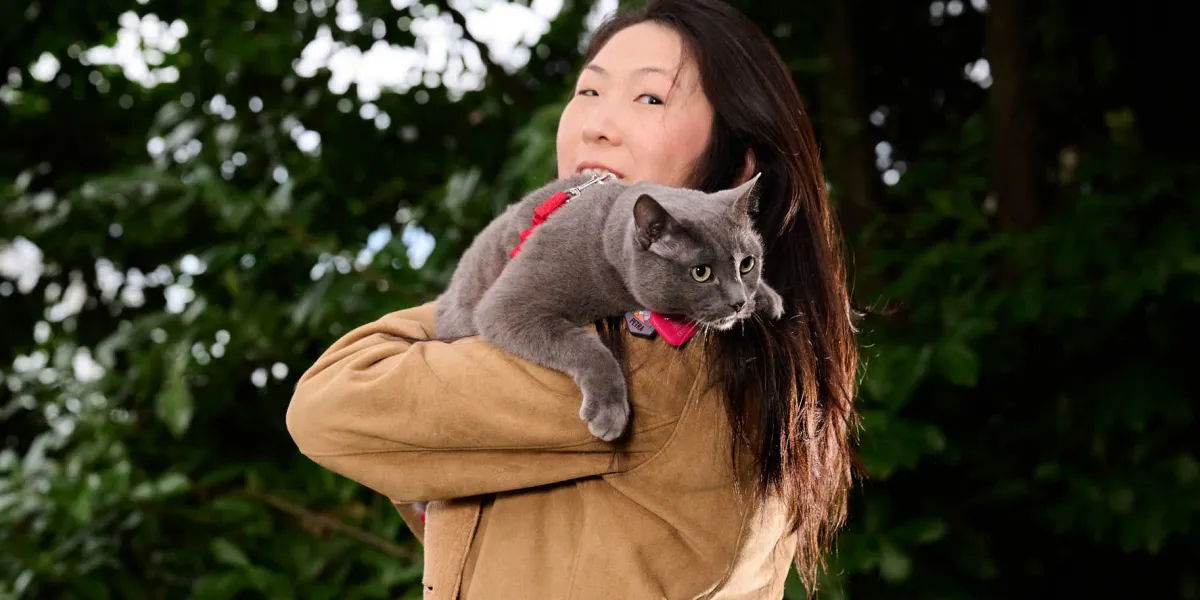
Darwin’s Arc turns its attention to cats in 2024, and although it’s too early for any results, even the research methods are proving interesting. A common method for extracting DNA from a live animal is to swab the inside of the cheek. Dogs don’t mind this process, but cats aren’t as comfortable with getting something stuck in their mouth. Nor do cats appreciate having hair plucked from their follicles, which is another potential source of DNA for sequencing. So Chad Nussbaum, PhD ’91, another Human Genome Project collaborator whom Liu recruited, helped the Darwin’s Ark team figure out how to effectively extract DNA from hair or shed hair—a major breakthrough for the field. (This means, in practice, that cats’ DNA is collected by brushing their fur. Now cats “not only don’t mind sample collection—some of them actually enjoy it,” Nussbaum says, laughing.)
This is good for cats, but it could also have far-reaching implications in the world of conservation, where obtaining DNA from endangered or vulnerable animals through blood or skin samples may be extremely difficult or distressing for the animals. Being able to rely instead on a few strands of naturally shed hair could open up new frontiers for conservationists working with sensitive species.
The knowledge that progress on such important issues could come from inside or outside the organization led Liu and Carlson to create Darwin’s Ark as a nonprofit and make its data available for free to researchers outside commercial settings. Although it already periodically shares its sequence data across various public repositories, those repositories are managed by different entities, making it more difficult for scientists to access the information. So researchers must often write in, explain what they are trying to do, and put in a custom request. Darwin’s Ark has just received a grant that will allow it to begin creating a public portal for the data, making it much easier for researchers to access, collate, and use it.
“Our hope is that we will be able to create a data set that scientists around the world can use to clarify what we are doing,” Liu says. “Whether you’re a cancer scientist or a neurological scientist or an immunology-focused scientist, having very large-scale data sets can help in any complex disease area.”
For Liu, Darwin’s Ark is the latest line in a long and extensive resume that includes work at Amazon and NASA. “The thread that ties it all together is big data,” she says.
After living and breathing data in her work on the Human Genome Project, Liu tackled a very different big data challenge on a team at Amazon that collected data on warehouse fulfillment. Based on his biological sciences background, he developed an evolutionary algorithm for outbound logistics that made it possible to-Without Continuously analyzing data to dynamically optimize storage and dramatically reduce fulfillment costs. The founder or co-founder of at least a dozen ventures so far, she built on her experience at Amazon with her most recent startup, a logistics company called Airterra, which helps e-commerce retailers streamline deliveries by bringing together highly fragmented last-mile shipping providers under one umbrella. Officially founded in 2020, it quickly achieved unicorn status and was acquired by fashion company American Eagle Outfitters in 2021. While Liu attributes some of that success to luck (“You start a shipping and logistics organization in a pandemic — of course you’re going to get acquired”), his co-founder Brent Bebout, MBA ’02, points to the skills and work ethic that made their “luck” possible.
According to Bebout, in addition to being “extremely collaborative” and “extremely knowledgeable”, Liu gave her everything in a way that set her apart. “She’s an emotional person,” he says. “I’ve never seen anyone who worked as many hours as Charlie did… I don’t think she ever slept.”
Liu jokes that she is in a “midlife crisis” as she decides what to do next, because there are so many things she can do. So she’s looking for the “greatest thing” she can do for the world.
Although Liu has done well as an entrepreneur, she grew up “well below the poverty line”. Both of those experiences shaped the kind of investor she became: someone with a specific interest in helping other entrepreneurs overcome obstacles. “I wanted to look back at all the obstacles I faced,” she says. “Not just as a woman, not just as a person of color, but[also]the economic obstacles of not having a network, not having access to successful people, not even understanding the basics of the financial markets.” To this end, he has spent much of his career trying to give back through mentorship and direct investment in ventures started by founders from underrepresented backgrounds.
