
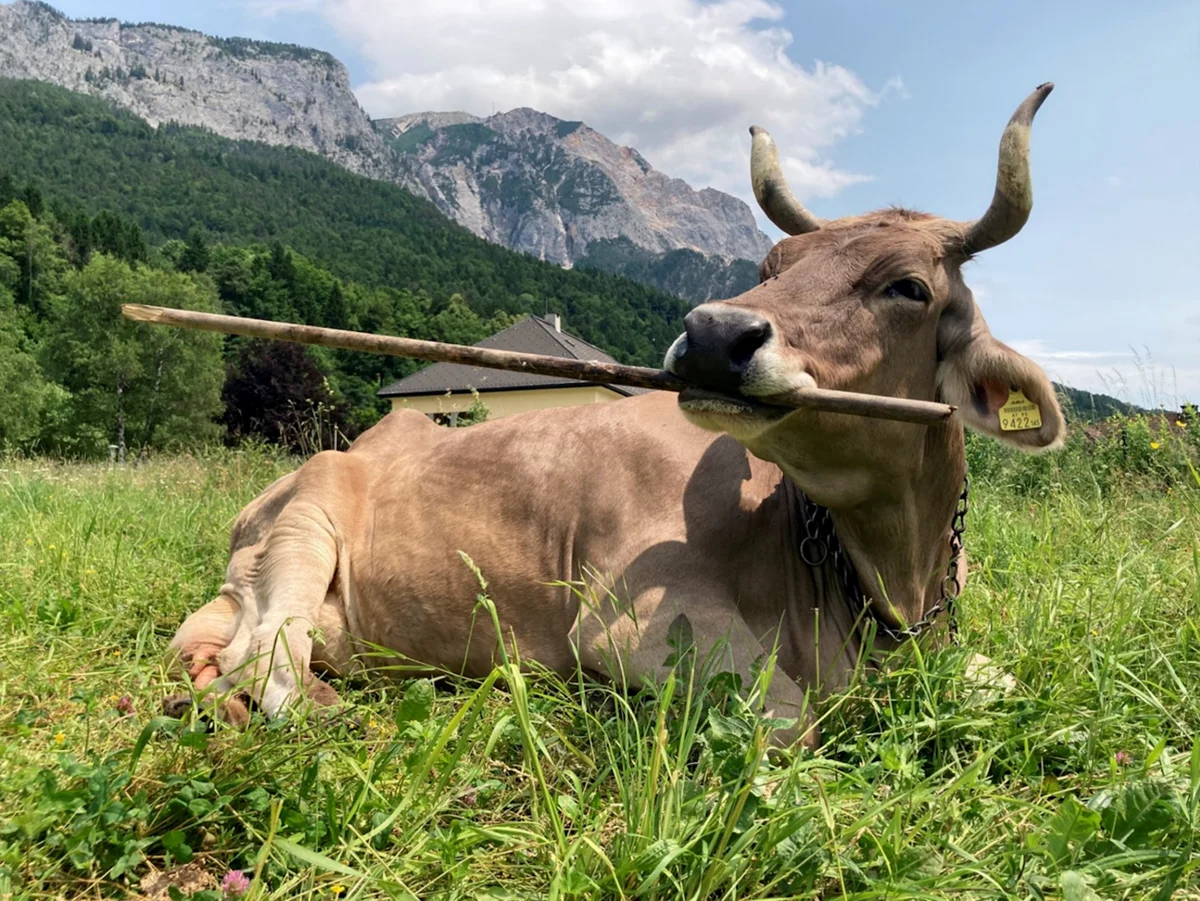
A pet cow in Austria has been documented using a broom to scratch hard-to-reach parts of her body — and switching which end of the tool she uses depending on the target. Researchers describe it as the first recorded case of flexible, multipurpose tool use in cattle.
Antonio J. Osuna Mascaro
What the researchers observed
The cow, a Braunvieh (Swiss brown) named Veronika, lives as a pet in Nötsch im Gailtal, a small Austrian town near the Italian border. Her owner, farmer and baker Witgar Wiegele, first noticed years ago that she would pick up sticks and fallen branches and use them to scratch herself, apparently to relieve irritation from insects. She is thought to have worked out this behaviour around 2016.
After cognitive biologist Alice Auersperg of the University of Veterinary Medicine Vienna came across video of Veronika, she and postdoctoral researcher Antonio Osuna-Mascaró travelled to the farm to study the animal over roughly two weeks. Their analysis was published in Current Biology in January 2026.
A single tool used two ways
The behaviour the team documented was more sophisticated than simple scratching. Given a deck-cleaning brush, Veronika would pick it up, reposition it with her tongue and hold it firmly with her teeth, then move it by swinging her head. She used the tool to reach areas she could not otherwise access, including the rump, groin, udder and belly.
Crucially, she used the two ends differently: the stiff bristles on the thick-skinned upper parts of her body, and the smooth wooden handle on the softer, more sensitive skin of her udder and underbelly. The researchers initially assumed she was simply grabbing the wrong end, but concluded over dozens of trials that the choice was deliberate. Using one object for multiple distinct purposes had, before this, been consistently recorded only in chimpanzees among non-human animals.

Veronica uses different ends of the broom and different techniques when scratching different parts of her body.
Antonio J. Osuna Mascaro
Why it went unnoticed for so long
The authors are careful not to overstate the case. They do not argue that Veronika is an exceptional individual, but that cattle may have long possessed a capacity for tool use that humans simply failed to observe. “There are around 1.5 billion head of cattle in the world, and humans have lived with them for at least 10,000 years,” Osuna-Mascaró has noted; that the ability is only being documented now is, in his words, surprising.
Several conditions may have allowed the behaviour to surface. Veronika is around 13 years old, far older than most farmed cattle, giving her roughly a decade to develop the skill. As a companion animal she also lived in a stimulating environment with access to sticks and rakes her owner provided — conditions largely absent from intensive farming, where animals have little opportunity to manipulate objects.
How other scientists reacted
Jill Pruetz, a primatologist at Texas State University who was not involved in the work and keeps two companion cows herself, praised the precision of Veronika’s movements and her ability to switch between the ends of the tool for different areas. Commentators have also pointed to the study’s welfare implications, suggesting it strengthens the case for enrichment — access to objects and stimulation — in how cattle are kept.
The finding also revived a long-running joke: Gary Larson’s 1982 Far Side cartoon “Cow Tools,” which depicted a cow beside a table of inscrutable implements. Decades later, a real cow with a real tool has given the gag an unexpected scientific footnote.
Limitations and what to watch
The evidence rests on a single, unusually long-lived and well-enriched animal, so it does not establish how common tool use is across cattle generally. Whether other cows would develop similar behaviour under comparable conditions remains an open question, and the researchers have asked people who have seen farm animals using tools to get in touch so the phenomenon can be studied more widely. Coverage of the study appeared across outlets including Scientific American and National Geographic.
